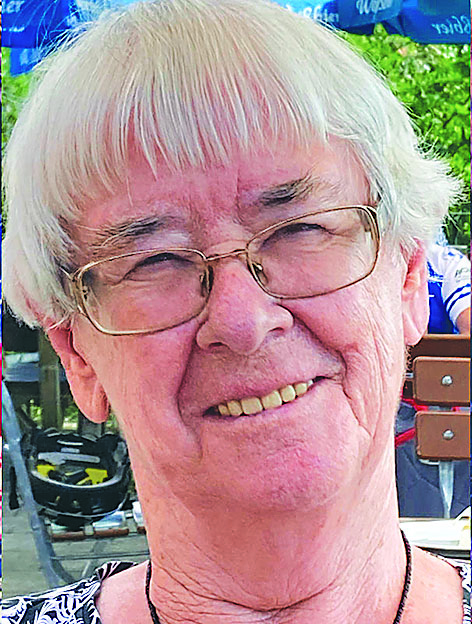
German citizen Christa Koura climbed the mountain in Nepal for the first time in 2030. Since then she has climbed the mountains of Nepal 13 times.
We use Google Cloud Translation Services. Google requires we provide the following disclaimer relating to use of this service:
This service may contain translations powered by Google. Google disclaims all warranties related to the translations, expressed or implied, including any warranties of accuracy, reliability, and any implied warranties of merchantability, fitness for a particular purpose, and noninfringement.
I had read many exciting books about mountain climbing in my youth and I was fascinated by mountaineering. Till then 'Mountaineering' or 'Trekking' was not popularly known as an activity for fun, interest or holiday.
Much later V. No. Around 2020-21, the custom of celebrating holidays by 'trekking' was invented. Only after this, my husband and I got the opportunity to go mountain climbing in Nepal, a place 8,000 meters above sea level,' said Christa Koura, who was born in Germany 87 years ago, remembering her past.
There is a 1500 mile long snow chain from Kashmir to Assam, of which 500 miles are within the Nepalese border. Nepal is an attractive destination for mountaineering as the highest snow range and ten of the world's major mountains are within Nepal. Thus, despite being an attractive destination for mountain climbing, it was not possible for anyone to climb the mountain in Nepal until the twenty-first century of Bikram Samvat due to administrative restrictions. As long as the Rana regime was in the country, i.e. until 2007, no one had the right to enter Nepal except with the permission of the Nepalese government and the British embassy, and mountain climbing was a far-fetched thing. At that time, it was impossible for ordinary foreigners who did not have access to come to Nepal for mountain climbing.
Nepalis used to travel even before the Rana period. Therefore, 'Yatra' was a well-known and well-known activity among the Nepalese people. However, travel up to that time was limited to pilgrimages, journeys for war or family or some special personal or administrative work. Where is that only! The journey itself was a nightmare. The journey was uncertain. If the person who left the house did not return, there would be no end to it. Therefore, travel was done only after determining the direction of travel. As in the story of 'Munamadan', there was a strong possibility that travelers might die of diseases like diarrhea on the way. Even though trains reached villages in the neighboring countries, there were no means of easy transportation in Nepal. So traveling was considered a difficult and challenging activity. When crossing the sea, it was customary to pour water. In such a situation of the country, what knowledge about the subject that we Nepalis travel or climb mountains for interest and hobby?
But, v. No. Born in Germany in 1993, i.e. during the Rana rule in Nepal, Krista, an alert young woman, had a passion for mountain climbing since her youth. Like the authors of the books she read, she began to imagine and dream of reaching the highest peaks of Nepal. However, as mountain climbing was not yet accessible to the masses, he got the opportunity to climb the mountain for the first time in the world of imagination, the Himalayan country of Nepal, only at the age of 37. She and her husband came to Nepal for the first time in 2030, seeing the possibility of their wish coming true. One mountain climbing did not satisfy him. So they keep coming to Nepal again and again, 13 times for mountain climbing and two more times to visit Kathmandu.
Krista's climbing schedule in Nepal
vs. 2030 Lamjung Himal
vs. no. 2032 Annapurna Himal (first)
vs. no. 2034 Chautara
Vs. 2035 Siklis
vs. 2037 Helambu
vs. no. 2040 Annapurna (Road to Thorong La Pass)
vs. 2042 Langtang
vs. no. 2044 Pokhara to Jumla
vs. no. 2047 Rollwalling
vs. no. 2049 Everest
Vs. 2051 Ganesh Himal
2054 Kanchenjunga
Vs. 2055 Lamjung Himal
Krista, who has traveled to Nepal so many times, is still living an active life at her home in Germany. She is not comfortable talking on the telephone due to her health, but writes e-mails to new and old friends far away. Remembering her trip to Nepal, she says- The first time we went, we liked the land of Nepal and its people so much, after that we kept going to Nepal for holidays.
Our first trekking started from Lamjung Himal. Two years later, we climbed Annapurna I again in 2032 with our little daughter Gabriella. After that our trekking in Nepal continued and we climbed Chautara in 2034 and Siklis in 2035 . Until 2035, we did mountain climbing under a group trekking program of German citizens arranged by German businessmen . After that we felt free to organize our own trip. Since 2037, we made our own group and went mountain climbing in Nepal. Our self-made trekking groups consisted of a minimum of two to a maximum of five people. We used to entrust the travel management of the groups we made to Nepali companies. They used to arrange for us Nepali Nikes, cooks and porters to help us in mountain climbing. We never went trekking alone ie without Nepalese helpers . As part of the mountain climbing organized by us, we climbed Helambu in 2037, Annapurna in 2040 via Thorong La Pass, Langtang in 2042 and Pokhara to Jumla in 2044, Rolwaling in 2047, Everest in 2049 (we could not reach the base camp), Ganesh Himal in 2051 and Kanchenjunga Himal in 2054. We finally celebrated our Silver Jubilee of Nepal Mountaineering by climbing Lamjung Himal once again in 2055 and also celebrated the immersion of our Nepalese Mountaineering . We had not yet gone to Nepal. Although not trekking, we went to Kathmandu two more times. Our latest or last trip to Nepal is the Kathmandu trip in 2057. It is called
, on June 3, 1950, French citizen Maurice Herzog made the history of mountaineering in the world by climbing Annapurna for the first time. By calculating in this way, this year i.e. 2025 has reached 75 years of mountain climbing in Nepal. Old mountaineers say that the period from 1950 to 1965 was a golden age for mountain climbing in Nepal, because at that time there was no limit as to which peaks could be climbed and which could not be reached, even if a mountain climbing permit was obtained. At the same time many high mountains were climbed. At that time, Pakistan, Tibet and India were in the midst of war and political instability, so climbing from there was not possible. Nepal was a safe and easy destination at that time. However, as there was not much tourist traffic, there were not many climbing groups lining up at one mountain at a time. At that time, many mountaineers also wrote many books and those books not only provided information about the mountains of Nepal but also became an inspiration for mountain climbing.
Not only did Christa read mountaineering books in her youth, all of them are still preserved in her collection. Paul Bauer, Reinhold Meissner, some of the authors of books written in German about mountain climbing in Nepal that he was influenced by reading before coming to Nepal. Kurt Boeck, Gustav Harder, Karl Maria Herligkofer, Sven Heydin, Wilhelm Flickhner, Gerhard Lenzer, Günter Hauser, Günter Strum, Ernst Schaefer, Henry Landor etc. Published in 1931, Paul Bauer's first book on mountaineering, 'The Struggle for the Himalayas: The First Ascent of Kanchenjunga by the Germans in 1929' (1929), won the world-renowned Olympic Gold Medal in Los Angeles.
Looking back at the history of Nepal mountain climbing by German mountaineers, we reach the year 1929. The German Mountain Association, founded in 1869, was the first German organization among the groups that were given mountain climbing permits to very few foreign mountaineers in the then Rana-ruled Nepal. It first got permission to climb Kanchenjunga Himal (8586m) in 1929. The organization's German office still holds material related to that climb and other subsequent climbs. These collections include letters, mountaineering plans, reports, photographs, recordings, propaganda materials, maps, etc. It is known from those records that the neighboring country Austria was also involved in those mountain climbing. Other institutions for mountaineering and related research also opened in Germany. Paul Bauer, as a member of the German Mountain Association, was one of the first group of German mountaineers to climb Kanchenjunga in Nepal. In 1952 another German mountaineer, Karl Maria Herligkofer, founded the German Institute for Foreign Research. Almost all of the authors mentioned above were affiliated in some way with these two organizations. Christa and I have never met in person. In our email conversation Christa wrote to me in German :
I don't know how old you are dear Alka. But I think you can't even imagine about our climbing time. I don't know about the developed roads of Nepal now. However, at that time we had to go through Pokhara to go to Kaligand. And the departure point for Helambu was Sundarijal. We never went hiking alone . We always walked in groups. We used to have a good relationship with the Nikes, the cooks, the porters who used to walk with us. They even sometimes called us Ba, Ma. We considered ourselves as their employer and always tried to be a good and friendly employer. People climbing us alone with backpacks might have thought the porters were exploiters carrying heavy loads. But that's not really the case. We didn't think so because the porters used to carry the food we ate at the hotel without porters. But the money they earned by carrying heavy loads for Nepali moneylenders was much less than the money we gave. So we used to travel with porters even if it cost us and we could carry our burdens ourselves . Moreover, there were very few lodges during our trek. So we preferred to pitch our own tent and sleep in it .
I wanted to speak, read and write Nepali and I tried a lot for that . I also took Nepali language classes from a Nepali teacher in Munich, but the results were not very satisfactory. I don't have the ability to learn a new language like my daughter. However, I still remember many Nepali words, can pronounce them and can write Devanagari well. When we were hiking in Nepal, I could read Nepali books to the children huddled around our tent. I had learned to read Nepali with so much difficulty, but the little children did not understand the hard work I had done and they took it for granted.
I, my husband and my daughter got to know Nepal and we are very happy about it . "I have pictures of Nepal and diaries of my travels, which are my precious memories."
I replied to Krista, 'Dear Krista! When you came to Nepal for the first time, my parents got married and three years after that, the year you came to Chautara, I was born in Kapilvastu in Terai. Yes, I can only imagine about your trip to Nepal. Even though I was born here, I have not been able to reach all the mountain ranges that you have gone to. Memoirs of climbers like you are the historical treasure of Nepal.'

