We don't need a lot of literature, we need good literature. No one is doomed to consider Rahre and Khare as waterfalls. Do we need so many authors or books or not? Is it written what is needed or not? To read or not to read? Can every literate Nepali writer?
We use Google Cloud Translation Services. Google requires we provide the following disclaimer relating to use of this service:
This service may contain translations powered by Google. Google disclaims all warranties related to the translations, expressed or implied, including any warranties of accuracy, reliability, and any implied warranties of merchantability, fitness for a particular purpose, and noninfringement.
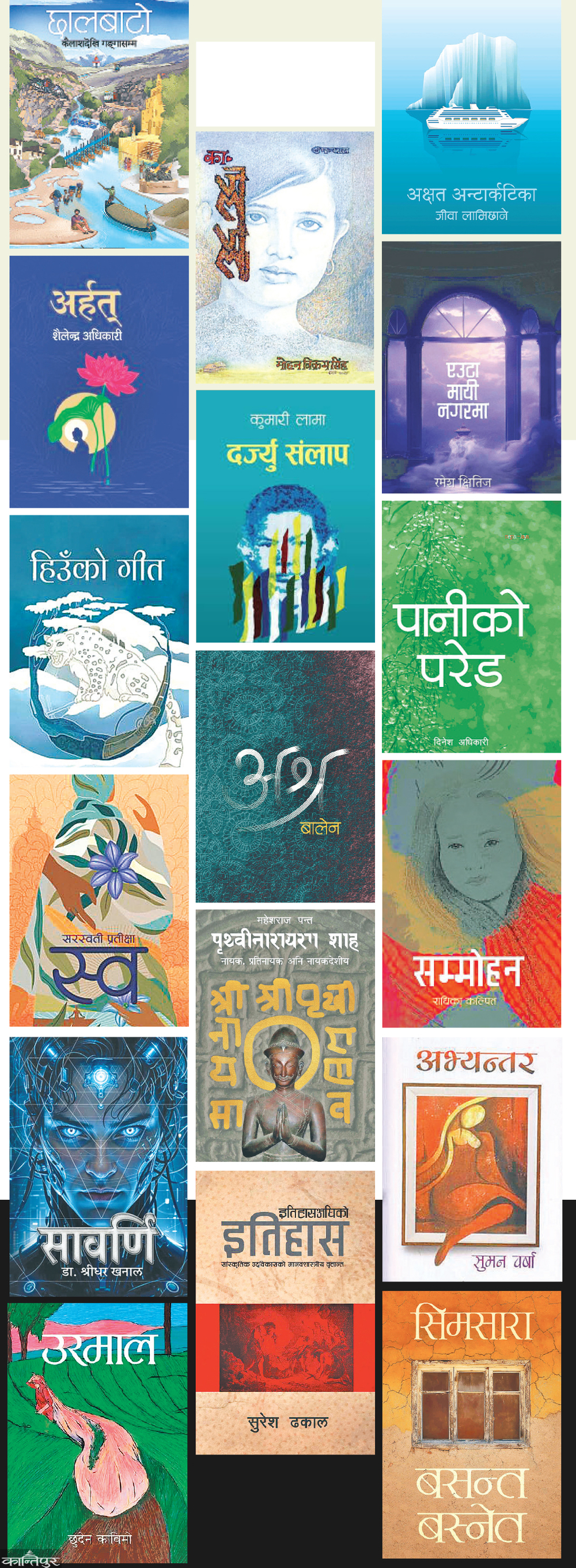
The Bhimkaya book of the year 2081 was proved, 'K. Flood'. This (maha) novel by former communist leader Mohanvikram Sinhakrit garnered buzz based on its page count (1,320) rather than subject matter or craft. Its fans saw the sudden news as 23 years of longevity for the 92-year-old leader. More than 500 characters and 500,000 words were spoken.
Yes
, it definitely has many pages. But it is not a mountain book like our ancient manuscript 'Chandranighantu' (1,918) or 'Sri Haricharitramurut Sagar' (4,042) which is named in Guinness World Records. Few more pages than Leo Tolstoy's novel War and Peace (1296). However, the story that has been written from page number 658 to 670 If the
was not repeated from 789 to 800, it could have been about the same, or if necessary editing had been done, it could have been a little less.
After all, literature is neither word count nor page count. It is not a character count, nor an age count. It can have the power to be timeless because of the right, creative, and concise words. However, despite his old age, Singh's efforts towards the novel must be commended. However, the quality of the book is still questionable.
In Nepal's left-wing circles, there is no boundary line between literature and propaganda. One does not dare to distinguish between novel and history. After telling the novel, what is real, what is fiction? However, it is sad to see our well-known writer, intellectual, philosopher sitting on the 'fact check' of the novel. Thankfully, the veteran leader Singh, perhaps for the first time, thanked his critics and admitted his faults or weaknesses. Another popular book of the year 2081 was 'Ashra'. Balen Shah, the mayor of Kathmandu, published his first collection of poems on Facebook on his birthday. However, there was no formal release, no interaction, and no country run. But it set a different standard in sales.
In Motiram Bhatt's time, poetry books were printed at most 1000 copies, now even in Balen's time, if the same 1000 copies are sold, it is labeled as a 'best seller'. Whether you consider Balen a poet or not is up to you. However, the sales of his books equal to those of 10 other poets shows that Balen is believed by the Gen-G generation. Now the book market cannot be heated by ignoring the Gen-G generation.
In some cases, the author himself does not even have to shout for the book. Balen never said anything about his poetry. However, some poets cried out in his name. Jhilke mocked him on social media as a poet. Let's say more, the 35-year-old rapper, Engineer Meyer's poetry book was promoted in reverse and became a celebrity book.
In astrological parlance, 2081 was the calendar year. Even if all creatures will be happy in the future, the poet-writer will surpass it. It is difficult to calculate how many books were released this year. Many of the books that hit the press at the beginning of March have not yet come out. One of them will take the ISBN (International Standard Book Number) given by the Central Library of Tribhuvan University, while the other will pay Rs. There are also books that can be taken out without paying a fee of 300. The deadline for submission of books to Madan Puraskar Guthi is 15th Baisakh. However, we do not have any body that keeps the official data of books. But, what can be said for sure, even though the country's economy is not safe, our writer and poet did not skimp on the book race. A fragile economy, increased immigration, technology and mechanization may have hit sales and distribution, but book publishing has not.
Let's start the conversation, from the story. In the year 2081, the novelty of Nepali narrative is Buddham Sharanam Gachchami. Narratives based on Buddha story, Buddha thought, Buddha vision, Buddha education have drawn the reader's attention. Saying this, it cannot be concluded that Nepali literature has left the Mahabharata stories and characters behind. The Nepali narrative has given an example of Bihaani trying to change the colte. There were not many novels this year. But as many as they come, they must have readability. Last year, the philosophical novel 'Advaita' by Krishna Gautama won the Padma Shri, so it was not expected to increase. Some novels this year have used beautiful zoning. Some have magical realism and the height of fantasy. Ethnic history has been excavated. Due to different topics and environment, novels like 'Swa', 'Simsara', 'Urmal', 'Savarni', 'Hiunko Geet', 'Arhat', 'Ahilya' etc. In terms of stories, 'Euta Mayi Nagarma', 'Hypnotism', 'Bahurupi', 'Visual Document', 'Abhyantar' etc. are also among the reading choices.
Also, the absence of intelligence, philosophy and thinking in some stories today is very striking. Narrative is not only a narrative of events, but also an author's point of view, thought, and philosophy. Sukti and Muktavali are the ones that make the reader fall in love. Searching for knowledge is not a mere dozi, it is a perfect literature. Therefore, the caste that has left the path of self-indulgence.
What is pleasant is that the enthusiasm of new and old poets did not decrease this year. Old poets from Dinesh Adhikari, Biplava Pratik to Hemprabhas met in the green square of poetry. Similarly, Leela Anmol, Suraj Rana, Sakun Angi, Yash Lama etc. came with poetry works. Readers also believed in his poetry.
In our long and rich tradition of poetry, the sadhana of poets is commendable. However, it is also true that some bad poetry overshadows good poetry. Due to the belief that poetry is a static structure, its artistic beauty and discipline are constantly being eroded. Common poet's expressions are fiery. It seems that the poet's heart has burned. The poor reader in search of Tookie is getting burned by the volcano. It's one thing to have
buzz, it's another thing to be good. Some poets-writers are doing their poetry silently. That is why the epic has not become a genre of the past. The epic poem 'Govardhan' written by Narayan Prasad Pokharel of Gorkha's Shahid Lakhan Rural Municipality-2 Banauti with poet Bhuvanhari Sigdel as the protagonist is noteworthy here. It is the duty of reviewers and editors to encourage this enthusiasm of poets. In the experience of
scholar, after the corona epidemic, the reader's attention has shifted towards non-fiction. The sales of books on history, geography and culture are increasing gradually. Being a Madan Award winning book, 'Mukam Ranmaidan' being the highest selling is not a new phenomenon. Maheshraj Pant's 'Prithvinarayan Shah', Ramesh Bhusal's 'Chalbato', Suresh Dhakal's 'History of History' etc. have given an example that even a classy non-fiction can attract the reader's attention. Language, literature and literature can improve only if there are writers and works of different genres. Among non-fiction books, essays have been published. However, we rarely get intellectual level essays. Political writings, travelogues, travelogues, portraits, autobiographies, diaries, etc. are also branches of essays. This year essays like 'Samjhun ki Birsun', 'Darju Sanlap', 'Akshat Antarctica' etc. won much appreciation.
The interesting story is that criticism, which is supposed to be the basis of creation, has become the weakest genre this year as well. It is a different matter that such a person publishes a book for personal purposes such as a university degree, promotion, etc., but there is no criticism to be proud of. It lacks awareness of the conscious reader. The glorification of classless and improvisational literature is its gift. Ekohoro suga sings - good, good, good. Awesome, awesome, awesome. In the absence of critics, it has not been possible to understand that literature is often a material to be savored rather than for general information or entertainment.
Nowadays, you can't see the original drama. Colorists are working through translation or dramatization of stories. Even though there are so many theaters, why is there no drama writer? Why did a trending genre disappear?
It is also unfair to say that the poet-writer has not written anything. Just because there are more new writers doesn't mean the old ones are better. We do not have the habit of always welcoming newcomers. That too can make a difference in the literary environment. He is expressing the specific traditions, history, culture, civilization, environment, customs etc. of Nepali society in narrative, non-narrative and poetry. New, new, new words have been added to the Nepali vocabulary. Today, villages and cities, home and abroad, local and global have emerged. Although the craft aspect seems to be insufficient, that awareness is salutable. However, the specific sense of literature is self-pleasure. Every art is a pursuit of happiness. Trying to keep yourself happy is not a bad thing. However, self-esteem is plaguing the society. Some people are under the illusion that a few drops of water are raised in Anjuli. Some have created a swang that when a fistful of soil is raised, the earth itself is raised. Some people have made noises like taking a whole atmosphere into the lungs when they get a little oxygen. Some of them have become masters of fine literature, albeit through sponsored appreciation. This is not the only unpleasant reason for textual disorientation in
literature. However, having thousands of poets and writers in such a small country is surprising to the rest of the world. The subculture of emerging as a writer without becoming a reader, eating, wearing garlands, making tikas and thinking that 'I have become a great person' is increasing. Who will explain that publishing poetry or retail writing is different, but publishing a book is a somewhat responsible job?
This year's awards were not so hotly contested. Some writers won awards, Arkathari was not recognized by awards. Except for one, most runners get the prize. Those who get the award will also get it. While government awards are captured by party workers, there is a lack of transparency in private sector awards. That chain will never stop.
This year there was no such dynamic work towards literature translation. However, there are reports of 'comedies' called Sahitya Mahotsav in many places. Even though it was named Mahotsav, it was not seen as more than an ordinary literary gathering or seminar. After the topic is organized and the speaker is organized, its power will be limited. Now it's time to review the literary festival itself, leaving the sponsored and ugly farce. In fact, what are we trying to do in the name of literature festival?
Many literary festivals are seasonal, not continuous. Literary festivals without branding are mere rituals. It is one thing for every municipality to say 'we also did a literature festival'. However, what is the meaning of spending resources and resources like that of the municipality? Rather, it can be more important to make it dignified and effective by holding a state-level festival. At present, people from foreign countries come to see the festival here, it is just a fantasy. It is not only the writer who saves the
literature, but also the reader of the literature. It is necessary to widen the embrace of Nepali literature in order to take advantage of the market. The Nepali literature that we are flourishing today has been narrowed down. In fact, it is only Nepali language literature or Kathmandu-oriented literature within Nepal. For that, Nepali literature outside Nepal (including Indian Nepali literature) and Nepali mother tongue should also be included in Nepali literature and only then our literature can live on its strength. There are few writers anywhere who represent the
era. Such rare writers are experimenting and inventing in themes, language, craft and diction. They have lit up the entire literary scene. In particular, we don't need a lot of literature, we need good literature. No one is doomed to consider Rahre and Khare as waterfalls. In fact, we have put so much effort into books, now we have to think, do we need so many authors or books or not? Is it written what is needed or not? To read or not to read? Can every literate Nepali writer be?
Today, Nepali literature has not only searched for a new edge in the novel, but also called for a new style. However, the writers have not left the 'comfort zone'. That's why some well-known and promising authors are trying to imitate their own style without writing a book that will feed them a pension. This is the bitter reality.
When such subjects are read, sold, or awarded, there is a kind of immobility in literature. A serious question has been raised whether the writer will regret the reader or make the reader regret. Writers must have at least this much confidence - literature is not only for the readers of today, but also for the readers born tomorrow.