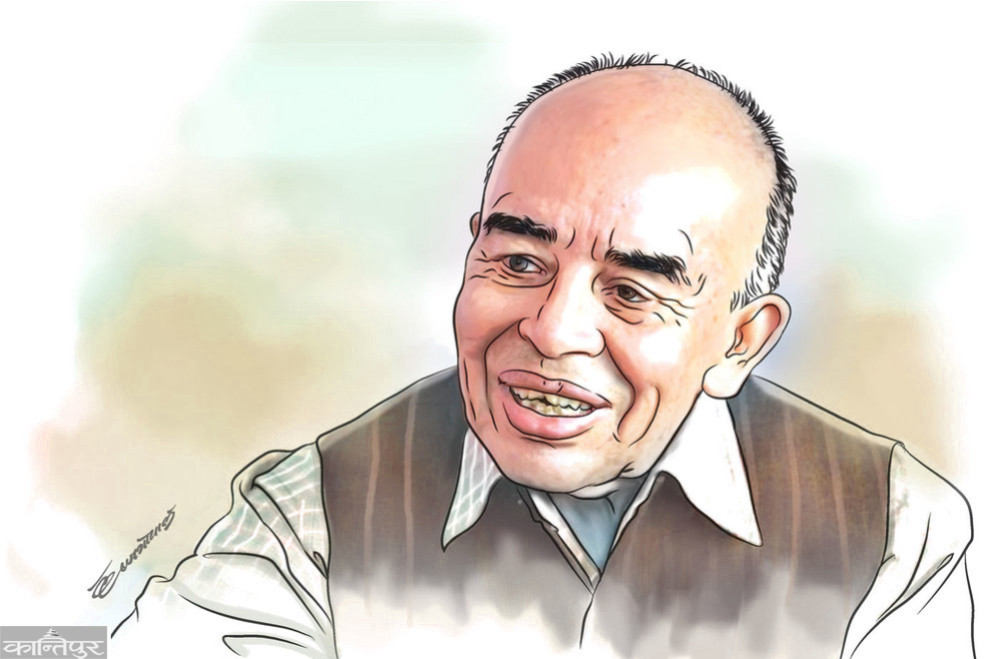
After India placed Limpiyadhura on its map, Nepali society became agitated and said 'that land was ours' - Bhairav Risal was a living proof. The 'power of letters' that he believed and the many facts he revealed through it have made Aksharji Bhairav memorable.
We use Google Cloud Translation Services. Google requires we provide the following disclaimer relating to use of this service:
This service may contain translations powered by Google. Google disclaims all warranties related to the translations, expressed or implied, including any warranties of accuracy, reliability, and any implied warranties of merchantability, fitness for a particular purpose, and noninfringement.
Tintak Bhairav Risal was 93 years old. On October 16, 2076, when summer was over and winter was approaching, a news reached his ears - India has released a new map keeping Kalapani in its own country. Even in that winter, Risal's blood seemed to boil, with the ranco of the news.
"This is really done by India," he said to me in a long conversation at that time, "I went there myself and conducted a census, that is Nepal's territory, how can India put it on the map?" But, I affectionately called him 'Bhairav Dai'. The reason for saying this is that he was my neighbor. Everyone in the village used to address him with the same sign - Bhairav Dai. We used to call him 'Bhairav dai' and call him 'Bhairav dai' by simply picking everyone's sign. Bhairav, who created the image of a jovial man with a chiseled palate, iron-edged pants and a crisp half-shirt, who walked with great agility, was equally at home with the children. Wherever I met, his habit of asking 'How much did you read, what did you read?' made me a little closer to 'Bhairav Dai' in the early days of my life.
'You know, what is power?' he asked me once, holding me by the hand. Until then, what we children were taught in school - energy is in green vegetables, fruits and legumes. I said so. Bhairav Dai laughed merrily. And, if - there is more power in letters than in fruits and vegetables, how do you say?
I said - how?
'When boarding a bus, a person who knows the alphabet quickly gets off at the place he wants to get off without asking anyone,' there was a glint in his eyes, 'a person who does not know the alphabet is afraid that he has missed a place to get somewhere. Have you seen that?'
I shook my head. And he added - again the power of food can be eaten again and again, so one should keep eating it. But the power of letters, once gone, is always there.
After hearing this, my child heart believed Bhairav Dai without doubt that the true power is in the letter. Yes, no matter how nutritious food is eaten, illiterate people suffer from the pain of not knowing letters. And, this sadness is not only when boarding the bus, but also after getting off, it continues throughout life. Because, letters open the door to that world, which cannot be found without reading its contents. I began to like Bhairav dai even more because he could tell even children the importance of letters in such an easy way. Bhairav Dai's Bhangima was ringing in my growing teenage heart as well as the gratitude seen in the eyes of loving mothers when I read a letter sent by a neighbor who was too polite to a white man who was wearing a mitt while visiting the village and said, "Don't write a letter in English".
Once you use it, it will work forever, no one can steal it, you don't have to carry it, you don't have to carry it, you can't burn it with fire and it can't be washed away by water, and it will be useful in any country and era. And I also remembered what Bhairav Dai's bright eyes were trying to say that day.
Since there was no fast road till then, there was inconvenience of transportation in Kanth villages. Because of that, Bhairav Dai lived in Ghattekulo. However, they kept coming with the village. When he came to the village, people would stop what they were doing and look at him very curiously. When Bhairav dai used to come, there used to be gatherings in the village on some social issue. And there, Bhairav dai used to tell his experiences of the countries and worlds he had seen. And people listened to him dumbfounded.
Ever since I left, people from all over the village used to gather together and feast, which is still going on. And, Bhairav dai had to come to that feast. The host of the banquet was Anant Seva Guthi. And the founder of that Guthi is Bhairav Dai, whom I came to know much later.
After Bhairav Dai passed away, the Guthiyars were bereaved. It was Bhairav Dai who started the custom in Guthi that one should go to the place of defecation with rice, money etc. This practice has caused a lot of deaths in the village.
When he came to the village, he would always listen to the children, tell the women to move forward and discuss what can be done to free the Dalits from untouchability.
Elections were held after the collapse of the Panchayat. Bhairav Dai also contested the elections - with the Madal icon. It was only then that we children came to know – Bhairav Dai is not only a journalist, but also a leader of Nepal Labor Farmers Party. During the Panchayat period, he has been participating in the democratic movement by becoming a member of the Communist Party. And, Bhairav Dai Madal went to the polls with the symbol. He went from house to house asking for votes. I saw that Bhairav Dai was being discussed everywhere in the villages and tolls. And, it was thought - Dai would win the election because the voters would blindly choose a man who had lived life in such a large circle, understood the power of letters and had such welfare thoughts. Bhairav Dai had a lot of confidence in himself. Maybe because of that, he didn't do much public meetings and flamboyant propaganda. He had the feeling of saying, 'What should I say to my neighbors in my own village?' and he did the same thing. Because of that, everyone was hoping that Dai would win the election. But, that did not happen, Dai lost the election.
After the results of the election, those who know analyzed the tolls and neighborhoods. And if he had contested the election from a big party, Bhairav Dai would have won for sure. Those who say this have not voted for Bhairav Dai. No matter what they say, a party is a party, a brother is a brother, where can the two be mixed together? I heard this many times from many uncles.
And I also got to know how Bhairav Dai's advice to stamp others without voting was implemented. It was not that Bhairav Dai did not know that politics that even Man Fuchche was tricked into. Dazai's heart must have been naturally engraved by his own neighborhood and brothers after watching the party, not himself. After that he stopped coming to the village so often. Even at the New Year's party, only Akkalzhukkal appeared. However, he was always kind to us children. After meeting him, his habit of showing affection and encouraging him to continue reading did not decrease at all.
What effect did Bhairav Dai have on my subconscious? I unknowingly grasped the world of letters. I chose the path of journalism. I started drawing poems and writing stories. More emphasis on reading books and visiting libraries. Coincidentally, I also became a freelance reporter writing news in "Radio Sagarmatha" along with Bhairav Daju, who left politics and went into radio journalism. The brother used to host two popular programs – 'Kuro Kantho' and 'Uhile Bajeko Palama'. I used to report for a news bulletin called 'Serofero of the Valley'. More than in the village, meetings with Bhairav Dai began at the radio station in Bakhundol. I got to listen to my brother's talk about the journalism of that time and the journalism of today. And, I had the opportunity to know Bhairav Dai closely about his various periods from journalism to social campaigning. After
I left radio and chose print journalism. As a freelancer, Bhairav dai used to call me and express his happiness by calling me and saying 'Kaida garyau' whenever my articles appeared in newspapers. Later, I joined 'Kantipur' regularly. His happiness knows no bounds.
'Lai hai, this man has taken my place,' Bhairav dai said to Sushila vaju while calling me home one day while serving me tea and kissed my cheeks with love. If I had to write about some past events, Bhairav dai used to give me a lot of information with great affection. He used to say rightly - 'There are more opportunities and facilities in journalism now than in our time, to take full advantage of it and move forward.'
I always felt a parental feeling and heartfelt affection in my conversation with my brother. Maybe for this reason, he became one of my reliable 'sources' for getting information about old things.
After India placed Limpiyadhura on its map, Bhairav Dai was the living proof that Nepali society became agitated and said 'that land was ours'. And, he gave me a list of everything he saw.
Not on the phone, but by calling at home, he not only told the story of going to Limpiyadhura to take census, he took out old papers from a missile-like hole and let them take their photos.
Bhairav Dai was not the only one to talk about Limpiyadhura in that venture, there was also juicy gossip about how he got into journalism, how he got a job during the census due to a job vacancy and how he entered the National News Committee. As Bhairav Dai, who was active in writing and lively writing even when he was approaching the age of 100 years, was narrating many anecdotes about the journalism of that time, I had the satisfaction of reading a living history of my own profession.
Born on July 21, 1985 in Gundu Tathli, Bhaktapur, lost his mother at the age of 3, and after his distraught father moved to Dadhikot, he was able to study at a language school in Luvhu, a nearby village.
In the year 2012, Bhairav Dai got the job of writing news in "Halkhabar Dainik" at the suggestion of Purna Prasad Upadhyay, the public relations officer of the Raja who lives near Katunje, after he did not get the job of an officer who passed the public service examination in 2012 because he was a member of the Communist Party. That was the point of 2013. Since there were not many newspapers until then, there were not many journalists. As much as he was, he got direct access to the mainstream of the state system. For example, in the same year that he started journalism, he had the opportunity to report on the journey of two important people - Raja Mahendra and Nepali Congress President BP Koirala. Bhairav Dai saw many things during Mahendra's two-week long visit to the Far West. One of them is that he has made a special 'notice' about the king. That said, during the entire journey, Mahendra did not laugh even once. However, Dazai could not write in the newspaper that the king was not laughing, because that was the way it was at that time.
In the same year i.e. on October 20, 2014, BP was going to Simra Airport in a plane from Kathmandu along with Bhairav Dai. Nepali Congress, Nepal Praja Parishad were holding a conference in Birgunj to decide on the strategy of how to force the king to set a date for the general elections. Its main proponent was BP. BP seems to have a more friendly and hearty nature than the king. Hey Bhairav Dai.
'As soon as Simra gets off, she will eat tatata jelevi,' BP said to brother Bhairav on the plane, 'like children eat papa.' 6 decades of the country passed between the different personalities of these two and the different worlds and state systems that these two represent. And, Bhairav Dai analyzed these 6 decades as a journalist - first through the private newspaper 'Halkhabar' and later through the government station 'Rashtriya Samachar Samiti'. Bhairav Aryal, a contemporary of Bhairav Dai in
journalism, but seven years younger, has written very accurately in one sentence about 'what was the journalism of that era' - one cannot write what one sees and one cannot see what one writes. It was obvious that the Panchayat was in disrepute, the people were unhappy and the leaders and staff were corrupt, but this could not be written. And it should have been written that the people are happy, the system is good, which could not be seen. The proof of the truth in this expression of Aryal was Bhairav Risal's own extensive experience. For example, Bhairav brother had to write the news that even when kerosene and salt ran out in the market, it was 'available in abundance'. He had to make the news only by the argument of the government lawyer when the case of BP's detention and death sentence was debated. And, Panchayat Prime Ministers who visited the district were scolded for writing short speeches.
Bhairav left this world last Sunday at the age of 97. However, the 'power of letters' that he believed and the many truths he revealed through it have made Akshar Jivi Bhairav Dai, who lived for centuries, memorable. It's true brother Bhairav - there is power in letters!