The transmission process goes through a cycle. A person builds his philosophy and belief system from the environment he lives in. That vision shows the way for the next generation. We are telling the robot what the elders taught us, the robot is telling us. This change is meaningful.
We use Google Cloud Translation Services. Google requires we provide the following disclaimer relating to use of this service:
This service may contain translations powered by Google. Google disclaims all warranties related to the translations, expressed or implied, including any warranties of accuracy, reliability, and any implied warranties of merchantability, fitness for a particular purpose, and noninfringement.
I spent the golden days of my life in acting and acting. Sometimes I think - what is art? And, I conclude - living life is an art. I became an artist in the process of learning to live. I stood - on the foundation of the theater, I leaned towards the film. It was a natural journey for an artist. As you move forward in the journey, something will be left behind. Surprisingly, Daya left the theater after being forgotten in the film.
But how can I leave that sacred stage? Yes, I left the stage but I never left the stage. Theater is a knowledge center, where knowledge, art and craft are combined. In that comprehensive knowledge center one meets with the scriptures of all arts.
It was after acting in 'Dasdhunga' that I felt that I would get work in films. After walking around saying 'film khelhu', I had to give up the temptation to act on the stage. After acting in the films 'Highway' and 'Loot', my engagement in cinema increased rapidly. I was not afraid to act in the theater. Even then I was clear about how to connect with theatre. Even during the nights and evenings when I was very busy with films, I never thought that the theater would or would leave my life. It has been 17 years since Mandala Theater was started by friends committed to
theatre. In that decade and a half, apart from films, most of my time was spent in theater management. Sometimes I used to steal time from films, sometimes I wrote plays, sometimes I used to direct plays. It took many years to climb the stage again. Over the years, he has acted in the plays 'Mahabhoj' and 'Court Martial'. About a dozen plays have also been written. After Mandala Theater moved from Anamnagar to Thapagaon, I directed the play 'Kuvindoko Katha'. The old play 'Meetju' was also staged with a redesign. Tired of
film work, whenever I entered Mandala Theater, I felt very comfortable and happy. Even today, I feel safe when I step into the Mandla-Angan. This is what draws me to drama. While working in films, I am a bit distant from the audience. I have to change a little in the atmosphere of many spectators and hahahuhu. I don't like all this, but it has to be done. We are fascinated by 'fake reaction'. So I think I will not leave the theater to keep myself 'organic'. I had some dreams, some visions from the beginning when I was struggling in
theater. Along with me, my team's dreams and visions were also added. We wanted to stage our own work and collaborate with artists from all over Nepal. We wanted to exchange art and culture with artists in the country and abroad.
We wanted to show our story, style and culture by sending foreign artists to Nepal. And, in the same way, we also wanted to represent the country and go to other countries to see and show new things. Now Mandala Theater is organizing 'Nitfest-2025' (Nepal International Theater Festival). The festival will run from March 19 to 25. This theater festival is conceived with the aim of taking our plays abroad and staging foreign plays in Nepal and exchanging cultures.
In 2007, I went to NSD (National School of Drama), New Delhi as an artist for the first time to participate in the Natya Mahotsav. That NSD-Festival was a unique and wonderful experience for me. The memories of those days are fresh with me.
In 2009, I participated for the first time as a director in another theater festival in Orissa. That was a great impression for me. The scenes I saw at that time, when the play was just beginning, are still dancing in my eyes. It was very charming and charming. It provided energy for two/three years. From that time, it was thought that there should be similar grand festivals in Nepal.
What I have always wanted is to have such a space in the city, where one can happily sit and drink tea, chat about various art topics and enjoy watching plays, listening to music or poetry.
We Nepali youth are disappointed in many ways. While commuting from home to office and from office to home, it is difficult to breathe on the way. We are building houses in the city without leaving a single corner. This home town is nothing short of a disaster. We have built such a city, where there is only haste and stress. Not even a moment's rest and peace. There is nothing in the city to relax or rest our minds.
Our best friend is drama, music, poetry or painting. Between going to the office and coming home, you can stop for a moment and say, "Oh, what an attractive place"! But such a space? We are working in art, but we are not able to create new spaces where art culture develops. What are we doing? I asked myself this question too.
Having such a dream, I kept insisting that we should do drama festival from the beginning. While working, Rajan Khatiwada, Somnath Khanal, Srijan Subba and other friends became the main planners of 'Knitfest'. When we started Knitfest in 2019, Arohan Gurukul, the place of drama worship, was defunct. Without the drama festival, we were not able to see other people's work. Intercultural exchange was not happening. We thought it was our responsibility to organize the festival. The next edition of Knitfest was held in 2023, at the new space Mandala Theater in Thapagaon.
This is the first time I have taken charge of Knitfest-Director. Right now I'm scared of whether or not I'll be able to fulfill the dream I've shared with my personal family, the Mandala family, the Knitfest family. Will I be able to fulfill the dreams of these friends who are united by seeing one dream, one future? Especially I am suffering.
I was comfortable in the way I used to work in Nepathya. I have a big dream, but I am also afraid that my friends will be disappointed if I cannot fulfill it. I can't explain my dreams to others, and I'm filtering them. Filtering doesn't show the correct blueprint of some things. Others have to associate with me long enough to understand my hypothesis. So I started preparing for this edition of Knitfest a year ago. Being a
director, I used to imagine a lot. I thought I would make the festival so grand, I would make it like that. How much was done, how much was not done. I believe in collaboration. We worked with theater organizations on the first Knitfest. This year we have collaborated with various organizations. Where are we in trouble when exploring the possibilities of collaboration? Where is our art culture in trouble? This knitfest became an opportunity to understand such things.
We artists are just working, working and working. We have not been able to understand what art contributes to society and the state in a policy way. Which government agency or ministry will give us financial assistance under which title? From the local, state to the federal government, there will be no clarity on this matter. We have to bring the sound to that place. We have not been able to explain the importance of our work to the relevant agencies and bureaucracy that look after art and culture. We have not been able to explain it to the corporate. We have realized that not being able is our own weakness.
Due to the country's economic situation, political situation and lack of art-policy, we are not the priority of the state. Similar to government policy, the policy situation on how to work with corporates. The government should also make a policy to cooperate with corporates. If we continue to organize festivals, an easy environment for understanding will be created. We are celebrating with the belief that after working, the results will come.
As much as we have done on the stage, it has been done by people together. We are performing a play by collecting tickets from the audience. I call it the great movement and practice of our time. There is also the issue that tickets are expensive. However, we are not able to pay the artist.
Knitfest has the support and involvement of many volunteer youth. We had a huge fund when we first started Knitfest. Now we have shrunk by 70 percent financially. However, the festival needs to continue. Most of us are not getting paid. The question also arises as to why volunteer when there are no resources. We will also have to work to open the way for resources to come in the future.
Knitfest is a child, which we are responsible for raising. We have decided that it will be easier later if Knitfest grows and makes its own existence. This too I call the great movement and practice of our time.
I think, if the festival held in the Gurukul was going on continuously, the Nepali theater could have reached a different place today. As more theater organizations become active, new ideas and visions are brought to the stage. When we started Knitfest, we thought of organizing it once in two years. After doing it once, it will settle down. The biggest problem faced by our theater is the lack of continuity. In the absence of continuity, somewhere we are looking at Agraz. We walk together as long as they are active. Sometimes when we expect, we are not looked after by elders. But, are we realizing that this responsibility is mine?
As soon as a generation is inactive, everything goes to waste. What is my role here? Being the festival director gave me the opportunity to think about my role more seriously. As much as we have done on stage, it has been due to the desire of a limited number of people. Only when you feel responsible, you will find the basis to continue. Let's say we have to come to the next generation. But how to transfer that? We work on themes. In the previous edition, our slogan was - 'Theater for social transformation.'
is being associated with the word 'Raithane'. Ours is a society that is more concerned about future generations. We do many things for our children. It is not enough to just worry about where the next generation will go. It is also our responsibility to guide them.
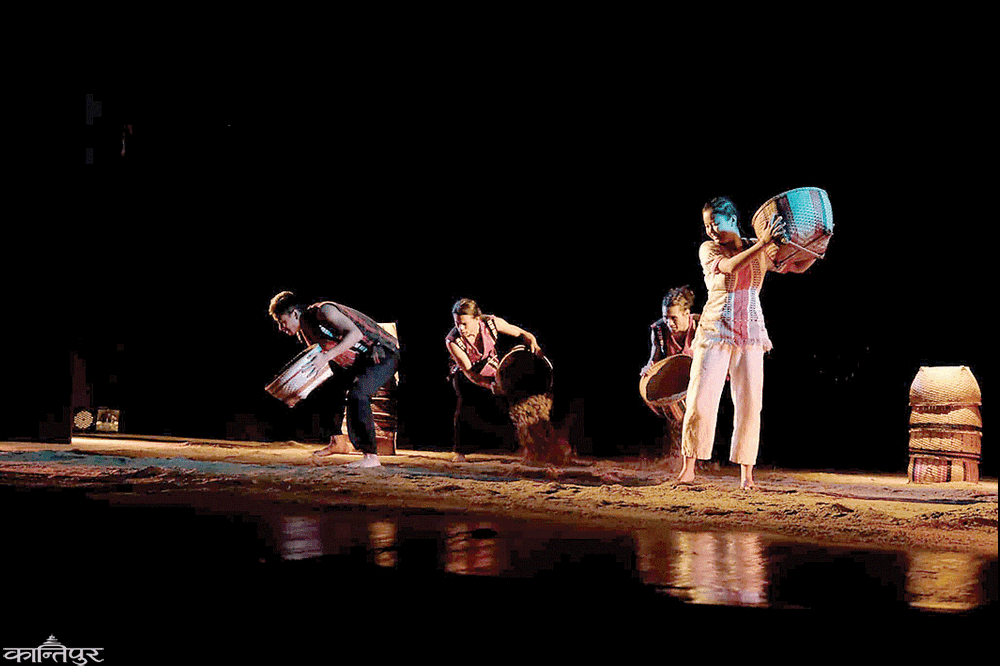
In this festival, we symbolically used everything from bamboo structures to robots at the Mandala Theater. While the bamboo was pointing to our past way of life, the robot was pointing to our future way of life. The journey from bamboo to robot is our journey.
It is also a journey of human community continuity. Bamboo The importance of art in the process of transferring generational knowledge to the robot generation. Man learns many things during his life. He builds a philosophy of life and a belief system from what he learns from his surroundings. The same philosophy and methodology will guide the next generation. We are now telling robots what our ancestors taught us. The robot is telling us again. This change is meaningful. The transmission process goes through a cycle. On the stage, we have come to the stage with similar beliefs or life philosophy of our own society. This is how art connects yesterday, today and tomorrow.
From the time of climbing gurukula to today The achievement we have got is the new generation. Such a generation, which is giving its creation. In recent times, there has been an increase in coming up with their own story in dramas. The young generation is writing, directing and creating new plays. This change would not have been possible without continuity. Knitfest is considered by me and my team as part of such continuity.
We need more festivals like Knitfest to showcase and promote art and culture, where different genres of art and different topics of society embrace each other. Where artists, art lovers and critics gather, debate and counter, appreciate and criticize art. In a similar process thoughts and dreams are exchanged. This process gives birth to a new subject. Things that cannot be seen in normal situations are seen through art. It is also a way for people to know themselves and others. Various art festivals inspire people to see, understand and think. Gives you a way to express yourself in the style you like. Being able to express oneself freely is the beauty of democracy.
Ironically, at this time, there is one censorship after another in the cinema from the state. The situation came to a point where I had to cut some scenes from the latest film 'Rajaganj' in which I acted myself. Yesterday art worshiped power, today it is questioning. Questioning exposes those in power. Art is opposed to power. Spreading like this is the power of the karma we are doing. Such a ban is not only a matter of mocking democracy, it is also a matter of making us understand the importance of our freedom.
In a democracy, the rulers are doing their own thing. We citizens should also do what we want. If our art-creation upsets someone, it is just a hangover from the thoughts he lived yesterday. Discussions, exhibitions, festivals and other activities of resistance in the public sphere are the victims of such hangovers.
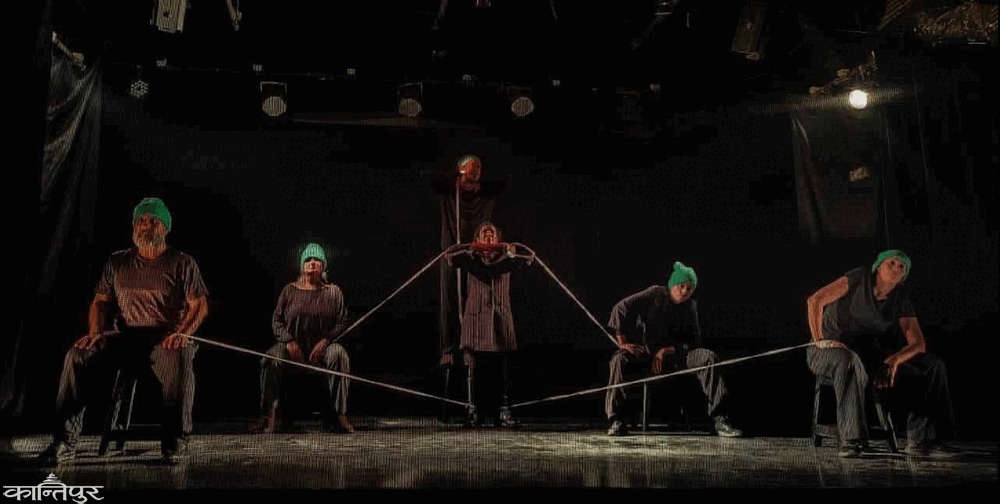
Nitfest (Nepal International Theater Festival) – 17 plays from 12 countries will be staged in 2025. 115 plays from all over the world were applied for staging in the ongoing festival at Mandala Theatre. From them, 12 plays, 10 foreign and 2 Nepali, were selected. Apart from that, a total of 17 plays including 1 from the organizing organization Mandala Theater, 3 from the local organizers of three cities and 1 from Chautari Theater have been selected.
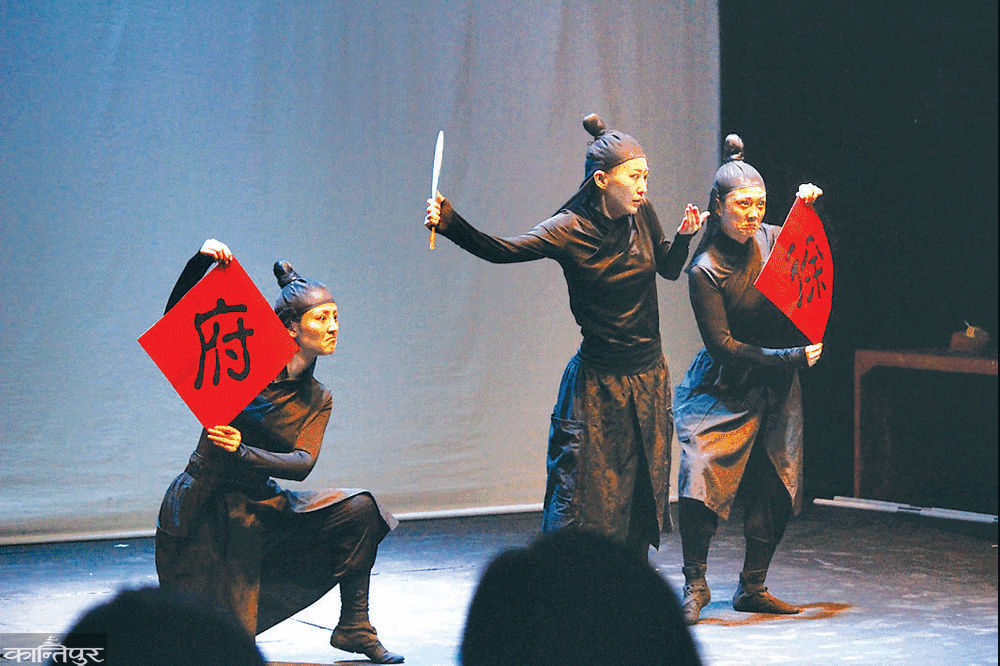
Nepal's 'Zhoda' and 'Sama Chako Sama Chako Ahiva He', Japan and Nepal's 'Kandata and Shakuntala', India's 'Aboriginal Cry' and 'Tamasa', China's 'Mochou Mochou', Tunisia's 'Esech', Iran's 'Antigone', Lithuania and Spain's 'Arrived', China's 'Charming Jinju Opera Episodes' and others. are being staged.
This time the festival will be held in 4 cities – Kathmandu, Pokhara, Bharatpur and Belbari. More than 100 foreign artists have come to participate in the festival. Artists from Scotland, China and Germany are holding workshops. Art exhibition, music, dance exhibition is going on.

