Life is a compromise. I have made compromises many times to survive, but my poems are not the product of compromises, I have not exchanged poetry for rice.
We use Google Cloud Translation Services. Google requires we provide the following disclaimer relating to use of this service:
This service may contain translations powered by Google. Google disclaims all warranties related to the translations, expressed or implied, including any warranties of accuracy, reliability, and any implied warranties of merchantability, fitness for a particular purpose, and noninfringement.
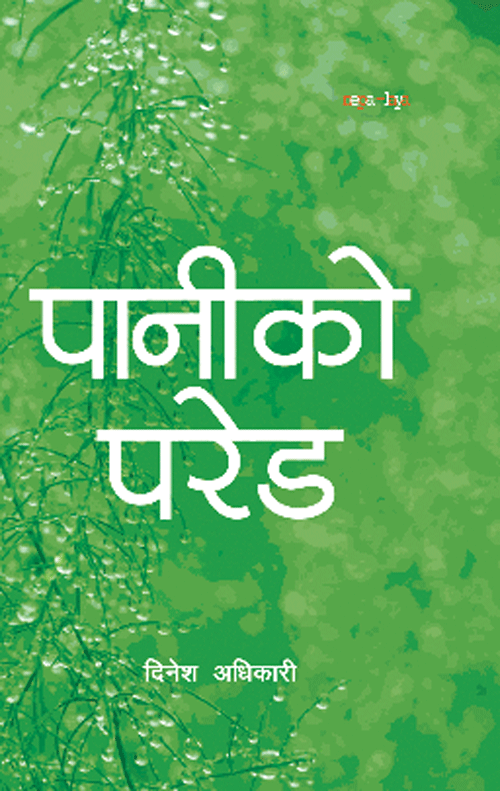
Looking back at this happy moment of the publication of my new poetry-book 'Water Parade', a kind of joy covers me when I look at my own poet's life. The path of struggle has been walked, but more than that, the heart is filled with the light of love and friendship.
I remember - in the year 2032 Chait, two of my small poems were published in the prestigious literary magazine 'Ratnashri' at that time. This was the first publication of my work in the sense of publication. With the beginning of the month of March 2081, the time when I started playing the parade of poetry also entered the fiftieth year from the point of view of publication. How much time has passed.
My poetry-journey, which started with the aim of winning prizes in school life, then entered the stage of wanting to print my name in newspapers. Some time passed in longing and trembling.
In the year 2036, poets recited poetry on the streets, standing directly in favor of freedom of speech and indirectly in favor of democracy and multi-party system. Along with our senior poets Mohan Koirala, Haribhakta Katuwal, Bhawani Ghimire, I and my contemporary friends joined this movement. Before this movement, known as the 'Street Poetry Revolution' in Nepali literature, the fact that the literary magazine issued a notice not to publish poetry saying that we do not publish poetry is still fresh in my memory. After the
street poetry revolution, a significant number of literary magazines began to appear. Many took out the poem number or the poem epithet. As a result, we did not have to face the problem of publication. Due to the street poetry revolution, to some extent, poetry's relationship with society began to become closer. Apart from the fact that the subject of social concerns began to find expression in poetry again, the linguistic simplicity introduced in poetry became the main reason for improving the relationship between society and poetry.
, after this street poetry revolution, my old habit or thinking of writing poetry with desire or impulse also changed. Now not only do I enjoy writing poetry, but I also want to keep writing poetry. I started getting serious.
A youth literary society that is not formally registered anywhere in the street poetry revolution, Kathmandu collected donations and published my first poetry collection 'Antarka Chitaharu' on 2037 Baisakh 1. Since then, 17 books have been published, including ten poems/poems.
I wasn't as lazy then as I am now. I used to go from Kathmandu to Jhapa, Biratnagar and sometimes to Pokhara, Palpa to read or recite a poem with my friends. There was no internet. I used to rush to the public library because I didn't have the financial means or access to buy the books I wanted to read.
It was also my habit to go to the great poets and listen to their words and creations. He used to take the opportunity to share his creations. The houses of poet Siddhicharan Shrestha, Kedarman Vyathit, Bhupi Sherchan and Vasu Sashi were among my major destinations. I was always overwhelmed by their affection. I still am.
Before the year 2046, rebel Chet's creations were not so easy to print. The panchayat administration was always keeping a sharp watch over the farmers. Moreover, if he was a government employee, he would have been at even greater risk. I also became a government employee from August 2038. In the same year, on the 22nd of January, Rashtrapukar (Weekly) published a poem titled 'Time' written jointly by me and my friend Bishnu Vibhu Ghimire.
We went to appear at the Bagmati Superintendent's office. We gave a statement. Threats were issued and papers were issued to appear when searched. Fortunately, Sui's administration did not find that the person who wrote the poem in the name of Dinesh Adhikari is a government employee, Dineshhari Adhikari. If that reality had been revealed at that time, I think that my job loss was almost certain, the possibility of going to jail was also strong.
Literary periodicals like 'Ruprekha', 'Bhanu', 'Abhivakta', 'Rachana', 'Swatantrata' and especially the weekly magazines 'Rashtrapukar' and 'Samiksha' used to not only publish but also encourage the rebellious works of me and my contemporary friends. Since 2041, when I started working as a 'Government Advocate', it was only natural that the panic of the administration revolved around me.
I was not ready to trade or compromise my writing with a job, and such a thought never occurred to me in nearly 34 years of working life. However, there was panic in the environment! So I took a different approach to print poetry. I thought that it would be safer to publish the poems of a rebel Chet in a newspaper with a government image than in a newspaper known to be anti-establishment. The administration does not keep a watchful eye on the works printed there. It went without saying.
During the Panchayat period, lawyers and professors were counted among the categories that could use relatively more freedom. About a week after the poem was taken from me to include only one of my poems in a literary magazine that was going to be published by the same few professors of the university, the poem that I got back saying that we did not dare to print it was published in Garima (monthly), a joint publication. From 2040 to 2046 I mostly followed this method.
Perhaps karma and struggle are complementary to each other. This story of struggle has, in my case, stretched to the point of making poetry the main genre of my writing. What happened - when the time of the street poetry revolution was coming to an end, a poet friend who was a bit older than me, 4/5 years older than me in terms of writing, suggested to me one day - because there are many people who write poetry, there is a big competition to be established in the poetry genre.
I've spent a few years on it, so there's no going back. Since you're just starting out, it might be easier to make an introduction if you turn your pen to essay or drama genres that seem 'empty' from the point of view of literary involvement. There was no malice in that suggestion. It's not human race, my heart also rose to the opposite side. I thought - why can't I write poetry that others can write? There is competition. I decided that day - now I will write poetry. The path of poetry that I have been walking till today is the product of that determination.
Now let me talk a little about my relationship with poetry. Poetry, for me, is the highest point of free expression. I do not prefer to limit it to an 'argument' or 'opinion'. I believe that freedom is its beauty and art is its origin. I think freedom expands the path of diversity.
Life is usually compromised. I have made such a deal many times to survive. However, my poems are not the product of agreement. I have not exchanged poetry with rice. My poems are the free wings of my mind. In this sense, poetry is my only love. I'm kind of against the idea of defining
poetry. Sometimes it seems, poetry is an artistic expression of life. Sometimes it feels like this is a rebellious statement of life. Not only is it an embrace of craft and imagination, but it is also an exploration of emotion and thought. The imprint of time is also a monologue of sensations. Again it cannot be narrowed down to any one point. Poetry is poetry.
I do not dare to write a poem on a completely new subject. Yes, I have always tried to make the presentation style a little different from others. 'Water Parade' is a collage of these and similar beliefs and feelings. It contains 77 poems selected from those written/published from 2064 to 2080, and some of them were published for the first time in this collection.

