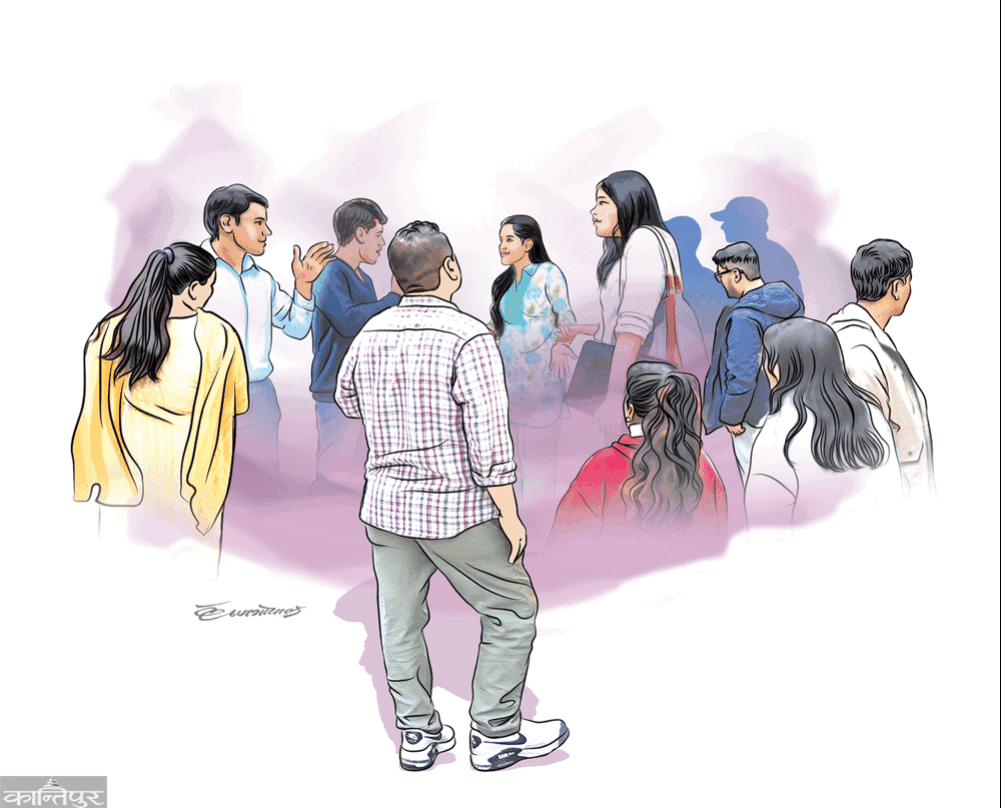
When Nepalese teenage workers were found in Indian restaurants, many questions arose - why did those Nepalese teenagers of school age come to work in South Indian restaurants and under what force? Is it just a coincidence to see Nepali teenagers every day?
We use Google Cloud Translation Services. Google requires we provide the following disclaimer relating to use of this service:
This service may contain translations powered by Google. Google disclaims all warranties related to the translations, expressed or implied, including any warranties of accuracy, reliability, and any implied warranties of merchantability, fitness for a particular purpose, and noninfringement.
December 7, 2081Munnar, Kerala, South IndiaWe all sat down for breakfast at a hotel with a panoramic view of Munnar, famous for its hilly views and tea estates. There was also a small stall next to it that prepared egg dishes according to the guest's preferences. The cook who was cooking there was smiling when he heard us speak Nepali.
"Make me an omelet with lots of salt!"
"Okay" he said with a smile and immediately made it and brought it.
...
December 8, 2081
Allappey, Kerala, South India
In the evening we were sitting on the houseboat and enjoying eating starfish from the same sea. Just then, a young man came to our boat.
I came to meet you after hearing that you have come from Nepal. How are they feeding? Our food and their food is different. I work at another plant. I will tell you!'
The next morning, he waved his hand from another plant and bid us farewell.
...
9th December, 2081
Punjabi Restaurant, Madurai, South India
The vast courtyard of the Meenakshi Temple in Madurai is visited every day by pilgrims from different countries of the world. When we reached the temple around 6 pm, there was a long line and we could leave only after darshan at 9 pm. By now everyone was very hungry.
There were many South Indian restaurants around the temple. But by everyone's consent, looking for a North Indian taste, we ended up at a Punjabi restaurant. The restaurant was packed. Before dinner, a slim sixteen/seven year old was seen busying herself at the counter where the salad and papad pashkin were prepared. After a while the teenager came to our table.
'Are you Nepalese?'
'Yes, we are many Nepalis here.'
We fell in love with that boy, we left with some Indian notes in our hands.
'We will meet sometime! I will come to Kathmandu,' said his friend, a bit eloquent.
...
Dec 12, 2081
Restaurant, Tiruvallur, Tamil Nadu, South India
Afternoon, 3 pm
On the highway from Mahabalipuram to Tirupati, I couldn't find a place to eat. The driver stopped at a small town-like settlement near the highway. While we were looking at the menu, a Nepali teenager came over to hear us. Those teenagers from Far West Nepal were shy, they don't know how to speak Nepali, they just laughed at us. Another local staff fed us satisfactorily.
...
The above description is part of a 14-day South India tour of Nepalese tourists. During our 14-day trip, we visited 7 cities by road. We tasted many restaurants. Seeing Nepalese teenage workers in most of the restaurants made me sad rather than happy and many questions arose. Why and under what compulsion did those Nepali teenagers of school age come to work in restaurants in South India? Is it just a coincidence to meet Nepalese teenagers every day?
Department of Labor has released the figures of 7,41,297 people who went abroad in the list of new and old workers who went abroad between 2023 July and 2024 July. There are 149 countries in the list, which does not include India. No work permit is required to go to India and work there. Only adults are included in the list of Nepali workers going abroad because they cannot get work permits unless they are adults.
However, those bright Nepali teenagers we met who went to work in far-away cities of far India where Nepalis do not speak Hindi, which is easily understood by Nepali people by watching movies and listening to songs in the Nepali language, may not have been included in the statistics of the Ministry of Labour. Why did the hands that should hold a pen and a book end up holding Dadu-Panyu? Under what compulsion are those young men, who are not well-dressed even with a mustache, toiling in the scorching heat in those cities of South India?
Was it not possible for them to go to school after eating two meals at home? Countless such questions sought answers. Family financial pressure and lack of money for living can be the reason and motivation for these teenagers to leave home and go to India. Not only in big cities of India, but also in small settlements, Nepali teenagers have reached for employment.
Talent flight or brain drain is a loss for every country. However, in the context of Nepal, foreign employment is included in the list of main occupations and sources of income of Nepalese. Foreign employment is the main source of income for the country. However, the country's future base youths going abroad for manual labor without any skills and basic education is a bigger loss than talent flight. Even if these teenagers return to the country after working for a few years, they are unable to find good employment for livelihood due to lack of any dynamic skills. Nepal's small and limited capacity is not enough to provide small jobs like in a big country like India. Comparably less money for similar jobs.
There are many young people in Nepal, who spent their teenage years working in India due to family enthusiasm and lack of finances. With the help of contacts and social networks, while in India, they establish various contacts and go to Arab countries by arranging employment opportunities from there.
Even though some workers return to Nepal, there are many examples in front of us of those forced to return to the same cities in India in their mid-teens due to lack of regular income. The motivation to go to India has increased among the workers even though the salary given when trying to work as a helper of the same nature in Nepal is very low compared to India.
The same principle applies to teenagers going to India not only for employment but also for study. As it is comparatively cheaper in India, Nepali students also go there for studies.
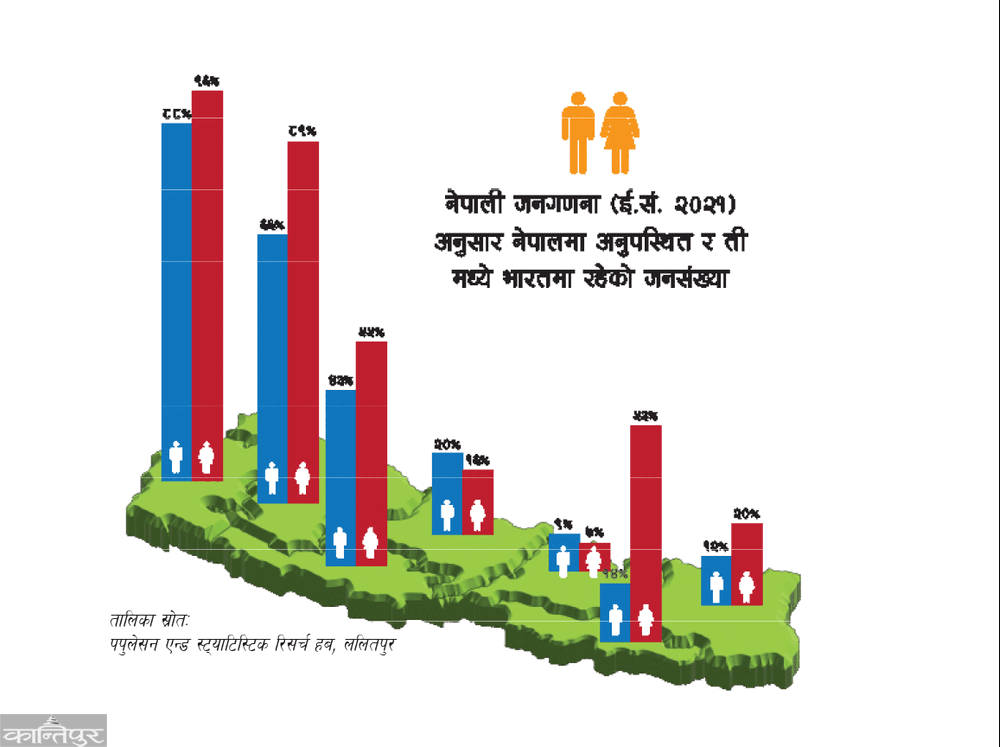
Population and Statistical Research Hub According to a statistical study based on the population of 2021, 32 percent of males and 41 percent of females of the total population outside Nepal are in India. This data after the covid epidemic. Collected in November 2021. Therefore, it can be assumed that this number may have increased even more in the present time.
This information has been compiled on the basis of gender as specified in the Population Details Form of Nepalis Absent in Nepal and Present in India. Age of workers at the time of leaving the country is also collected in the data but was not available at the time of this study. Therefore, the exact percentage of teenagers in India could not be calculated based on age. The graphics presented here have presented the details of Nepalis absent in Nepal based on the data of Nepali Census (AD 2021).
The graphics show only the number of Nepalis in India and outside India. The census mentions that Nepali citizens who go to India go for various reasons, such as: employment, business, seeking employment, dependent, other and unknown. From that description, if we separate the population going to India for employment and in search of employment, the following details emerge .
According to Nepali Census (AD 2021) number of Nepalis in India seeking employment and employment : 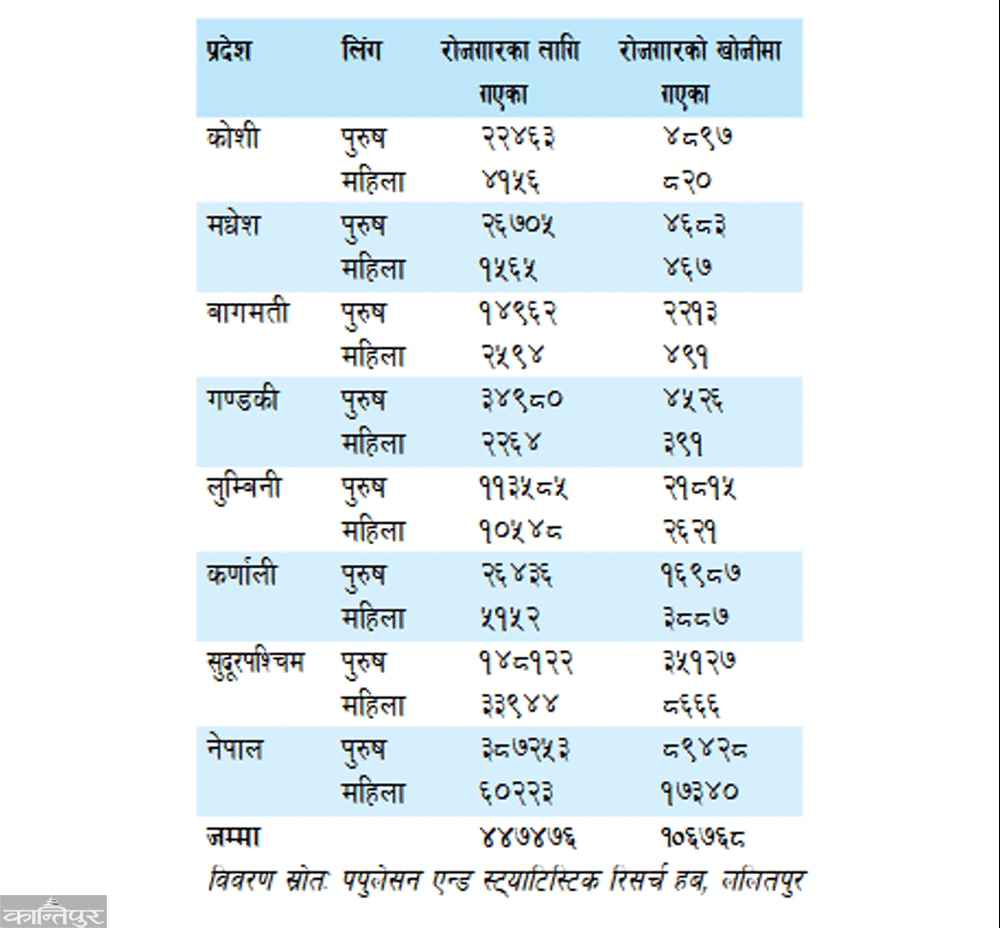
Graphics and table presented here show that most Nepalese people go to India for jobs from Far West Province while Karnali Province comes second. Of the absentee population of the Far West, 88 percent of males and 96 percent of females are in India. 66 percent of men and 89 percent of women from Karnali province are in India, while only 43 percent of men and 55 percent of women from Lumbini province have gone to India from Nepalese absentees.
The lowest number of Nepalis who go to India are from Bagmati Province, but among the population going abroad, the population of Bagmati Province is high around Koshi and Madhesh. Interestingly, the number of people going to India from Madhesh province, which is said to be close to Indian language and culture, is less and this number is only slightly more than Bagmati province. Most of the teenagers we met in India were from the Far West and Lumbini, while only one was from Bagmati. Across Nepal, 268,221 boys and 51,375 girls between the ages of 15 and 19 are absent.
If teenagers and young adults experience unemployment at an early age, it can have a lifelong impact on their income and employment stability. Because due to lack of finances, they start work with poor qualifications and later in their working life, it is difficult for them to face the challenges of labor market opportunities.
This can cause them to lack confidence. After a certain age, they lack the courage and opportunity to learn new skills and continue their education. Therefore, they are less likely to make a big leap in their careers and their standard of living may not rise. And there is no encouraging change in life. Exceptionally, some youths and teenagers can raise their standards later, but most cannot. Therefore, the more teenagers enter the job market without training, skills and higher education or even basic education, the more harmful it is for the country.
In the future, unskilled and uneducated manpower may be in abundance. Therefore, in order to ensure the future of the country, creating opportunities for employment-oriented education and providing basic education and income-generating training to teenagers becomes mandatory for building a beautiful future for any country. According to the data presented above, it is very necessary to take such a step towards Far West, Karnali and Lumbini provinces as soon as possible and to raise public awareness about income-generating training.