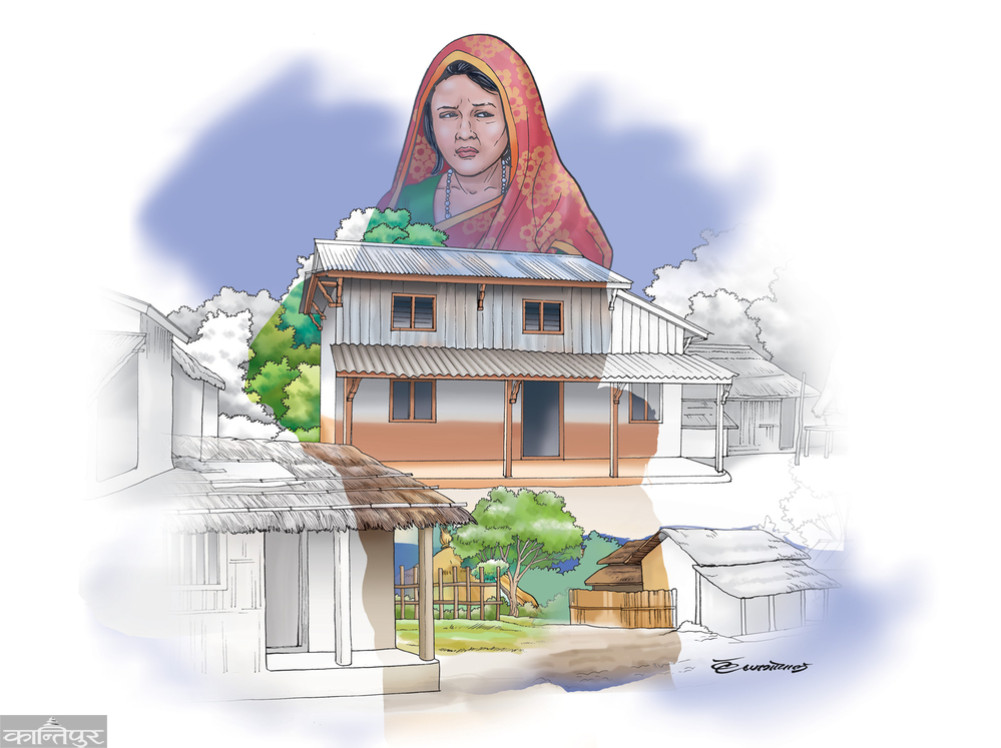
The hills look rugged and Madhesh is flat. From the point of view of geographical structure, both are different, but from the point of view of experience, both of them have the same complexity, the complexity is also similar.
We use Google Cloud Translation Services. Google requires we provide the following disclaimer relating to use of this service:
This service may contain translations powered by Google. Google disclaims all warranties related to the translations, expressed or implied, including any warranties of accuracy, reliability, and any implied warranties of merchantability, fitness for a particular purpose, and noninfringement.
I, who grew up playing hide and seek in Kholsakholsi in the mountains, am currently farming Akshar in the soil of Madhesh. My ears, which are awakened by the sound of the temple bells, are now used to hearing 'Allah Hoon Akbar'.
My hands that only go to say 'Namaskar' sometimes rise in 'Pranam', sometimes in 'Salam Walekum', sometimes blessing the bowed head by saying 'Gor Lagaisi'.
I got to taste not only tej rate, Chhath's thekuwa, Maghi's sanes and Eid's sebai. The taste of snails and musular is going to blow your tongue. I have started humming Bhajan Kirtan and Naad. Be it Shivcharcha or Jitiya, Ashtajam, Puja Matkor, Samachkewa Brahma Puja or Chhathimai Bhajan. Catching the rhythm of the culture and enjoying the different aspects of the broad cultural dimension of Madhesh, I have been able to understand the sociology in the countryside. What is the
and daughter's
flowing water, flying birds
Bhir Larkyo Khar
My house is there by Karma
This song was hummed a lot in the teenage years while removing the rice from the rice paddies in the hills or cutting straw in the fields of Chindhunga. Where was this song? This was the question of every young girl's heart and the answer. Which would have mixed in the answer with deep anxiety and pain with his own uncertain life.
For me, who grew up hearing that 'a daughter has no house of her own, no surname, no desire', Madhesh is a place led by my own desire. Even though we were connected to Madhesh due to marriage, we were not forced to live in Madhesh. When life was going well, the advertisement of the Teacher Service Commission opened, which awakened the urge to become a government school teacher.
The same hoothooti ruined the course of our life. Leaving Karta Beni, holding the rope of karma, I crossed Kaligand along with my 3-year-old daughter and 7-month-old son in the womb. And, I arrived at the river bank of Chandi, where we are testing ourselves, our understanding and our own strength.
After planting paddy for 30 days in the mountains, the paddy was barely enough to eat for 4 months, and the remaining 8 months were mostly cooked at home, the rice of Unda. Where does this rice come from? It was her turn to solve my child's question, 'From Madhesh.' Madhesh means paddy growing place. A moving place.
After growing up a little, I saw some people coming to the village saying Sirak, Khol, Tanna. But the people of my village did not treat the man very well. I could feel the insults and insults done to them with my keen mind. Even the old men of the village used to say to their daughters and daughters-in-law, 'Beware of these'. Why do you say that? While understanding, I heard from someone's mouth, 'These are desi people, they can do anything, they are very bad.' People living in Madhesh.'' In such a busy place where rice grows, there are people like this who are living!,' I was shocked for the first time in Balkhai and then the process of shaking with Madhesh continued. Sometimes I was shocked by the news of bombings in the headlines of newspapers, sometimes I was shocked by the news of women persecuted in the name of witches, and sometimes I was shocked by the faces of women who were burned because of dowry.
Most of all, during Navratri in 2065, I was shocked to see the sound of the dam and the mutilated body in front of my eyes at Chandranigahpur Chowk. And, that was my last gasp.
After that incident, many questions started rising in my mind. People around me were referring to Tarai as a symbol of trahi-trahi. I said I could never agree with them.
On the day of leaving the mountain, a class 9 student asked, 'Ma'am, are you going to Rautahat?' The answer was in the question, I shook my head. He added, 'Ma'am, do you know which district you are going to? That district comes from last to number one in literacy rate. It is a district where violence and criminal activity is high.
If you look at the statistics of violence against women, it is even more terrible. Your house is in such a district!'' His words echo in my ears to this day. In that uncomprehending face of his, not only was he worried about his teacher, Madhesh was also taking shape with a view of seeing and understanding.
The view of Madhesh from the hill was one of a kind. The point of view of Madhesh from Madhesh is not very different. Take it! Dumaria Po. It should be fixed here. It's not right at the bottom.' My relatives-well-wishers used to express great concern. My school was just 9 km south of Chandranigahpur, but according to everyone, the place was not 'right'.
After giving birth, most of them gave the same opinion, 'Don't carry a small child. What kind of people they are.
!,' I reprimanded many times. A son who was born with hemoglobin deficiency was regularly sick, but the apjas was found by others. He was angry inside. Unable to speak everywhere, not even compatible. How many places did I protest, how many places did I do it without even hearing it.
Sir Ganga keeps saying, 'Don't have preconceived notions about any place or person. We can misunderstand and misbehave because of preconceived notions.' I initially tried to understand Madhesh through the eyes of my students.
Being a government school, I was able to be close to the children of the marginalized and underprivileged families of the society. Through that student, he also met his family. After starting to closely observe the joys, sorrows and problems of the people who are at the bottom of the rural economic-social pyramid, I suddenly felt that I had come close to the real face of Madhesh.
Just as the mountain appears to be standing, so too is Lamatanna spread - Madhesh. Just as the mountains blossom in their bosoms with red roses and red leaves, Madhesh also blooms – gulmohar and sunflowers. Just as the mountains are shaken by the storms, storms and landslides of time, in the same way Madhesh sometimes floods, sometimes floods, sometimes cold waves!
At a glance, the mountains look rough and Madhesh is flat. From the point of view of geographical structure, both are different, but from the point of view of experience, both have the same complexity, there is also similarity in complexity. Discrimination and disorder prevalent in the society is the same on both sides. There are characters on both sides who struggle, tear, and win against the odds. The tension of power and power is only a thorn in the back of both. The difference is that the country understands the language of the mountains, but the language of Madhesh?
ing language? Let me tell you a little story. It is the event of the first week of entering school. I was in the office because there was no routine. A lady rushed into the office. He said 'Hamar Bhainsur Margel Bida' to Hedsar and left quickly. After that, Ma'am didn't come for a few days. I kept thinking to myself, how many days of leave would be needed for a buffalo to die! I found out only later that it was not a buffalo but a buffalo, i.e. brother-in-law, who had passed away. Sometimes it seems, when the Madhesh say 'Bhainsur', those who understand it mean buffalo!
Madhesh is not only a fertile land but also a rich and diverse place in terms of art, culture and language. However, standing in the granary of this country, I have seen and met the most hungry people. Hunger is rampant in Madhesh. While the eating class, who are only the cultivators of the land here, are the owners of something else.
They have a hunger for education. There is a hunger for language, hunger for identity, hunger for opportunities, hunger for belonging and most of all for the love shown by the country in the living and the living classes. How long will Madhesh be able to satisfy the entire country without being hungry? This hunger is also the basis of the conflict that occasionally arises in Madhesh, which is being done by clever players who play political games in the name of the countryside.
I look back, it has been a decade - closeness with Madhesh. In this one decade, the face of Madhesh is slowly changing, but at a very slow pace. The first need of Madhesh is the development of education, but education is neglected. As black paper is poured on the road, since there is no development education that will pay off tomorrow, the local level here has not been able to care about education.
Local level tolls, pitches, slopes of neighborhood streets. Locals tie cows, goats, buffaloes on the same road. Development should strengthen the people who are at the bottom. To make a person strong, his thinking should be shaped. Education gives shape.
Who would think like this? This question keeps popping up in my mind. When questioning the leaders, they blame it by saying 'they are like that'. To blame only or to change the alleged 'them'?
This year, since the third week of November, the cold has increased in Madhesh. Sitting in Madhya-Madhesh, I am silent - to the budding heart like a rose that is smiling even after consuming the dew that has been washed by the cold waves of time on the newspaper. I feel these hearts beating in my own heart.
Every time I see the red of pain in the eyes that are torn by lack, then I feel 'lu' in my heart. I like to take this 'lu' home to climb Bhimphedi. I want to cut down the mountain of Thankot and I want to ask from Singh Darbar - to account for the discrimination and humiliation suffered by Madhesh over the years.