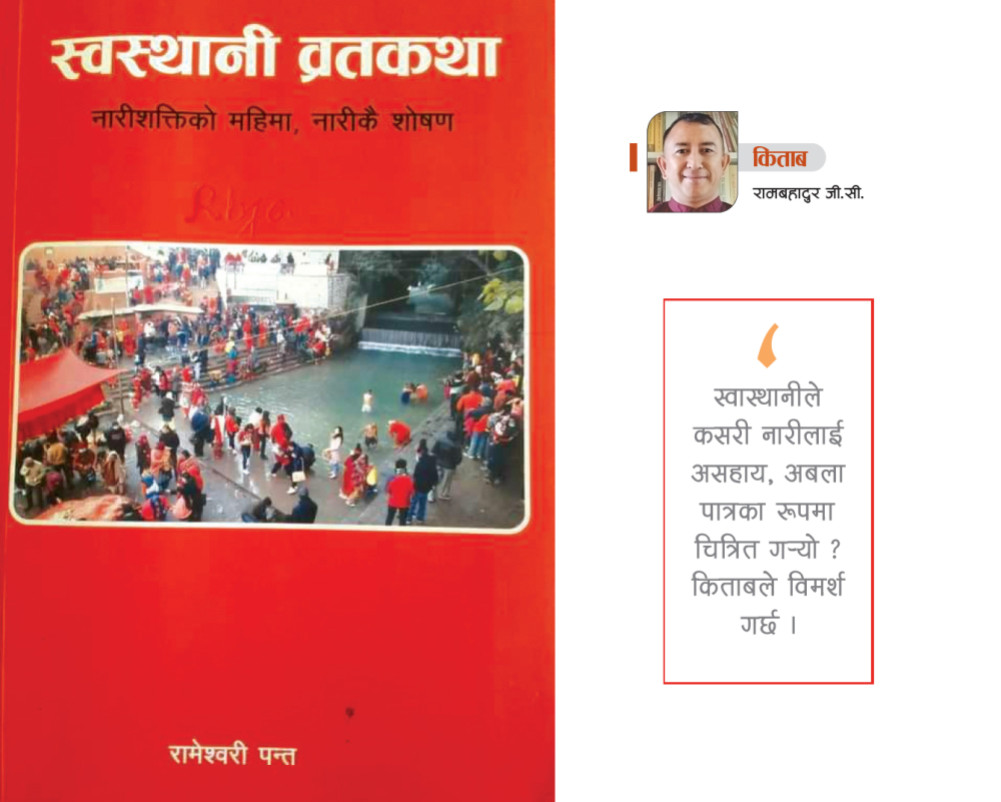
How did Swasthani portray women as helpless, helpless characters? The book discusses.
We use Google Cloud Translation Services. Google requires we provide the following disclaimer relating to use of this service:
This service may contain translations powered by Google. Google disclaims all warranties related to the translations, expressed or implied, including any warranties of accuracy, reliability, and any implied warranties of merchantability, fitness for a particular purpose, and noninfringement.
Author Rameshwari Pant's book 'Swasthani Vrat Katha: Glory of Nari Shakti, Exploitation of Women' has discussed many characters of Swasthani Granth. She has a different view of the characters Goma, Shiv Bhatta, Shivsharma, Navaraj, Satidevi, Parvati, Chandravati, Brinda, Shiva, Vishnu, Jalandhar, Indra and their antagonistic - unnatural characters and roles.
He has written this critical book after visiting Sankhu Shalinadi in Kathmandu and other religious areas, observing and interacting with the devotees and local people. In Swasthani story, Swasthani Parameshwari, that is, women's power is glorified, but how did the male character described in the story behave unfairly and insensitively towards the female character? How did the patriarchy, in a well-planned, conspiratorial way, create various religious texts and scriptures including Swasthani, and continue to discriminate, exploit, oppress and oppress women?
How are women portrayed as innocent, helpless, weak and innocent characters? If Katham raised his voice against the unjust and cruel actions that were done to him, and raised questions, how did the male power try to humiliate and disrespect the public by calling them 'undisciplined', 'loose', 'shameless', 'mukhale', 'besomati' and 'slutty'? ? The book has debated these and similar questions.
The author has brought the praise and idealism of the character described in the story into the circle of debate. She has played a leading role in the awareness campaign to shed light on its mystery and reality by saying that it is not so. The
author not only raised the critical subject but also said that the illiterate mothers, sisters and daughters of yesterday have developed the feeling of becoming literate, learning, teaching and showing curiosity due to the custom and tradition of listening to and narrating fasting stories. The author claims that Swasthani vratakatha is a mirror of the society of that time and it has exposed the social mentality of the society four and a half hundred years ago. However, the author is also of the opinion that a fictional story with the coating of religion is a poisoned bread made of a psychological pattern that is considered to be true and real.
Swasthani vratkatha gives support to child marriage, discordant marriage, polygamy, coercion and fraudulent behavior and covers it with a religious velvet veil, the author insists. It can be said about the insistence and foolish idea that 'since the healthy fasting story was prepared in the conditions and consciousness of that time, take it in the same way, interpret it and do not comment otherwise' - as if that kind of thought flowed in yesterday's social system and consciousness, but in today's situation and consciousness, it is also in the same form. taken, idealized and not appropriate to follow and not timely.
Actually there are many good aspects in the festivals and rituals under our Eastern philosophy and tradition. One should be able to unhesitatingly reject the negative aspects, unscientific and superstitious messages and customs within them without compromising on following and assimilating the life-giving, positive and scientific aspects of it. This book is therefore readable and collectable.