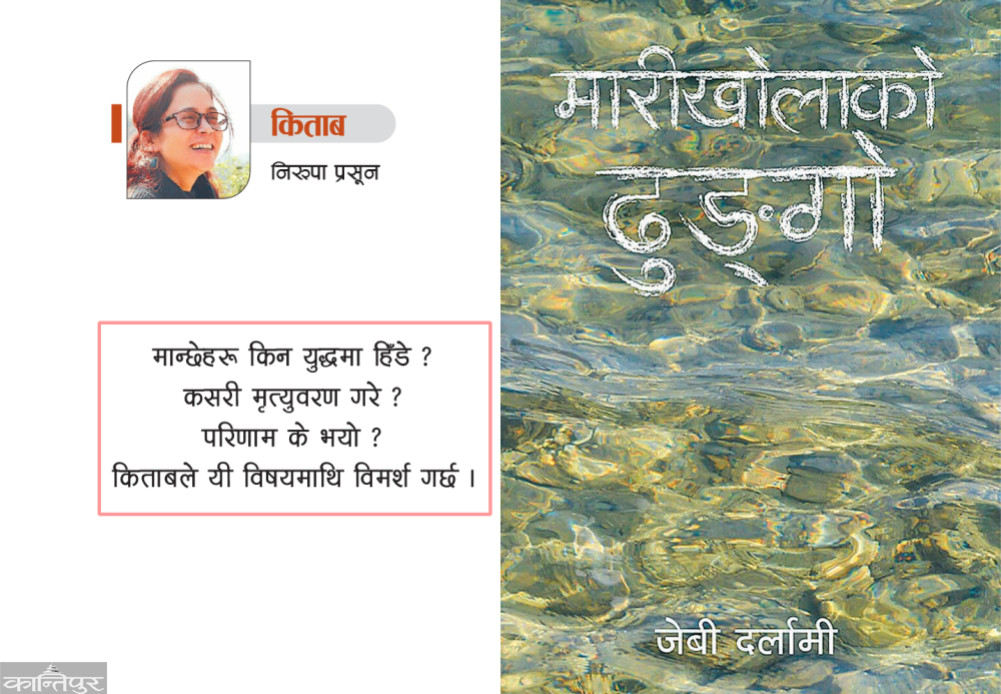
Why did people go to war? How did you die? What was the result? The book discusses these topics.
We use Google Cloud Translation Services. Google requires we provide the following disclaimer relating to use of this service:
This service may contain translations powered by Google. Google disclaims all warranties related to the translations, expressed or implied, including any warranties of accuracy, reliability, and any implied warranties of merchantability, fitness for a particular purpose, and noninfringement.
"After time, the thing called laughter is disappearing somewhere!" "War does no good to anyone, except the merchant who sells arms."
These are the lines of writer JB Darlami's new novel 'Marikholako Dhungo'. While reading the novel, the history and that time that fades with time comes fresh. It is a narrative, but more than a narrative it is also a history book. The book describes the events of that time in the rhythm of the narrative.
The language of the book is smooth. The vernacular style has made the novel simple and readable. The ups and downs, despair, hope, fear of death, the way the protestors, the common people and the ruling party suffered during the war, have been captured in the novel through the characters and environment. The
novel is not biased against anyone. Earlier, novels or stories written in the background of mass movements advocated one side or were under the political influence of one. The beauty of the novel is that - fairness. In the
novel, it is not shown that only revolutionaries get martyrdom. The victims are only the Maoists, it is not presented in any way, there is good faith towards the army-police as well. It is also mentioned how the ruling party killed the children of common people by calling them 'Maoists'. How did the protesters torture and kill the common people? Did you suffer by raising donations? Along with that, it can be said that the author has written the novel by studying it from two sides, as the topic of rape and killing of innocent people's daughters by the army-police is also mentioned.
vs. Finally, in the fire of the revolution that was sown in 2052: 'The comrades who left everything and walked away carried greed with them.' This one line seems to carry the whole reality. The author has presented a lot in few words. A novel of one hundred and thirty-four pages manages to occupy the whole. The 'punch lines' are great too. The 'turn and twist' of the novel makes it happen. The
novel has a strong presence of the main or representative character 'Comrade Alapatra', another 'Meera Bhusal' and supporting characters. The novel is presented standing on the ground of reality. In the desire for change, the character who 'leads' the movement by holding Jiuzyan Dharap for rebellion against the monarchy is dismissed as incompetent in the end. The novel is successful in portraying the character's mood or the reality of those who participated in the movement at that time. How did people join the Maoists? How did you die? How attracted? What happened later? The author has discussed these topics. It takes courage to write so thoroughly about a movement that has a long history in Nepal's politics.
'Marikhola's stone' This is the story of the time before the people's movement of 2062/2063 - when the Maoists started a war to remove the monarchy, started a campaign from village to village to establish the republic, the story since then.
Maoist was born with the original slogan that 'every person's rights and roles should be equal', 'the gap between the rich and the poor' should be bridged, and 'caste discrimination should be abolished'. Has it been achieved? Lost yesterday's commitment? What benefit did the country get by sacrificing thousands of innocent people? "Marikhola's Stone" has asked for answers to thousands of such questions. Overall, the novel is a document of a bygone era. As written on the last page, this novel is not only a story, but also a curious and mysterious art called a story.
When reading the book, it seems that the author of this novel, who writes outside of Kathmandu, did not come to writing only because of passion.
Many thick novels are written, but this short book is tight and strong, it is not scattered in stories-substories, unnecessary things are not written, so it is a complete novel even though it is small.