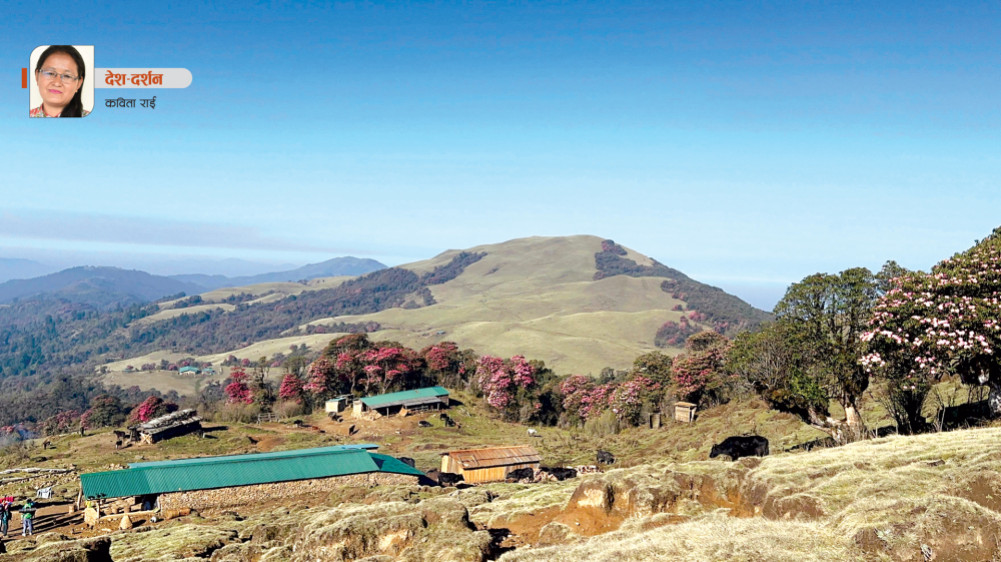
The Nachhongs come out of the bay singing the Mundum, follow the Arun-Koshi, stop at Khuwalung, and pass through the head of Silichung to Ninamma.
We use Google Cloud Translation Services. Google requires we provide the following disclaimer relating to use of this service:
This service may contain translations powered by Google. Google disclaims all warranties related to the translations, expressed or implied, including any warranties of accuracy, reliability, and any implied warranties of merchantability, fitness for a particular purpose, and noninfringement.
With the beginning of the year 2081, the former Minister of Culture, Tourism and Civil Aviation, Sudan Kirati, went on a spring trip. On the trek to Bhojpur, Khotang, Solukhumbu. I also did the Chakhia-Silichung Mundum footpath in that team.
After reaching Kathmandu after the Mundum Padayatra, Sudan Kirati submitted a proposal to the Minister of Culture and Tourism for the development of 'Three Doors, Nine Keys'. That is, Raithane's concept of tourism development should be linked with art and culture.
Why did Kirati call this journey Basant-Yatra? Perhaps he went on this journey for refreshment or to keep in touch with the people and the youth and to accumulate strength? Rajan Sameep and Karan Mukmin inspired me to go on this journey. I thought I should visit Silicung once in my life. As a child, we heard strange myths about Salpapokhari and Silichung. For example, "There is a ladder to heaven at the top of Silichung," "Whatever you ask for with Salpa Pond, it is fulfilled," "Dhami drums, jhamta, tapri, etc. placed in Salpa Pond, which has no spring and outlet, come out into the Irkhuwa River," and so on.
Salpa and Silichung are places associated with Kirati myth and Mundum. Our Mundumi Nachhongs come out of the ocean singing Mundum – follow the Arun Koshi, stop at Khuwalung and climb up through the head of Silichung to visit Ninamma (sky – the so-called heaven). These are the beliefs and faith of Rai Kirati. While some Mundumi Dhami are sitting in Dhami Than, while singing Risiya, they sing, "Lu Hai reached the bottom of the sea, Luhai Khuwalung arrived, Lu Hai Salpa reached, Lu Hai Silichung Chadhiyo" and the canchiris burn incense. That's why some rude old men tease Nachong by saying, "How much is the price of salt in Chatara, how much is the snow falling in Myung?" However, the lifestyle, social and community system of the Kirati community is governed by the risiyas sung by the Nachongs. This path is called Mundum Padmarg because those Nachhongs are the way to spiritually travel to Mundumi while singing Risiya.
Experts have suggested a minimum package of 12 to 14 days to trek from Kathmandu and return to Kathmandu. However, our travel plan starting from Bhojpur was for a maximum of five days. Our journey started from Chakhiya.
On the first day, we stayed at Myeung Gothstay. We could not see him because we were angry. By the time we reached Myung, it was raining with wind. Different colors of guras, chimals and other wild flowers made the road beautiful.
On the morning of the second day, the weather opened up all around because of the overnight storm. We got to watch the sunrise from the heights and watch the rays of the sun dance on the beautiful, huge duck pond.
The toughest journey of the trek was said to be on the second day. However, it will not be noticed that the path is cut by the blooming gurans, chimals and many wild flowers and nearby snow chains. Satdobato will be reached after walking for two hours from Mayung. There are beautiful mountains and wetlands in Satdobato. After an hour's descent from here, you will reach the sandy Bhanjyang. Everyone has their second day's breakfast here in the sandy Bhanjang shed.
The stairs starting from the sandy Bhanjang are tough. After going uphill, he had to go down again to reach Heku, and he laughed. After reaching 3000 meters, the under construction road of Mundum Trail ends. Following the old main road, you have to go uphill.
is everyone's way to eat sato laurevir. As steep as a stick. You will be hungry and thirsty, no matter how much you walk, you will not be able to do it. He said that the road would be cut and another hill would start again. If you fight, the chance of survival is low, this road is a bumpy road that makes everyone feel bad. After climbing one step, many sticks and baby clothes are found on the hill. It will take about two and a half hours to cut Laurevir at a height of 3626 meters.
When Laurevir came out on the hill, he was angry and even the day was like night in the light. After going down two hundred meters, four long picture sheds were seen on the road. The team going ahead has chosen their accommodation in the first shed. We went towards the back looking for a spacious shed that could accommodate fourteen of us. It was spacious, less windy. Sudan Kirati lit the fire with great difficulty. He spread the silk of Malingo and put the image in the barn on it.
The third day's journey was said to be smooth and short. After drinking the cold water of Rawadhap, we started down at 6:30 in the morning. Rawadhap, with its dead old sage trees and abundant water springs, seemed to await a beautiful civilization. After coming down from there, you can see the beauty of Mundhumpokhari and Hadi Pond a little below through the 3213 meter high mane. After walking for half an hour from Mundum Pond, Salpa Exit was found.
The road going up from Salpa exit goes up to Silicung tip. However, it was not so difficult to walk on the road covered with large piles of hailstones frozen into snow, kingdom of crows and chimals, damp and thick fog. There was a herd of chaunri grazing in the valley below.
Kulupangkho is a historical Bhanjyang, which is touched by Bhojpur and Solukhumbu. In 1953, the team of Tenzing Norgay Sherpa and Edmund Hillary, along with the porters, entered the summit of Mt.
We went to Salpa Basecam from Kulupangkho. Now the challenge was to climb the 4 thousand 155 meter Silichung. Many people are returning from the halfway point. It was a very steep and small stony path, if you climb it, there will be nothing left. A young daughter was also on the trip, which added to the worry.
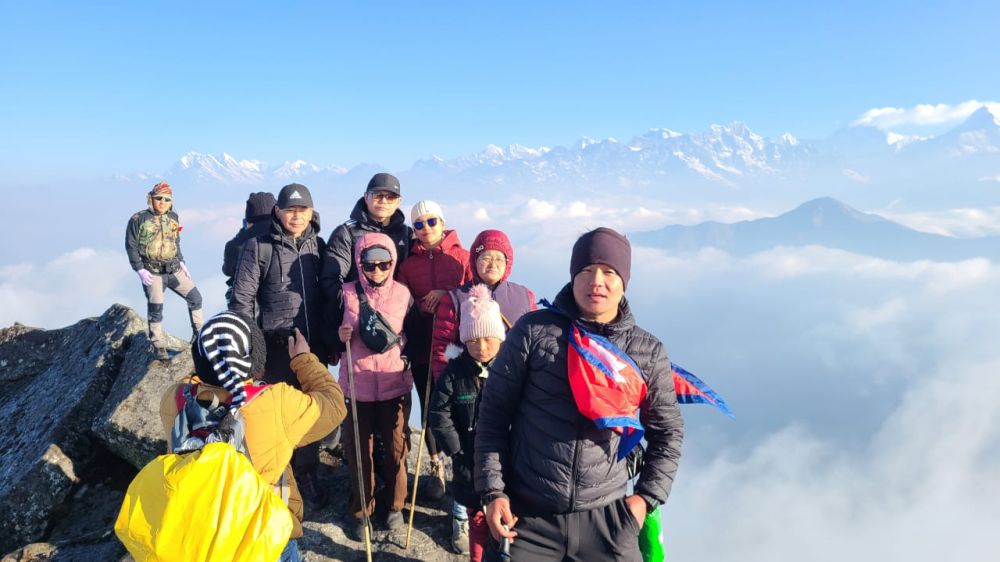
On the fourth day (May 7) at 2:24 in the morning, we left Salpa Basecam for Silichung. The statue of Sumnima-Paruhang was being replaced and unveiled in Silichung – by Sudan Kirati. The team started at 6 am.
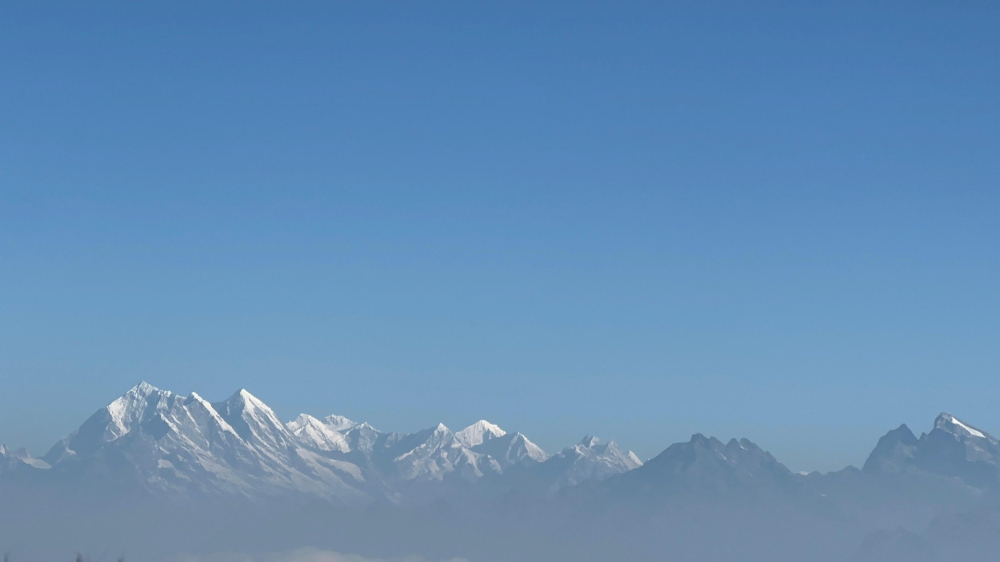
As difficult as height is, everyone likes to be tall. It was not possible to fulfill the desire to pick the high-quality vegetation Sunpati, Bhairungpati. The bird and its nest could not be seen. Deer and Ghoral jumping in Bhir could not be seen. There was no ladder to heaven. It was a pleasant feeling. We were above the fog. In front of the eyes were - Everest, Makalu, Kanchenjunga and other snow ranges. Below us were many other mountains, spits and human settlements. The feeling of victory of climbing Silicung without being affected by the sudden cold wind was thrilling.
After half an hour, we slowly made our way down the downhill path of Bhir. We visited the Salpa pond in the lap of Silichung. We participated in the opening of Nachong Park. On the fourth day, we stayed there and on the fifth day, we returned to the headquarters by car via Tenzing Hillary Marg. After some meetings and discussions with the youth, the former minister's team returned to Solukhumbu.
There were many difficulties and hardships in the journey. Thirst-quenching water is not available, toilets are required at certain distances. Mobile network does not work well along the trail. The stay is not safe, it is difficult to walk in small groups. If there is a health problem, there is no cure. However, from the point of view of ecology and tourism, the Mundum trail is really beautiful.