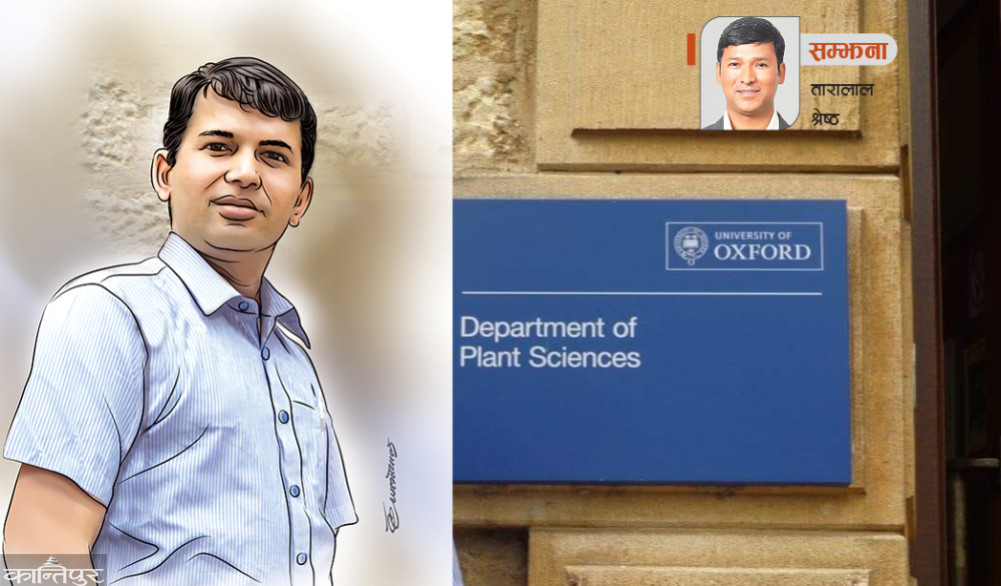
A professor has now become history, why does the obituary of that loved one feel like my own obituary?
We use Google Cloud Translation Services. Google requires we provide the following disclaimer relating to use of this service:
This service may contain translations powered by Google. Google disclaims all warranties related to the translations, expressed or implied, including any warranties of accuracy, reliability, and any implied warranties of merchantability, fitness for a particular purpose, and noninfringement.
23 Baisakh 2081. I left the phone and went to university. It was late at night when I returned home. Professors, Journalists, Multiple Miscalls of Cyclists. I hurriedly make a few calls back. Unpleasant news: Dr. Govind Rizal dies in Kirtipur bus accident.
Bicycle friend who always pedals, passed away in a bus accident? The body became pale. I called Govinda's phone asking who to call. The bell kept ringing, he didn't wake up. Who had the dead friend's phone set? Cyclists often carry phones in their bags. From my room, the scene looks like under the window, where I can see the hustle and bustle. I reach the scene.
I see Govinda's bicycle safely inside Tribhuvan University as usual. We often used to come back after having lunch there. He used to go to Baniyantar riding a bicycle. I used to pedal towards Kirtipur Fort.
The police were investigating. The uncontrolled bus came to the gate and overturned. Saying that he will run away, he presses Govinda at the gate of the Trivi Ayurveda Research Center. He came for tea after the last class of the semester, with a cycling friend who met physically after 20 years. I will search further. The police asks: Who are you from the deceased?
Time travel
Puran Pokharel, who was carrying Govind's 'Foreigner in Paradise' autobiography, arrived in panic. Puran wanted to meet the writer even after death. Going with him to the trauma center. Wind is blowing, light. Along the way I go back to the history of relations with Bhutanese refugees, like a time traveler. The
is around 2004. During the Vidyavaridhi investigation, the refugee issue dragged on. I found out that there are many Bhutanese refugees in Kathmandu. Rise up with them. It was felt that we should cooperate with the struggling subaltern community, we should help the liberation movement of the oppressed, otherwise Bhat intellectuals will become like parrots of the elite. I started going to Sutuk refugee camp without even letting supervisor Abhi Subedi know. I used to earn good money by teaching. I would fly to Bhadrapur and then walk to the refugee camps. There was no preplanning where to go, whom to meet, where to stay. When I was on leave, I would go to the camp. Dasain-Tihar, Barkhebida was spent there.
2007 classmate Muktinath Ghimire handed over the manuscript of Teknath Rizal's 'Palace to Prison'. At Teknath-Nivasa Lalitpur, we used to recite manuscripts all day long, like a pandit reciting a Purana. Teknath would listen and respond. We would correct. That book was not printed in quality. Teknath started writing another book, after 'Nirvasan', 'Torture Killing Me Softly'. I volunteered and helped as much as I could. I could see that Teknath's relationship with the camp was becoming distant. Govinda used to help Teknath.
I wrote the novel 'Sapnako Samadhi' while running a refugee camp. Govind along with Shanta Karki is doing a post doc in the Philippines after completing his studies in Japan. He is reading books written on his community immediately. He also read my book. Our relationship deepened from the virtual meeting. Books began to be discussed. I was editing the book 'Sakshi' by YN Chaulagai, after Shivlal Dahal's 'Albida Beldangi' and Om Pokharel's 'Silhouette of Truth'. I have sent a PDF of the manuscript. Govinda's response was printed in the blurb of 'Sakshi'. Dr. Govinda Arrived in Kathmandu with peace. Mandala Theater held a debate on refugee-focused literature at Anamnagar. My first physical encounter with Govinda-Shanta took place in Mandalay.
editing relationship
I used to tell Govinda to write something in his free time. I thought that an agricultural scientist would write something about agriculture. One day Govinda came to Kirtipur. Handing me a manuscript of 200,000 words, he said, 'You have to edit it, how much do you charge?'
I got emotional. A refugee post doc is staying in Nepal, renovating a hut in Beldangi. When there are difficulties with travel documents, the Ministry of Home Affairs, sometimes the Ministry of Foreign Affairs, comes to the rescue. Seeks access to the inaccessible like me. No solid job. If you are married to a Nepali, it is not possible to get Nepali citizenship. Nor is it easy to become a resettlement. He was telling me how much money he would take. Yet Govinda lived a civilized, magnificent life, a vibrant personality who triumphed even in defeat. That is why he called Nepal the golden land, himself a foreigner.
"Rather than taking money from you, he hanged himself from that tree and died," I pointed to the tree near Mangal School. He was shocked. Someone talked about asking for huge sums of money when talking about editing. The 1200 page manuscript was not finished. I gave Naveen Tiwari, a student, to proofread the manuscript. After taking a long time to edit, we went to Bhainsepati to meet artist Sharad Ranjith. He made the cover art. We published 'Foreigner in Paradise' from New Delhi. We sent thousands of hardbound books abroad. I helped edit half a dozen books of refugee friends. Govinda's book made him proud. Our relationship has always been unconditional: pure, simple, beyond the influence of selfishness.
The story of the book
Spouse Shanta Lokseva fought and became joint secretary, Kirtipur Horticulture Chief. Govind used to come to Kirtipur with Shanta. He started temporary teaching at Kirtipur University, lived in Baniyantar. He bought a bicycle like mine and started riding. We formed the Cycle Culture Community. Selflessly made time for cycling events, despite his busy schedule. We used to chat for hours in the same Ayurveda canteen. There was never any difference between us during the decade and a half of association. There would be arguments, and it would end in a gentlemanly agreement. He was my mentor, I was his. Readers, editors all. I was again allowed to read the Bhimkaya manuscript of Bhutanese history.
We were discussing that manuscript. It got ugly, it was a matter of pruning.
Govinda was very touched by the issue of caste. My book 'Baljharina Past and Tangled Present' has touched me. They are bent on translating it into English. A thick book, tangled in the middle. He said that he could stay with me for a week and translate. The translation campaign was also incomplete. Govind wanted to co-author some books with me. We drew up a blueprint for co-authoring. One of them was Dr. Biography of Bhampa Rai. It was agreed to go to the camp and write the biography of Bhampa. Viren Magar has already started work on Bhampa's biography. We stopped. I realized that I had to dig a lot before Bhampa passed away. After the biography was not published for years, we got together again. Talked to Bhampa. Bhampa said let's co-write in agreement. Prakash Angdembe also wanted to help. Viren did not accept co-authorship. We did not intervene, we retreated. We kept talking about Bhampa's biography.
and shock The
storm was trying to move. We rushed to the trauma center. When we reached the hospital gate, it started raining. Some professors were at the hospital, and bicycle friends. There were no Bhutanese. Govinda's spouse was taken home by relatives in an unconscious state.
The police were looking for relatives to understand the death certificate of the deceased. I said 'I understand the obituary of the deceased'. The police said, 'Who are you from the deceased?' They said, 'I am the closest friend'. The police said 'no match'. Relatives are in America.
The spouse is not in a position to understand the obituary. I am not considered a police officer to issue a death certificate. Instead they kicked us out because it was crowded.
We're back inside. Bicycle friends who have just met Govinda have come.
We requested the policeman with the death certificate that we wanted to see Govinda's face. "He is that, see for yourself," he said. We went inside, lifted the cloth and looked at the friend's face.
Bicycle friends started crying. A more integral friend of mine, with whom I never had a selfish relationship. We cried a lot watching her innocent face.
Govinda was limited to memory. He became history in the canteen of the same Ayurveda center. The out-of-control bus overturned right up to the gate. Friends standing together ran away. Govinda did not run away. The bus hits him badly. The three of us met, but while Govinda was still fighting, while he was burning at Aryaghat. It was our dream to run a
intellectual cycling campaign. He was my only cycling friend in a huge university like Trivi. which became history. I am crying, crying like a helpless one. Why is the obituary of a foreign professor feeling like my own obituary? Am I not as good an actor as him? This is what the crowd at his funeral was saying.