The cultural thinking called 'Aputo' has not only damaged men's psychology, but also brought idolatry to the family and society.
We use Google Cloud Translation Services. Google requires we provide the following disclaimer relating to use of this service:
This service may contain translations powered by Google. Google disclaims all warranties related to the translations, expressed or implied, including any warranties of accuracy, reliability, and any implied warranties of merchantability, fitness for a particular purpose, and noninfringement.
A decade ago, another writer Rajan Mukarung, who is leading a literary movement in the release of 'Lato Pahad' collection of stories, pointed to the danger of Upendra Subba going to the cinema in the hope of gaining more fans and giving up writing stories. As Mukarung assessed, Subba had not written new poems and stories for a long time.
On the other hand, with the commercial success of the film 'Jari', the directorial challenge and additional responsibility came on the shoulders of Upendra Subba, which he is testing with the new film 'Mansara'.
It is not possible with an artistic mind to tell serious issues by showing the face of a simple story. Cinema is a visual language in which the audience can be guided to the thematic seriousness beyond the scene through allusions and casual dialogue. Upendra has given a meaningful message right from the cinematography to the selection of characters. He realized that Mansara, a variety of rice which does not grow well when planted alone, grows well when planted with others. The rice that grows independently needs the help of others. Upendra, who was looking for a suitable medium to depict the story of a mixed society like ours and the love of men and women together, came across Mansara. 'Mansara' has symbolically expressed the squeeze that is respected and strengthened only by the relationship between individuals in the discipline of the family and the practical chemistry between the community and the society with freedom. It is time to reinterpret our social attitude towards the problems, needs and ideology of 'single mother' in the changing time frame.
Tests of sexual ability and the desire for progeny for progeny exist in all human societies, perhaps. In Nepali society, there is a cultural tradition that the need for children is more urgent. Mansara tells Dadhiram - 'It's not easy to be a father-in-law, Baje ∕' Dadhiram has a question in his mind - 'Is son-son only a blood relation?' Dadhiram chooses this question as a momentary peace of mind. There seems to be an insatiable flame burning in his heart, which no mere verbal reparation can give lasting peace. Is he alone to blame for Dadhiram's mood when he got married again because he was childless? It is said that man's consciousness is created through his social relations, there is no such thing as self-created consciousness. Whatever he thinks, his background is rooted in social thought. Dadhiram Pokharel's mental pain of being childless is not only responsible for his physical strength-weakness in the graph. The 'cultural' thinking of one's own community is primarily responsible. In the patriarchal Hindu society, it is believed that not only is there no lineage extension without a son, but also that the ladder to 'heaven' will collapse if the son does not contribute after death. And, in a way, the very existence of being human can be marked. The psychological impact of being a 'puto' makes a man a failed husband and a failed son Dadhiram's eligibility speaks that even
is painful. This rite has brought idolatry not only to one's personality, but to the entire family. The argument between Dadhiram and Nanimaya over the name of the son born in the future and Dadhiram's parental attachment to the younger Mansaraputra with extra affection seems to be dominated by 'improper' psychology. Even today in the society called modern era, this movie has raised an indirect question about the fact that everyone is suffering due to our cultural thinking. ``Mansara'' makes us think about our attitude of worrying about the rotting of flowers and leaves but ignoring the roots of worms. The
of 'Mansara' is another topic that can be discussed - love. Love is taken only as sentimentality and its ideological aspect is neglected. Not only this, love is seen only from the perspective of marital needs. Cinema also leads us to review this narrow vision of ours. Mansara says - 'Sayavati's poi can be. But, it is difficult to be a lover, Baje ∕' Mansara, who is happy to have found a kind neighbor who reads, says after seeing Dadhiram's behavior - 'But, Baje, you turned out to be sick like other men. Well, what do men see in women's bodies? She hates herself for being a woman. Anger comes.' Mansara's conclusion is that although food and love should not be adulterated, men bring a lot of adulteration. The angle that boys who look at girls only through the eyes of sex, do not understand real love is very poignant.
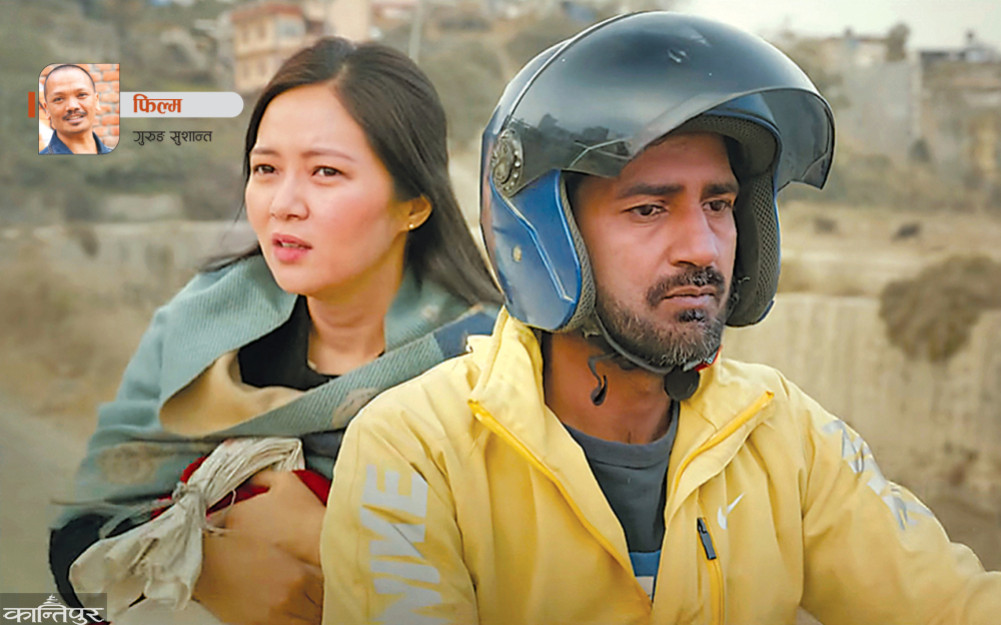
In the commercially successful 'Kabaddi' series, especially the acting of actor Dayahang Rai, it can be considered natural that the audience started to complain about monotony. Reason - Although the time context of the cinema was different, the eligibility of 'Kazi' was the same. Dayahang got an opportunity to break that monotony in 'Mansara', which it feels like he made full use of. Due to the deep influence of Mundhum on the qualifications of the manang he plays, most of his dialogues and thinking style seem poetic. The difference in eligibility of Dayahang from other films has added a different flavor to 'Mansara'. Miruna Magar seems to be working hard to excel in acting as before. Miruna's struggles with entitlement, her courage to stand alone, not only the hardships of single parenthood, but her views on love and men from the vicissitudes she has gone through are very meaningful. Let's say - Mansara is expressing a very serious philosophy in simple language. His acting is so natural that the audience laughs and cries spontaneously. Praveen Khatiwada is another actor who acts in such a way as to make the audience burst into tears without realizing it while laughing with laughter. Some people can call Praveen 'bold' after watching the scene of Sambhogarat Dadhiram. However, just saying that is not enough. It would be appropriate to call his acting-art a strong pillar of 'Mansara'. The character played by Praveen in this film can be remarkable in his film-career. Menuka Pradhan's acting rhythm should be appreciated as it is sweet. However, Menuka's 'dialogue delivery', who handled the character of Jhokki and loving Nanimaya very skillfully, who does not shy away from not only arguing about her existence with the man, but also touching each other, shows the unnaturalness of love in one place. Actors Hemant Budhathoki, Jeevan Baral, Kiran Chamling Rai, Anil Subba, Manhang Lavati and others have done a sweet job, along with child actor Nenahang Rai who appeared in the role of Tancho. Although Upendra Subba himself is a humorous character, his role helps to explain the difference between two different cultures. Literary buffs will welcome the addition of poet Biplava Prateik and singer Satyaraj Acharya as acting bonus. Overall, there is no doubt that the entire group of actors will be loved by the audience from the acting angle.
The pace of the 'first half' of this movie may seem a bit slow as attention is paid to small detailing. The connoisseur of 'art movie' has no complaints about it. If the slow pace is accepted as Mundhumi rhythm, the pace after the 'second half' keeps the audience fully engaged and moving along.
Apart from the issue of getting citizenship through mother's name, this movie ignores another aspect - politics. What has been cleverly done is to briefly indicate the current environment from some headlines of the newspaper. It was a time when the interim constitution was in effect but the new constitution was not made, especially when the caste fronts had intense discussions. Judging by the age of the younger one, when Manang and Mansara fell in love and sang Palam, civil war was going on in the villages of Nepal. When the country's politics is at a critical juncture, every section of the society is affected by it. The eastern hills were also not beyond the influence of that war. However, cinema is mostly silent on this. The
director's focus seems to be on culture rather than politics. He has to show the cultural differences between the Bahmanas and the Limbus. Bringing forward symbols like cow-buffalo and pig, dung and lidi, janai and palam, khuwa and tonga, alcohol and milk, breaking the commentary of binary opposition, he says that these are only cultural differences with freedom. And, it has to be proved that co-travel is possible only by respecting each other's culture. Wine and milk have their own importance. It has its own distinct existence. However, if you try to mix it by force, neither the originality of the alcohol remains, nor the purity of the milk. Dadhiram and Mansara have been communally tangling with each other and the mutual support of being good neighbors continues. This is where the originality and complexity of our multicultural society is seen. It is called
, cinema-literacy is very low in Nepali society. Cinematographers complain that most of our cinema scripts are weak. In spite of having a good reputation in the literary circle, giving fake feathers and additional praise to the director who is making an honest effort to say his words through cinema can ultimately be suicide for Nepali cinema. However, this much can be said - Upendra's work has given a glimmer of optimism in the market-oriented crowd that makes formulaic films by counting songs and 'fight' numbers. We have very few directors who do such work.
There is always a challenge to get the timing right, especially because of some of the technical complexities of cinema compared to written narratives. Since in writing the scene is depicted with words, the story develops in different 'settings' according to the imagination of the reader. However, in cinema, according to the director's thinking, the essence of the screenplay has to be tied to the same scene by the story, actors and 'setting' on the canvas captured by the camera. A competent director keeps the doors of imagination and meaning open beyond the gaps between the scenes shown in the cinema. Using the poetic facility of being a poet, the director can take us beyond the scene in this cinema. While watching a movie, most places feel like we are meditating on the flow of some beautiful music. The audience who watched 'Manasara' will surely say that Upendra Subba really passed the test this time. The whole 'team' who made a beautiful and rhythmic movie like Palamkai Rhythm deserves thanks.