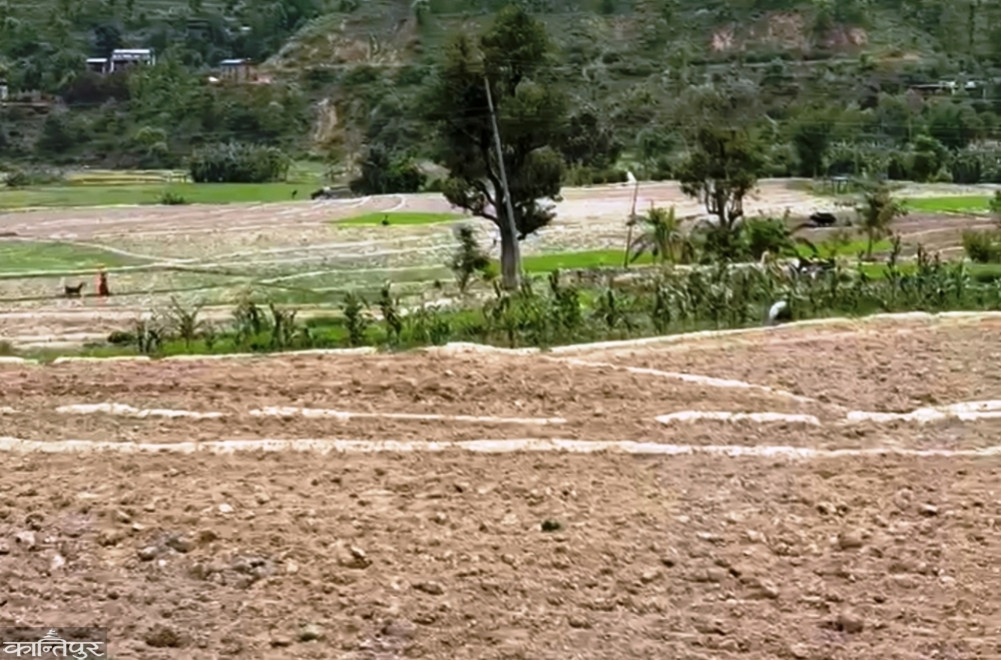
Due to insufficient rainfall, the fields that have been plowed and prepared for planting are about to turn into dust.
We use Google Cloud Translation Services. Google requires we provide the following disclaimer relating to use of this service:
This service may contain translations powered by Google. Google disclaims all warranties related to the translations, expressed or implied, including any warranties of accuracy, reliability, and any implied warranties of merchantability, fitness for a particular purpose, and noninfringement.
Till Asad, only 80 percent of Salyan's fields have been sown with paddy. Due to insufficient rainfall in various places in the district that do not have irrigation facilities, paddy planting has not been done yet.
The fields around Bangad Khola in Bangad Kupinde Municipality, Deval in Kumakh Rural Municipality, Sukekhola, Pedikhola, Kapurkot in Sharda Municipality and some places in Kalimati Rural Municipality have not been sown yet.
Due to insufficient rainfall, the fields that have been plowed and prepared for planting are about to become dusty. The paddy beds kept by farmers in the fields have been torn up. Farmers are worried that the beds will be wasted as they will not be able to plant them until the seedlings grow.
Kriti Bahadur Rana, who has a farm of more than three ropanis in the vicinity of Bangad Khola in Bangad Kupinde Municipality, said that he was unable to plant crops due to the drought. ‘They have planted crops near the source of Bangad Khola, so they have applied water to the fields.’ The rivulet is dry because the water is not flowing, how can they plant crops?’ he said. ‘The fields that were ploughed and prepared are only dust.’
Nev Bahadur Bista, a local from Sharada Municipality 5, who has a farm of four ropanis in Sukekhola in Sharada Municipality 3, said that he was unable to prepare for planting even until Asad due to the late arrival of the monsoon. ‘The paddy has grown and the fields are ready for ploughing, but due to the lack of rain, he was unable to plant crops.’ The canal for irrigation is not working. It is not possible to sow until it rains,' he said. 'Last year too, the paddy was wasted due to lack of timely rain. This year too, there is a worry.' He is worried that he will have to buy rice like last year because he could easily feed a family of five for four months with 12 bushels of rice grown in a 4-ropani field.'
Karna Bahadur Rawat of Deval in Kumakh Rural Municipality said that not only his village but also everyone in the village is facing problems with sowing. Last year, sowing was completed in the third week of Ashar, but this time it is raining. He said that due to lack of sufficient water in the canal, it is necessary to wait for a week for sowing.'
Kamal Bohara, agricultural technician of Bangad Kupinde Municipality, said that 50 percent of the 889 hectares of fields in various places of Bangad Kupinde Municipality could not be sown due to lack of sufficient rainfall. He said that even though the Bheri River is about 500 meters below the place where the fields are located in Bangad, they have to sit and watch the sky due to the lack of water supply facilities.
Suroj Kunwar, head of the agriculture branch of Kumakh rural municipality, said that the drought from Jestha to the second week of Asard has delayed sowing in various parts of Kumakh this year. He said that 30 percent of the fields within the municipality are yet to be sown.
Mahesh Acharya, head of the Agricultural Development Office, Salyan, said that due to the late rains, 80 percent of the 6,059 hectares of fields across the district could not be sown by the end of Asard.