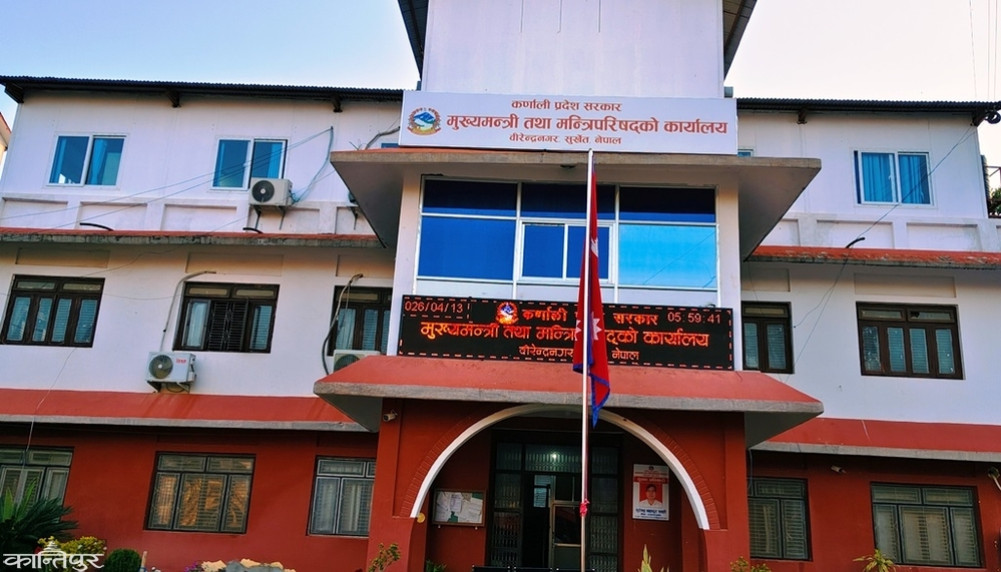
The government claims that the budget expenditure has been reduced due to a shortage of technical staff, the Genji movement, the House of Representatives elections, a shortage of construction materials including bitumen, and a rise in fuel prices.
We use Google Cloud Translation Services. Google requires we provide the following disclaimer relating to use of this service:
This service may contain translations powered by Google. Google disclaims all warranties related to the translations, expressed or implied, including any warranties of accuracy, reliability, and any implied warranties of merchantability, fitness for a particular purpose, and noninfringement.
The Karnali provincial government has barely spent 62 percent of the budget in the current fiscal year. The Karnali government, which brought a budget of 33.19 billion 3.655 billion rupees, has been able to spend only 20.57 billion 12 million rupees (61.97 percent).
The government claims that the budget expenditure has been reduced due to the shortage of technical staff, the Genji movement, the House of Representatives elections, a long-standing lack of coordination between the federal and provincial governments, rumors of a change of government, shortage of construction materials including bitumen, and the increase in fuel prices.
The government, which spent 64.18 percent last year, had spent 86.24 percent of the amount in the fiscal year 2080/81. The budget was spent at a rate of almost 65 percent in the two years before that. Based on that, the government's budget has been lower this year for the past 5 years.
The Provincial Accounts Controller's Office has stated that Rs 12.62 billion 24 lakh has been returned to the Provincial Consolidated Fund in Karnali this year. According to the office, 73.48 percent of the current expenditure has been spent, while 55.74 percent of the development budget (capital expenditure) has been spent, informed Provincial Accounts Controller Ratna Subedi.
'If we compare the expenditure, more money is spent on salaries, fuel, maintenance, etc. than on the development budget every year,' he said. 'Development expenditure is also decreasing every year due to delays in ensuring the resources of the development plan, delays in authorization, confusion in the contract process, and lack of technical staff.'
Out of the Rs 12.59 billion budget, Rs 9.25 billion has been spent on the current budget and Rs 11.13 billion out of the Rs 19.98 billion has been spent on the capital budget. Similarly, out of the Rs 615 million budget, Rs 177 million (28.86 percent) has been spent on financial management.
Ministry-wise, the Ministry of Internal Affairs and Law has spent 93.67 percent of the amount and the Ministry of Physical Infrastructure and Urban Development has spent the least 49.20 percent. The Ministry of Internal Affairs has been merged with the Office of the Chief Minister and Council of Ministers since last Mangsir. The highest budget of 11.12 billion rupees was allocated for physical infrastructure. Out of that, only 5.41 billion rupees have been spent.
The ministry has allocated funds for 743 schemes, but has barely completed the work of only 100 schemes. The secretary of the ministry, Arjun Kumar Bam, said that progress has not been seen since many of the schemes are multi-year. Similarly, the Ministry of Water Resources and Energy Development, which has nearly 1,300 schemes, has also completed the work of only 700 schemes. It has been able to spend 2.91 billion (75.98 percent) of the budget of 3.83 billion rupees.
According to the Office of the Chief Minister and Council of Ministers, there is a shortage of about 28 percent of employees in Karnali, which has a staff strength of about 2,900. The shortage of technical employees is particularly high, said the Secretary of the Office, Laxmi Kumar BK. According to him, there is a shortage of about 40 percent of employees in the technical sector.
The work of the provincial government came to a standstill for about two months due to the Genji movement. The meeting of the Council of Ministers itself was held about a month and a half after the movement, and the reconstruction of the structures damaged during the movement has not yet begun. 38 government structures in Karnali were set on fire and vandalized. ‘The provincial government could not coordinate with the interim government formed after the agitation for almost 3/4 months, which also affected some of the work,’ said Karnali government spokesperson and Minister for Land Management, Agriculture and Cooperatives Binod Kumar Shah, ‘The festive season started immediately, then the federal parliament elections, which also caused some problems for the government to gain momentum, which was reflected in the budget expenditure.’ He said that even though the attitude of the employees was weak due to the agitation, it had some impact on the government’s work.
The government had barely implemented the budget of Rs 11.94 billion (36 percent) by the end of Jestha. In the month of Asad alone, it spent Rs 8.62 billion.4 million, and on the last day of payment, Rs 1.58 billion was paid only on Asad 25.
Former Deputy Secretary Khamba Prasad Thani says that the work was not achieved when the provincial government’s budget was spent only in Asad. ‘At other times, all the budgets are put on hold, the employees are also relaxed, only when Baisakh begins do they start implementing the plans,’ he said, ‘The provincial government has failed to implement the budget every year by making various excuses. This year too, the Genji movement was used as an excuse. The people have not been able to experience the provincial government due to the slow development and service delivery.’
UML and Congress have a joint government in Karnali. UML parliamentary party leader Yamalal Kandel was appointed Chief Minister on Chaitra 27, 2080. An official from the Ministry of Finance said that despite the occasional rumors of a change of government, the government’s work was affected for some time. According to him, Chief Minister Kandel had convened a meeting of all the heads of offices under the government in Shrawan last year to improve budget implementation and had signed a 10-point performance agreement with the ministers. Accordingly, the ministries had also signed performance agreements with their subordinate bodies.
Chetan Kumar Timilsena, spokesperson for the Ministry of Economic Affairs and Planning, said that there are problems in budget implementation due to lack of coordination between laws and programs, lack of coordination between the expenditure incurred by development offices on plans and their physical progress, failure to ensure timely resources for multi-year plans, and shortage of construction materials.