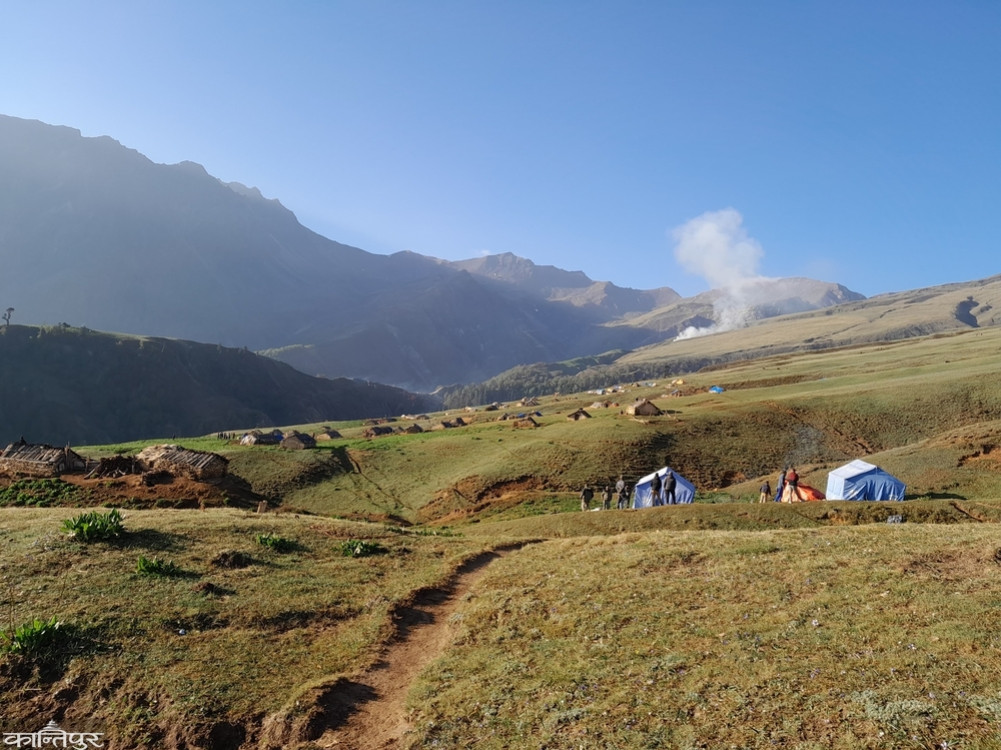
As annual Yarsagumba production declines, locals worry about their livelihoods.
We use Google Cloud Translation Services. Google requires we provide the following disclaimer relating to use of this service:
This service may contain translations powered by Google. Google disclaims all warranties related to the translations, expressed or implied, including any warranties of accuracy, reliability, and any implied warranties of merchantability, fitness for a particular purpose, and noninfringement.
It has been nearly two decades since 62-year-old Durgabahadur Budha of Khatyad Rural Municipality-3, Mugu, started going to various pastures in Mugum Karmarong Rural Municipality to collect yarsagumba. This year too, in the first week of Jestha, he went with his wife Shanti and sons Govinda and Prakash to the Thulo Koiki pasture to pick yarsa.
After walking for three days and reaching the pasture with supplies worth nearly 50,000 rupees, his family could not collect more than 210 yarsa in two weeks. They sold those yarsa right in the pasture at the rate of 1,000 rupees per piece and returned to the village in the first week of Asar.
“We risked our lives crossing rugged cliffs to reach the pasture, but even after four people searched for 14 or 15 days, we couldn’t find more than 12 or 15 yarsa a day,” he said. “Expenses kept rising, and since it became difficult to find yarsa even after wandering the pasture all day, we returned to the village in the first week of Asar.” He said it was difficult to earn even 100,000 rupees after deducting the expenses in the pasture. Last year, his family had earned 350,000 rupees from yarsa, and the year before that, they had earned 250,000 rupees.
His neighbor Padambahadur Budha also stayed in the pasture for two weeks with his wife Pabitra. After spending nearly 25,000 rupees to reach the pasture, the Budha couple collected 120 yarsa. “Some days we wouldn’t find even a single yarsa, and on good days, we’d find at most 8 or 10,” he said. “After most collectors started returning, we headed home too.”
Pabitra fell ill from the cold and was bedridden in the pasture for a week. “Above were only cliffs, below the Karnali River, and we had to clear snow to make a path to the pasture,” she said. “Production was low, and even then, we couldn’t find good-quality yarsa, so there was no option but to return home early.” Last year, they had earned 200,000 rupees from picking yarsa, but this year, she complained, they barely managed to save 80,000 rupees. As it became difficult to make a living from yarsa collection, for the past two years, she has been sending her two sons and daughters-in-law to India for labor work.
This year, nearly 4,000 collectors entered the Koiki, Chaku, Haddang, Chestu, Roman Patan, Kele, Chuldur, Tedding, Yamjal, and other pastures of Mugum Karmarong, according to the rural municipality. Information officer Sobendra Mall said that about 2.8 million rupees in revenue was collected from them. “This time, about 70 percent of collectors have already returned, saying they couldn’t find yarsa,” he said. “Now, there may be about 1,000 to 1,200 collectors left there, and they are also preparing to return.”
He said that an entry fee ranging from 500 to 2,500 rupees was collected from collectors. According to him, collectors sold yarsa to local traders in the pasture at rates ranging from 700 to 1,000 rupees per piece. He estimates that this year, yarsa was sold in the pasture at 1.6 to 1.8 million rupees per kilogram.
In the pasture, local traders buy yarsa from collectors per piece, and at the end of the season, wholesale traders from outside come and buy yarsa from local traders per kilogram. Last year, the Division Forest Office reported that 107 kilograms of yarsagumba export permits were issued from Mugum Karmarong. According to the office, this year, no trader has taken an export permit.
Due to extreme cold and lack of irrigation facilities, only one crop of upland rice is grown annually throughout Mugum Karmarong Rural Municipality. As a result, local production does not last anyone more than three months, said Tashi Lama of Mugum Karmarong-3. “Our main occupation is yarsa collection,” he said. “If we don’t get yarsa, it’s difficult to manage the family’s expenses for the whole year.” He has been going to the pasture for nearly a decade, but this year, he couldn’t go due to illness. However, his parents and elder brother and sister-in-law went to the pasture. “Now, everyone says they couldn’t find any yarsa,” he said. “My parents sent word that they would return after a week.” He said he had learned that they had picked about 250 yarsa.
According to Shey Phoksundo National Park, this year, 6,205 yarsa collectors reached 21 pastures in Dolpa, including Rupapatan, Chinarangsi, Majhdanda, Majhdhari, Batulile, Kanda, Phurke, Gyane, and Jairi. From this, 10.7 million rupees in revenue was collected. The park collected an entry fee of 500 rupees from residents of the buffer zone, 2,000 from district residents, and 3,000 from collectors from outside the district. According to the park, nearly 2,000 yarsa collectors have already returned. Acting Conservation Officer Bijyan Sen Wali said that the returning collectors reported not finding any yarsa. “We estimate that production is lower than last year,” he said. “We’ll know everything after the season ends.” According to him, last year, 150 kilograms of yarsagumba export permits were issued. The park collects 31,000 rupees in revenue per kilogram of yarsa for export permits. This year, so far, permits have been issued for only 20.5 kilograms.
The Division Forest Office reported that yarsa is also collected in the national forests of Saikumari, Bokepani, Thange, Hempa, Bandanda, and Khanikhola in Dolpa. Last year, the office issued export permits for 192 kilograms of yarsa. “Some amount is collected as entry fees by community forests,” said Division Forest Officer Jitendra Mahat. “We issue export permits when traders take yarsagumba outside the district.” He said that this year, no trader has come to take an export permit.
Chandrabahadur Mahar of Nalagad Municipality-3, Jajarkot, who returned from Dolpa’s pastures a week ago, said that yarsa production was low this year. “Let’s not even talk about the hardships of going and returning; when we reach the pasture, we have to risk altitude sickness, falling from cliffs, and illness, risking our lives to walk the cliffs day and night,” he said. “This time, there was less yarsa in the pasture, and even then, it was hard to get a good price. In previous years, we used to stay in the pasture for at least one and a half months, but this year, with luck not on our side, we had no choice but to return in two weeks.”
In the last week of Jestha, he, his wife Bindu, and 19-year-old son Harkabahadur went to Baulikad pasture in Dolpa to pick yarsa. After gathering supplies worth nearly 30,000 rupees, the three family members managed to pick yarsa worth only 80,000 rupees. According to him, yarsa was sold in the pasture at 700 to 1,000 rupees per piece.
Division Forest Officer Mahat said that yarsa production has decreased due to unfavorable rainfall, reduced reproductive capacity from human activities, and the impact of climate change. According to him, this year, many yarsa were found to be moldy, so traders were reluctant to buy them, as collectors complained.
Along with production, the price of yarsa has been decreasing every year, said Parbal Lama, a trader from Chharkatangsong, Dolpa. According to him, yarsa that sold for 2.7 million rupees per kilogram the year before last was sold for 2.4 million rupees per kilogram last year. “This year, high-quality yarsa hasn’t been found, so prices are expected to fall,” he said. “If we could take it directly to China to sell, we’d get a better price, but we’re forced to sell at whatever price the traders who come to Kathmandu offer.”
According to the Provincial Police Office, this year, two yarsa collectors died of altitude sickness in Dolpa and two in Mugu, totaling four. The office’s data shows that about 50 people who suffered from altitude sickness in the pasture were rescued by volunteers and security personnel. Due to difficult terrain, heavy snowfall, carelessness, and unfavorable weather, yarsa collectors’ lives are at risk every year, said Provincial Police Chief DIG Jayaraj Sapkota.
According to the Provincial Forest Directorate, 941 kilograms of yarsagumba were exported last year. The directorate stated that the year before last, 1,200 kilograms were produced, and in fiscal year 2080/81, 1,900 kilograms of yarsagumba were produced. In 2074/75, 2,169 kilograms, and in fiscal year 2075/76, 2,414 kilograms of yarsa were exported, according to the directorate.
During the coronavirus pandemic, yarsa collection was halted in Karnali for nearly three years. Even after not picking yarsa for three consecutive years, the reproductive process was affected, said botanist Bed Prakash Sharma. According to him, unfavorable rainfall, increased human activity, deforestation, the impact of climate change, and fires are also causing a decline in the production of yarsa and other medicinal herbs.
Most residents of the Himalayan and hilly districts of Karnali are compelled to collect yarsa and other medicinal herbs for their livelihood due to low agricultural production and lack of suitable employment. “If we don’t earn from medicinal herbs, there’s no option but to go to India for labor to support the household,” said Lankabahadur Rokaya of Tripurasundari Municipality-4, Dolpa. “There are no other sources of income, so we search for some kind of herb throughout the year.” According to him, he picks yarsa in Jestha-Asar and collects kutuko, panchaunle, samayo, ghuchchi mushrooms, padamchal, late chuk, bhutle, satuwa, atis, sunjari, setak chini, and other herbs at other times. He said that except during the snowy season, some kind of herb is always being collected.
Since the main source of income for the people of Karnali Province is the collection of medicinal herbs, Minister for Industry, Tourism, Forests and Environment of Karnali Province, Suresh Adhikari, said that conservation and commercialization of herbs are necessary to strengthen the provincial economy and for the prosperity of the province. According to him, a master plan is being prepared for the conservation of yarsa. He said that initiatives are being taken for job creation through herbs and tourism, increased economic activities, and overall provincial economic development and prosperity.