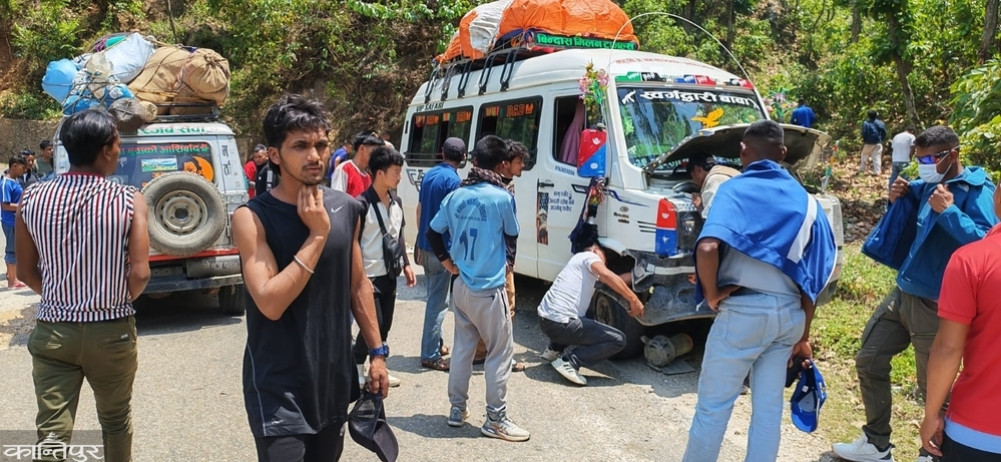
Nearly 56 percent of all accidents in the province occur on the Karnali Highway. According to the Provincial Police Office, 917 people have died on this highway since fiscal year 2071/72.
We use Google Cloud Translation Services. Google requires we provide the following disclaimer relating to use of this service:
This service may contain translations powered by Google. Google disclaims all warranties related to the translations, expressed or implied, including any warranties of accuracy, reliability, and any implied warranties of merchantability, fitness for a particular purpose, and noninfringement.
The Karnali Province–02–001 Kha 1055 numbered mini bus (Force vehicle) heading from Surkhet to Raskot in Kalikot plunged into the Karnali River from the Karnali Highway at Sangetada, Chamunda Bindrasaini Municipality–7, Dailekh, at 11:30 last Thursday. One person was found dead at the scene, while the bodies of a man and a woman were found on the banks of the Karnali River near Chisapani, Kailali. The exact number of people on board the vehicle is still unknown, and the crashed vehicle has not been found even after six days.
In the second week of Jestha last year, a bus with registration number M–1 Kha 660 heading from Mugu to Nepalgunj crashed at Sisnedanda, Athbis Municipality–2, Dailekh, along the Karnali Highway, killing three people at the scene and injuring 33 others. There have been dozens of major accidents on the highway before as well. In Chaitra 2066, 42 people lost their lives in an accident at Kitu, Dailekh, and in 2069, 28 people died in an accident at Bittamod, Serabada, Kalikot.
According to police statistics, among the road accidents in Karnali Province, nearly 56 percent have occurred on the Karnali Highway. The Provincial Police Office reports that since fiscal year 2071/72, 917 people have died on the highway. In just the past three years, 111 people have lost their lives and 309 have been injured on this road. Karnali Province Police Chief DIG Jayaraj Sapkota stated that the increase in accidents on the Karnali Highway is due to narrow and difficult roads, overloading of passengers, old vehicles, and disregard for traffic rules.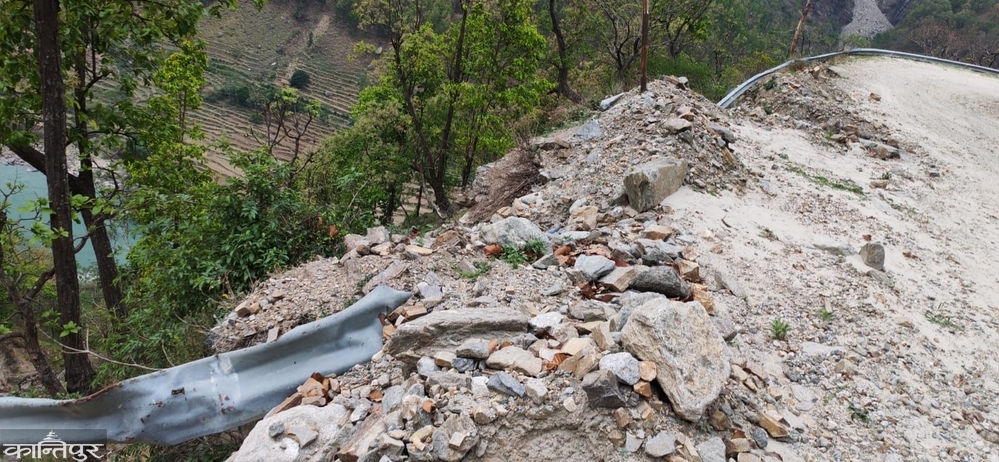 Dahikhola–Hulm section of the Karnali Highway. Photo: Tularam/Kantipur
“Accidents are also increasing due to excessive speed,” he said. “Karnali’s difficult geography and dilapidated roads make it a challenge to prevent accidents.” According to him, in the current fiscal year, 34 people have died in 113 accidents on the highway; last fiscal year, 31 died, and in fiscal year 2080/81, 46 people lost their lives. Police statistics show that 190 people have been injured during this period.
According to police, in the past decade, there have been 4,002 accidents across Karnali Province, resulting in 1,637 deaths and 1,927 injuries. In Karnali, the Mid-Hill Highway, Rapti Highway, Karnali Corridor, and Nepalgunj–Surkhet roads are also in operation. However, the accident rate on these highways is lower than on the Karnali Highway, according to police.
SP Mukund Prasad Rijal, chief of the Nepal Police Highway Safety and Traffic Management Office, Surkhet, said that the main reasons for the increase in accidents on the Karnali Highway are the poor condition of the road, old vehicles, and driver negligence. According to him, overloading, narrow and damaged roads, and high speed are also contributing to the rise in accidents.
Associate Professor Kamal Lamsal of Mid-Western University says that the recent spate of accidents in Karnali, where road access is only just expanding, has left passengers and drivers fearful. “Accidents on the Karnali Highway are more horrific than elsewhere; in the most recent accident, the vehicle has not been found even after six days,” he said. “Here, when an accident happens, the human toll is high, which has increased the risk and fear for travelers.”
The highest risk of accidents on the Karnali Highway is from Dahikhola in Dailekh to Galjebazar in Kalikot. In this section, there have been 98 accidents in the past three years, with 35 fatalities, according to police. Within this section, places like Dahikhola and Kitubhir in Dailekh, and Serabada, Timure, Tadibhir, Bihani, and Hulmjite in Kalikot are particularly accident-prone.
In the current fiscal year, 7 people have died in accidents in this section; last year, 11 died, and in fiscal year 2080/81, 17 people lost their lives. According to police, to curb the rising number of accidents, night-time driving has been banned on the highway.
Engineer Karn Bahadur KC said that the narrow bends at various points in the Dailekh and Kalikot sections of the Karnali Highway have increased the risk of accidents. According to him, vehicles cannot be seen from one bend to the next, and the lack of traffic signs in most places has also contributed to the rise in accidents.
“The highway should have been two lanes from the very beginning,” he said. “Because the army rushed the work, the standards may not have been met, and despite later efforts, those standards were never achieved.” According to him, by engineering standards, the 232 km journey from Jumla should be completed in just six hours. But now, passengers are forced to travel for up to 24 hours.
The Karnali Highway directly connects Surkhet, Dailekh, Kalikot, Jumla, and Mugu. In fiscal year 2076/77, the road was blacktopped using Otasil technology. With World Bank assistance of one billion rupees, the government blacktopped 126 km from Surkhet to Khidkijyula and 107 km from Khidkijyula to Jumla. Currently, about 80 percent of the blacktop has deteriorated.
Nearly 670 million rupees have been spent on repairs over the past three fiscal years. According to the Road Division Offices in Surkhet and Jumla, 240 million rupees were spent on road maintenance in the current fiscal year, 210 million last year, and 310 million in fiscal year 2080/81. “There is a landslide risk everywhere, and most of the budget is spent just to prevent landslides,” said Saurabh Kumar Singh, Information Officer at the Road Division Office, Jumla. “Work is done one year, then another landslide occurs the next year, and we are forced to work on the same landslide again.”
The road has continued to deteriorate as blacktop repairs on the Karnali Highway have been stalled for a long time. Just a week ago, the Road Division Office, Jumla, canceled 16 long-pending contracts under the Karnali Highway. Two months ago, it also canceled 10 problematic contracts on the highway. According to Information Officer Singh, the canceled contracts date back to fiscal year 2074/75.
“Even after repeated written warnings, the contractor companies showed no interest in construction, so the contracts were canceled as per the provisions of the Public Procurement Act,” he said. “We have issued public notices and recently terminated 16 contracts—12 in Kalikot, 3 in Jumla, and 1 in Mugu.” According to him, contractors have long had a tendency to take contracts but not do the work.
Despite millions being spent annually on road maintenance, the risks remain the same, according to driver Milan Kshetri. “It’s difficult to pass vehicles in narrow and treacherous cliff sections; if another vehicle comes from the opposite direction, you have to back up,” he said. “If a vehicle breaks down on the road, other vehicles are forced to spend the night there.” Civil activist Kamal Bik said that travel has become risky because the road is only single-lane. “Cheap technology was used for the blacktop, and even then, the work was not of good quality,” he said. “Now, we are forced to travel in dust and mud all year round, and the risk of accidents remains the same.”
The construction of the Karnali Highway, which was inaugurated by then Prime Minister Girija Prasad Koirala in 2048 BS, was only completed 15 years later after facing problems due to the armed conflict and budget shortages. When construction became difficult due to rocky terrain, the government handed over responsibility for the road to the Nepal Army. The Nepal Army opened the track on Chaitra 30, 2063.
‘Safety bars’ built with a billion-rupee investment—some dilapidated, some destroyed
Most of the ‘safety bars’ built for road safety on the Karnali Highway have become dilapidated. In fiscal year 2076/77, with World Bank assistance, iron safety bars were installed in narrow and steep sections and retaining walls were built in wider sections to reduce accidents, along with blacktopping using Otasil technology. However, most have been broken by landslides and falling rocks, and the remaining safety bars are also in poor condition.
“Safety bars helped boost driver morale and made passengers feel safe,” said Nand Bahadur Bista, Assistant Sub-Inspector and in-charge of the District Traffic Office, Kalikot. “Safety bars can generally prevent serious damage in accidents involving motorcycles and three-wheelers, and are also helpful for other vehicles.”
Driver Bikram Rokaya, who has been driving the Surkhet–Jumla route for 12 years, said that in the dangerous and steep sections of the highway, where terrifying cliffs and the Karnali River are visible directly from the edge, safety bars make passengers feel safer. “Nowadays, we are scared because many bars are broken,” he said. “Passengers are even more frightened.”
Iron safety bars were installed at Kitubhir in Dailekh, Serabada, Timure, Tadibhir, Bihani, Hulmjite in Kalikot, Kalyan in Surkhet, and Gadgadeni in Jumla, where there have been major and frequent accidents. With support from the Road Sector Development Project (RSDP), nearly one billion rupees were spent installing iron bars on the highway.
Khadananda Chaulagai, chairperson of the Tadi Bazaar Management Committee, said that in some places, the safety bars installed in narrow and difficult sections have made the road even narrower. According to him, in some places, the safety bars have made it difficult for pedestrians to walk.
“There is a risk of pedestrians being pinned against the bars by speeding vehicles,” he said. “In some places, there isn’t even a walkway left for pedestrians.” He said that since there is no alternative route from Tadi to Manma Bazaar, this causes problems. “The highway is not wide enough for two-way traffic; on a single-lane road, vehicles coming from the opposite direction have to back up to give way,” he said. “Because of the hard rock, it is also difficult to widen the road.”