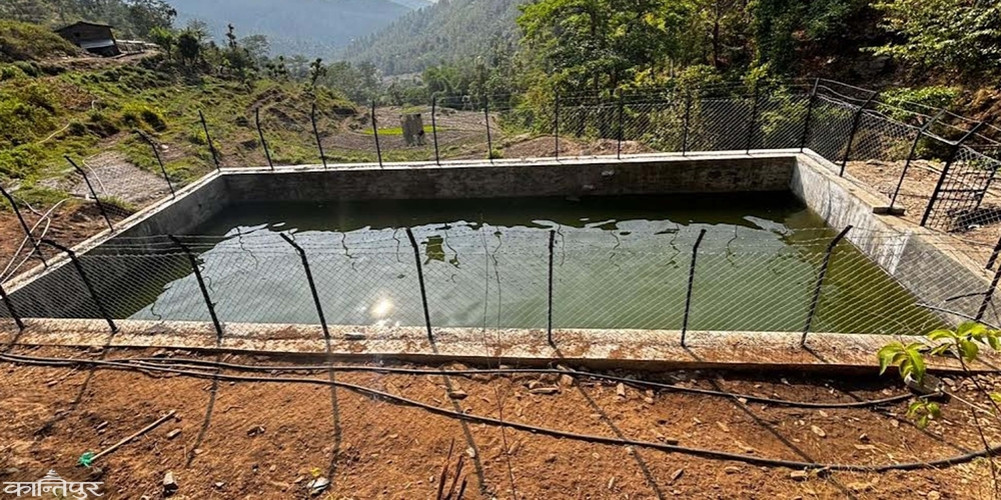
Under the Chief Minister Employment Program, an irrigation pond built with a budget of 1.5 million rupees has made it easier for farmers from 35 households to cultivate rice, wheat, and vegetables throughout the year.
We use Google Cloud Translation Services. Google requires we provide the following disclaimer relating to use of this service:
This service may contain translations powered by Google. Google disclaims all warranties related to the translations, expressed or implied, including any warranties of accuracy, reliability, and any implied warranties of merchantability, fitness for a particular purpose, and noninfringement.
After the construction of an irrigation pond in Lwaldhari, Kumakh Rural Municipality–5 of the district, local farmers have found relief. With a budget of 1.5 million rupees under the Chief Minister Employment Program and local labor contribution, an irrigation pond with a capacity of 150,000 liters was built, making it easier for farmers to irrigate their fields throughout the year.
Due to the lack of an irrigation canal, until last year, locals were forced to plant maize during the rainy season and transplant rice only during the monsoon showers. After the construction of the irrigation pond, they have been able to complete rice transplantation on time in more than 100 ropani of fields located about 800 meters above sea level. This has directly benefited 35 farming households.
After the construction of the irrigation pond, there are no longer the same problems cultivating arable land as in the past, said Pathe Kami, chairperson of the Irrigation Pond Construction Committee. According to him, this time it has even been possible to transplant rice on land previously used for maize. “There is no permanent canal for irrigation in the fields. Farmers used to make temporary canals after the springs emerged during the monsoon and cultivate their land. If there wasn’t enough rainfall, the fields would remain fallow,” he said. “Now that water can be delivered directly to the fields through pipes from the irrigation pond, it has become much easier.”
According to him, the irrigation pond will benefit not only rice crops but also wheat crops planted in winter.
Local farmer Khagendra Malla said that the problem of more than half the land remaining fallow due to insufficient rainfall has now been resolved. According to him, now, with irrigation facilities, it will be easier not only to grow rice during the rainy season and wheat in winter, but also to engage in commercial vegetable farming.
“The production from rice and wheat doesn’t even last for three months. Now, income can be increased by cultivating vegetables,” he said. “Previously, whenever it rained, we had to rush from home to irrigate our fields, regardless of day or night. If we were late, we would miss our turn. The lack of irrigation caused a lot of hardship. Now, it has become much easier. We no longer have to do that.”
Padam Bahadur Budhamagar, ward chairperson of Kumakh Rural Municipality–5, said that every year there used to be irrigation problems in the fields located at high altitude, and farmers were forced to rely on rainwater for rice cultivation. According to him, after the construction of the irrigation pond, farmers no longer have to wait for rainwater and can now farm regularly.