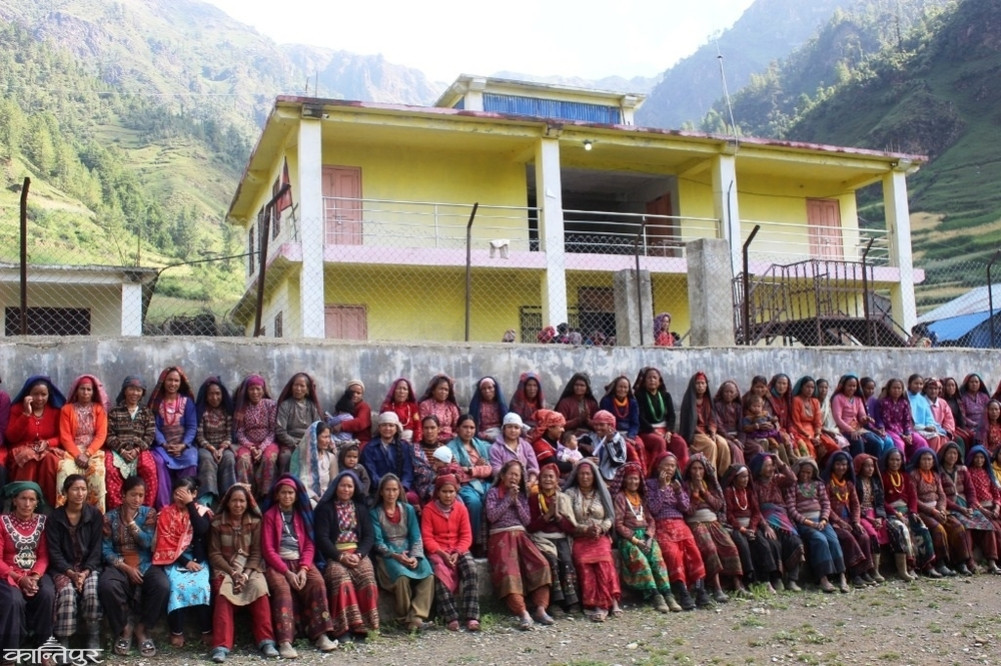
The women of Patmara village finally understood that if they did not stand up for themselves, their daughters and daughters-in-law would also have to suffer the same cycle of discrimination and oppression.
We use Google Cloud Translation Services. Google requires we provide the following disclaimer relating to use of this service:
This service may contain translations powered by Google. Google disclaims all warranties related to the translations, expressed or implied, including any warranties of accuracy, reliability, and any implied warranties of merchantability, fitness for a particular purpose, and noninfringement.
Patarasi Rural Municipality-7, Patmara village of Jumla is known as a beautiful village covered with white snow in winter and covered with greenery in monsoon. However, hidden within the beauty of this remote village was an ugly reality - the pain of being a woman.
Until five years ago, the lives of women here were confined within a certain and depressing perimeter. Seven days a month, which the society called 'chhui' (menstruation), were a punishment for them. The cold, damp, and noisy cattle shed was their home.
Rupa Thapa of the same village, who is 50 years old today, has that bitter document of the past safe with her. 'At that time, we had to sleep with insects and grasshoppers in the shed, neither our bodies nor our minds were safe.' Rupa laughs bitterly remembering those old days. Rupa, a mother of seven, never heard of an iron 'mill' while her children were growing up, and pregnancy tests were a distant thing. When she fell ill, she had to rely on a healer and hide the pain of childbirth in the corner of the barn.
At that time, Taradevi Thapa of Patmara was also fed up with social discrimination. The social belief that women should endure caste-based untouchability and the exclusive rule of men when going to Dhara-Pandhera had made a deep impression on her psyche.
However, time is not always the same. There is a limit to injustice and discrimination, after which tolerance turns into rebellion. The women of Patmara village understood that if they do not stand up for themselves, their daughters-in-law will also have to face the same cycle of discrimination.
Women from 185 households in the village gradually started organizing. They held monthly meetings, saved a little money, and created a place to discuss common village problems. When these women, who had never seen an 'iron mill', stood together, the ancient power structure of the village began to shake. Dhansara Thapa became another strong pillar of this campaign. She started holding discussions with men and women together three to four times a month. 'Earlier, women were afraid that sharing their pain would ruin the honor of the family,' says Dhansara, 'but we explained that honor is not earned by enduring discrimination, but by demanding rights.'
Patmara village has changed now. The society that used to pressure people to take them to a doctor when they were sick, now rushes to take them to the hospital. Yesterday, parents who married off their daughters before they reached puberty are now aware of the legal process of child marriage and its physical effects. Dhansara proudly says, ‘There is not a single child marriage in the village now and no one is in favor of allowing it.’
50-year-old Rupa Thapa, who once suffered from the monopolistic rule of men, has become a Baisakhi for the next generation. Nowadays, she is found in some houses in the village advising women to stay in a safe room instead of a shed during menstruation. She herself goes door to door to ensure that pregnant women go to the hospital regularly, take iron pills, and feed nutritious food to both mother and child. The villagers also help her.
This collective courage of the village women has made Patmara a peaceful and conscious village. This indomitable courage of these rural women is not limited to the village alone. Their efforts have also been supported by the Social Development Office, Jumla and the National Human Rights Commission, Karnali Province Branch.
Kalpana Nepal Acharya, Jumla Chief of the National Human Rights Commission, considers this courage of the women commendable. She says, ‘Our vision should now be to establish a peaceful, beautiful and human rights-friendly society, in which these women have stood as the foundation.’
Top Bahadur Budha, Chief of the Social Development Office, says that along with the construction of physical infrastructure, the office is working to spread awareness to uproot harmful practices that have been entrenched in the society for years and is also expanding such campaigns to other local levels in the district. According to him, women’s participation in village change is not only attractive, but also seems to be fruitful.
Rupa, who has not seen an iron mill yesterday, Taradevi, who is tired of discrimination, and Dhansara, who is determined to change the society – these are not just characters. These are the pictures from Karnali, which show that when women are aware of their rights and health, it does not take long for the old and ugly ruins of society to collapse. The women of Patmara village have proven that small steps taken together, not big speeches, are enough for change.
Now men in the village are also appreciating the work of women. The responsibility of stopping harmful practices from the peace and security of the village lies on the shoulders of women.