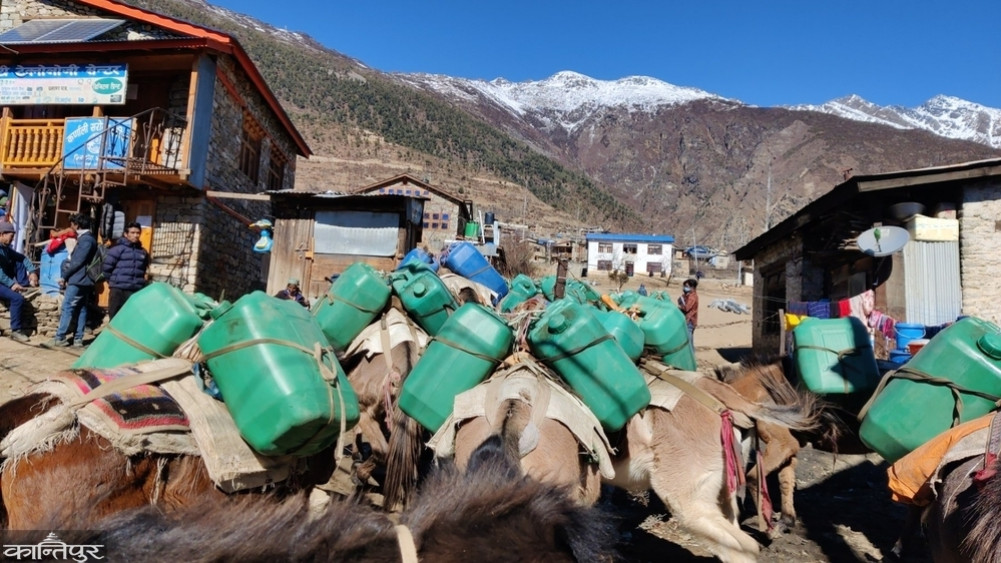
Due to the lack of easy supply of gas, the lack of authorized gas company dealers throughout the district, and expensive transportation costs, consumers are forced to bear the brunt of the price hike.
We use Google Cloud Translation Services. Google requires we provide the following disclaimer relating to use of this service:
This service may contain translations powered by Google. Google disclaims all warranties related to the translations, expressed or implied, including any warranties of accuracy, reliability, and any implied warranties of merchantability, fitness for a particular purpose, and noninfringement.
In the provincial capital Birendranagar, a half-cylinder of gas costs Rs 1,030. But the same gas has to be bought for Rs 1,700 in Simkot, the district headquarters of Humla. On top of that, consumers in the Himalayan region have been hit even harder due to the shortage of gas.
Consumers have been hit by high prices due to the lack of easy supply of gas, the lack of authorized gas company dealers in the district, and expensive transportation costs. ‘Earlier, a fully filled cylinder was available for Rs 2,500 to Rs 2,800,’ said local teacher Man Bahadur Rokaya. ‘Now, there is no trust in weight or price; a half-filled cylinder is available for Rs 1,200 to Rs 1,400.’
Due to the shortage, locals who were used to cooking with gas for health and convenience reasons have been forced to cook with firewood again, said Nima Lama, the owner of Sim Valley Hotel in Simkot. ‘Even if we buy it at a high price, we cannot get gas,’ he said. ‘After the road facilities were provided, we had abandoned firewood and started cooking on gas, but we were forced to return to firewood.’ According to him, since there are no community forests around Simkot, firewood is brought to the district headquarters Simkot by mules from rural municipalities such as Kharpunath and Sarkegad. He said that the price of a heavy firewood in Simkot has increased from 800 to 1,000 to 1,200 rupees.
Gas is available in Humla from Bheri, Saipal, Rapti, Nepal and other places. However, local businessman Bakhat Lama said that the price of gas has increased since there is no official dealer of any company in the district. ‘We have to import the same gas that is available in Nepalgunj and Surkhet. Vehicles do not want to transport gas. The cost of transporting half a full cylinder is the same.’ According to him, the cost of transporting a cylinder of gas is between Rs 200 and Rs 250 as the road that was opened only in Ashar is unpaved. ‘We also had to add some benefits to that,’ he said. ‘As the supply of gas is not easy in Nepalgunj and Surkhet, we are forced to buy it at a high price of Rs 100-150 per cylinder.’ Cooking with gas has also increased in rural areas of Humla. But due to the shortage of gas in the district headquarters itself, Kamal Budha of Kharpunath Rural Municipality-3 said that they are forced to rely on firewood for cooking.’
Businessman Santosh Singh said that there is also a shortage of gas in Sarkegad market. ‘Consumer demand has increased significantly,’ he said, ‘Traders in Nepalgunj and Surkhet are refusing to send gas here.’ According to him, it is difficult to get gas in commercial centers such as Piplang in Chankheli Rural Municipality, Yangchubazar in Kharpunath, Srinagar in Adanchuli, and others.
The price of petrol in Surkhet’s oil stores is Rs 196 per liter and diesel is Rs 194 per liter. But when the same fuel reaches Simkot, it is being sold for Rs 260 to 300. ‘There are no petrol pumps here, traders sell fuel in drums at arbitrary prices,’ said Janak Budha of Simkot Rural Municipality-6, ‘There is not even a proper device to measure a liter, so we are forced to pay whatever price they say.’
Transport entrepreneur Padam Bhandari, who operates a jeep on local routes in Simkot, complained that even though the government has reduced the price of fuel, they are forced to buy diesel and petrol for just Rs 300. ‘Since the checking is done at the headquarters, traders sell it for up to Rs 260 per liter, it is difficult to get fuel for less than Rs 300 elsewhere,’ he said. ‘Since the price of oil is high, we have been forced to increase the fare accordingly.’ He informed that three months ago, the Simkot-Kharpu route was being offered to the reserve for Rs 5,000, but now it is being offered to passengers for Rs 7,000.’
Assistant Chief District Officer Rajendra Kumar Chand said that there have been no complaints about black marketing of fuel and gas so far. ‘It must have been a bit expensive because of the expensive transportation fare on the unpaved road,’ he said, ‘There have been no complaints from consumers, we are also monitoring from time to time, if any complaints are found, the trader will be brought to book.’