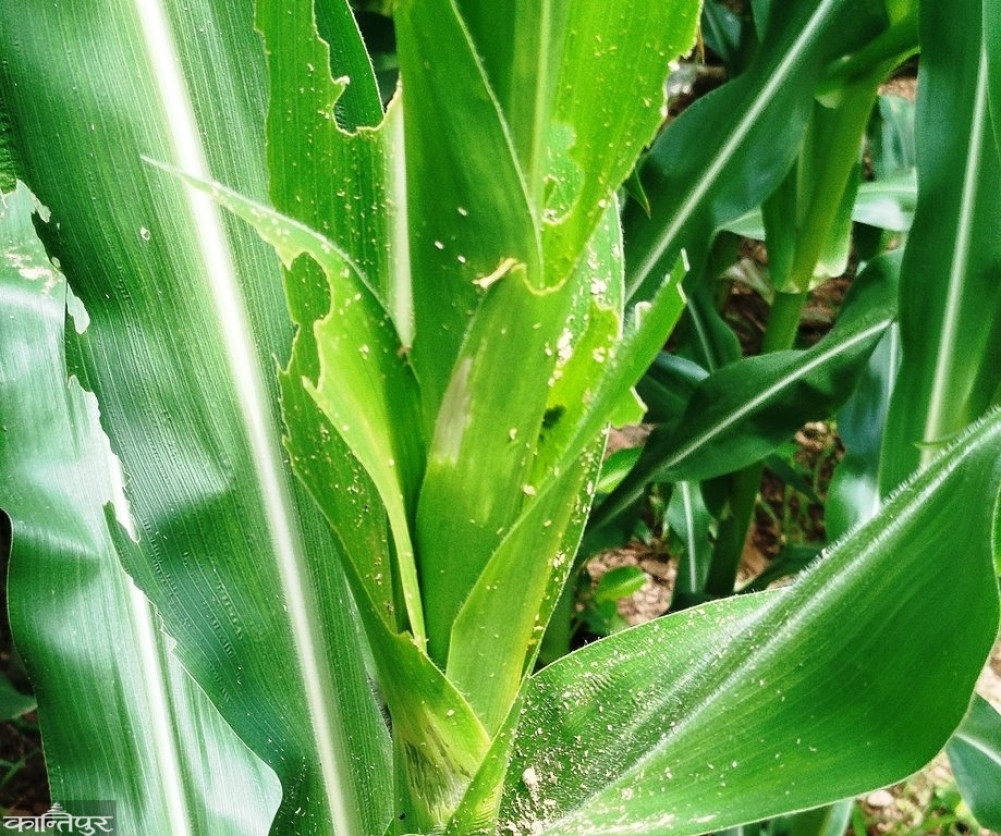
Some farmers have been forced to sow corn a second time after insects began destroying corn that was just harvested and was about to ripen.
We use Google Cloud Translation Services. Google requires we provide the following disclaimer relating to use of this service:
This service may contain translations powered by Google. Google disclaims all warranties related to the translations, expressed or implied, including any warranties of accuracy, reliability, and any implied warranties of merchantability, fitness for a particular purpose, and noninfringement.
The armyworm outbreak, which has spread along with the rains after a long drought, has damaged the maize crop in all 10 local levels of Salyan. Some farmers have been forced to sow maize for the second time as the insects have started destroying everything from newly harvested maize to maize that is ready to be harvested.
Agricultural technicians have said that the armyworm has eaten the maize pods and young shoots in most areas of the district, including Sharda Municipality, Bangad Kupinde Municipality, Kumakh and Darma Rural Municipality, and the plants have started to wither. This year, maize has been cultivated in an area of about 18,000 hectares in Salyan.
Sita Singh of Sharda Municipality-3 said that the armyworm has caused great damage to the maize planted in five ropanis. ‘A single bushel of maize has been eaten, some plants have dried up,’ she said, ‘not only ours, but the situation is similar for farmers across the village.’
According to Dev Bahadur Budhathoki of Bangad Kupinde Municipality-9, the pest could not be controlled even after using pesticides brought from Agrovet on maize planted in 10 ropanis. ‘Earlier, more than four bushels of maize were produced, so the family’s expenses were covered for four months,’ he said, ‘there is no possibility of the pest this year.’
According to Shiva Prakash Oli, agricultural technician of Kumakh Rural Municipality, maize crops covering an area of more than 15-20 hectares have been affected in all seven wards. He said that the rains after a long drought have increased the outbreak of armyworms and the municipality is distributing pesticides through the wards.
Ramhari Gaire, head of the agriculture branch of Darma Rural Municipality, said that although armyworms have been seen in all wards, there has been partial damage in many places. "We have given pesticides to many affected farmers, and the outbreak is decreasing somewhat with the increase in rainfall," he said.
According to Narayan Belbase, head of the agriculture branch of Bangad Kupinde Municipality, about 80 percent of the maize planted in the municipality on an area of about 2,000 hectares has been affected by the armyworm. "After rice, maize is the main crop here. If production decreases, the livelihood of farmers will be affected," he said.
Ishwori Narayan Gharti, head of the Agricultural Development Office, Salyan, said that the armyworm outbreak has spread throughout the district due to the lack of rainfall for a long time. "The exact details of the damage are yet to come from the municipality," he said. "If it is not controlled in time, there may be a significant decline in production. The office is providing the necessary pesticides."