Due to insufficient rainfall, only 28 percent of rice has been planted in Karnali Province so far.
We use Google Cloud Translation Services. Google requires we provide the following disclaimer relating to use of this service:
This service may contain translations powered by Google. Google disclaims all warranties related to the translations, expressed or implied, including any warranties of accuracy, reliability, and any implied warranties of merchantability, fitness for a particular purpose, and noninfringement.
Jhak Bahadur Batala of Kudu, Bheri Municipality-13, Jajarkot, worries about planting every day. ‘If we don’t grow rice, what will we eat throughout the year? We are already waiting for rain,’ he said, who cultivates rice in about 15 ropanis of land every year. ‘The fields are cracked due to lack of rain, the seeds of the paddy have also started drying up, and now we have stopped going to the fields.’
His neighbor Dharmajit Budha’s nearly 12 ropanis of land is also barren due to the prolonged drought. ‘What will we do even if we plow the fields until it rains? Since there is no rain even until mid-barkha, the seeds kept in the paddy have spilled,’ he said, ‘Planting is uncertain as the rains have not started.’
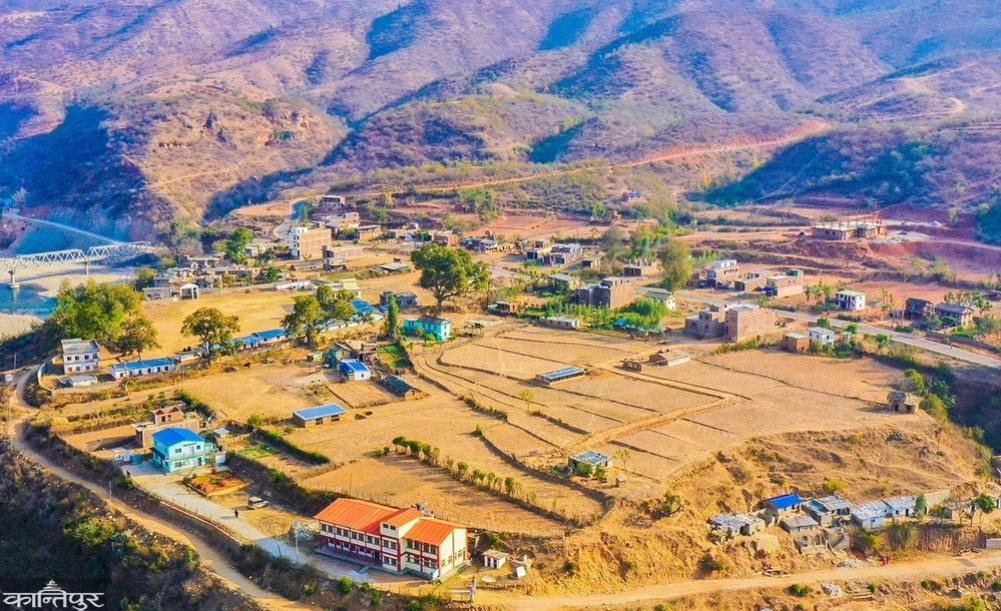
There is about 1,000 acres of cultivable land in Kudu Jiulo on the banks of the Bheri River. But planting has not yet begun in the vast field about 50 meters above the Bheri River. 'The river is flowing below the village, but we are forced to wait for rain for planting,' said local farmer Top Bahadur Batala. 'Due to lack of irrigation, we are forced to plant only one crop of rice a year. If that crop is not enough, we have no option but to go to India to work as laborers to earn food for the whole year.' According to him, last year, most farmers had already planted rice at this time because the rains started early.
In Chaurjahari, located in Rakum West, across the Kuduphant, almost half of the farmers have not planted rice either. ‘Sowing has been completed in the fields with irrigation facilities, but we are waiting for rain,’ said local farmer Gopilal Gosai, ‘The prolonged drought has made it difficult to save the fields, and the planting is still not finalized.’ According to him, nearly 3,000 farmers have not yet taken care of the planting in the fields around Chaurjahari, including Vijayashwari, Laheresimal, and Kholagaun.
Due to the drought, most farmers in Punma, Bhur, Sima, Salma, Paink, Pajaru, Garkhakot, Majkot, Suwanauli, Dashera, Khagenkot, Ragda, Bhagwati, Thalaraikar, Jugathapachaur, Dhime, Barekot and other districts of Jajarkot have not been able to plant, said Vidya Gautam, head of the Agricultural Development Office. According to her, only 20 percent of the planting has been done in Jajarkot so far. According to him, out of 24,369 cultivable lands in the district, 15,529 hectares are under cultivation. Of which, only 4,990 hectares have irrigation facilities. In Salyan, too, areas like Sallibazar, Srinagar, Lanti, Mokhla, Dhorchaur, Tharmare are barren due to drought. ‘If it had rained, we could have planted within the first week of Ashar,’ said Mohan Oli, a farmer from Tharmare. ‘This year, there has been a long drought, if it does not rain within a week, it is difficult to save even the seeds of the paddy.’
Nar Bahadur Khadka, a farmer from Sallekhola in Triveni Rural Municipality, said that some farmers have not even been able to plant paddy. "The road was dug in Poharsal and the ditches were filled, and we have not been able to lay the fences due to the waterlogging," he said. "If it rains, we can sow seeds in a month. This year, even if the rains start this week, it seems that sowing will only be done towards the end of Shrawan." He informed that he has started ploughing the fields to lay the fences in the hope of rain.
Mahesh Acharya, head of the Agricultural Development Office, said that out of the 43,724 hectares of cultivable land in Salyan, only 5,080 hectares have irrigation facilities. According to him, about half of that land is used for paddy cultivation. He informed that 43 percent of the paddy planting has been completed so far. ‘The lack of favorable rainfall has also affected production,’ he said, ‘The drought has taken a big toll on farmers. Most of the fields are now barren because the cultivable land dries up when ploughed without rain.’
Agricultural expert Navin Sharma says that farmers in Karnali always face problems with fertilizer, seeds and irrigation during the sowing season. ‘Now, farmers have been troubled by drought,’ he said, ‘due to lack of timely sowing, crops do not flourish properly, diseases and pests also plague them, and there are problems with tillage, which has been seen to directly affect production.’ According to him, rice varieties including Khumal-4, Khumal-8, Khumal-11, Chhomrong and Radha-4, Radha-12, Mansuli, Savitri, Bindheshwori and Chaite rice are cultivated in Karnali and in the interior areas. He informed that these varieties of rice require more water.
Only 28.15 percent of the sowing has been completed in Karnali as of Monday. The Ministry of Land Management, Agriculture and Cooperatives has stated that paddy is being cultivated in an area of 43,290 hectares across the province. According to the ministry, only 12,155 hectares of paddy have been sown so far, said Sanjiv Kumar Karna, secretary of the ministry.
According to the ministry, the maximum sowing has been completed in Jumla at 95 percent, Dolpa at 92 percent, Humla at 75 percent and Mugu at 68 percent, while Surkhet has the lowest sowing at only 6 percent. Ram Bhakta Adhikari, head of the Agricultural Development Office, said that the sowing has been done in a hurry as paddy is cultivated only in the areas along the Karnali and Tila rivers in Jumla. According to him, if farmers plant paddy by Chaitra 20, the sowing should be completed within 40 days. He informed that since marsh rice is produced in 7 months, farmers will do its sowing, tillage and other work according to the calendar.
Paddy is cultivated in an area of 14,600 hectares in Surkhet. Last year, 54,152 metric tons of paddy were produced. 'Despite being the district with the highest paddy production in the province, most of the fields are cultivated with rainwater,' said Ramesh Khadka, Agriculture Officer of the Ministry. 'Sowing has been completed in places with irrigation facilities, other farmers are waiting for water.'
48 percent of the sowing has been completed in Kalikot, while 35 farmers in Rukum West and 12 percent in Dailekh have sown paddy. Out of 287,761 hectares of cultivable land across Karnali Province, 262 hectares have been cultivated. Of which, only about 19.06 percent (38,233 hectares) has irrigation facilities for the entire twelve months.
By Asad 15 last year, about 54 percent of the sowing was completed in Karnali. Similarly, 58 percent of the farmers had sown by mid-Asad last year. Last year, 147,250 metric tons of paddy was produced across Karnali. Agriculture Officer Khadka informed that due to drought, about 30 percent of the farmers across the province were not even able to plant seed beds.