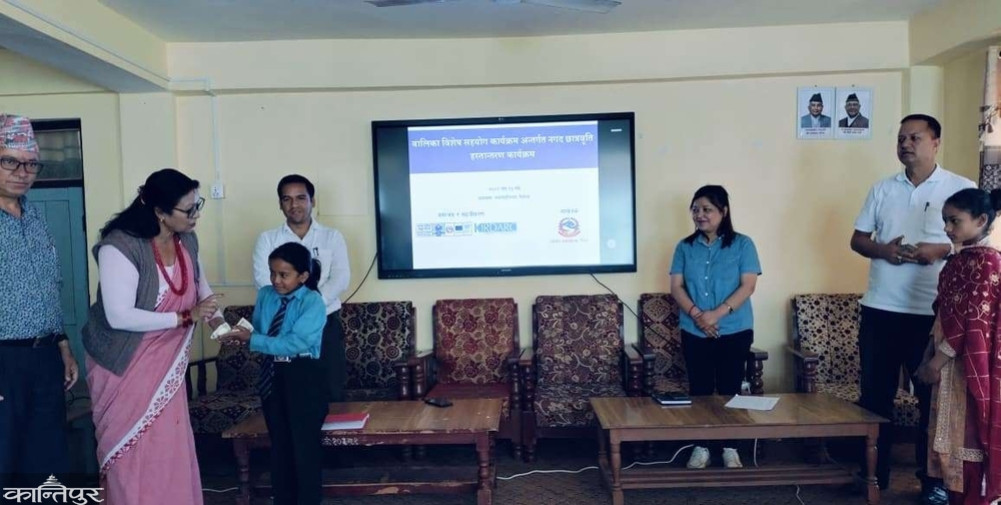
For a secure future and higher education, the municipality of Karnali has started depositing Rs 30,000 into the accounts of at-risk daughters.
We use Google Cloud Translation Services. Google requires we provide the following disclaimer relating to use of this service:
This service may contain translations powered by Google. Google disclaims all warranties related to the translations, expressed or implied, including any warranties of accuracy, reliability, and any implied warranties of merchantability, fitness for a particular purpose, and noninfringement.
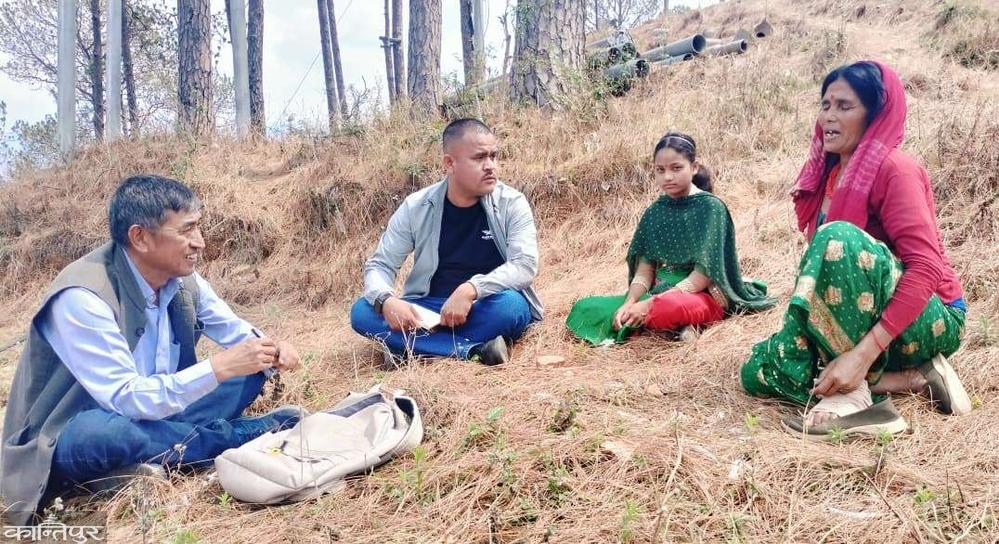
Sangita Bayak, a student of Gutuki in Chokune Rural Municipality-5 of Surkhet, is studying in grade five. Her 10-year-old sister Tulsi and eight-year-old Rabina are studying in grade four with her. However, their childhood was not as easy as that of other girls. Their father died when they were young. After that, their mother left them and remarried. They are now under the care of their aunt Pushpa Bayak.
Despite the poor living conditions in the village, Pushpa was constantly worried about how far she could educate her three nieces. ‘When we were worried about how to raise and educate them, the rural municipality implemented the special program for girls,’ she said. ‘The municipality has deposited the money in the account of the daughters in a fixed-term account so that they cannot get married even before they turn 20 and cannot withdraw it.’ Arrangements have been made so that the money will not be paid even if they drop out of school or get married as a child. That means that the daughters will be able to study up to higher education. Now, they are purchasing their educational materials and covering their education expenses from the interest earned from the fixed-term account every year.
To reduce such risks, various municipalities in Karnali are running special support programs for girls to protect their lives according to the need for care and protection of their daughters. Mina Bik, Narayan Municipality-7, Dailekh, is 14 years old. She is studying in grade 8 at the local Basanta Secondary School. She lost her mother six months after her birth, and Mina’s father also passed away when she was two years old. After her mother passed away, Mina was raised by her younger mother (father's brother's daughter-in-law). 'After her parents passed away when she was young, I raised and educated Mina, and I still want to educate her.' However, school expenses are gradually increasing. Now, I think that joining the special program for girls will bring some relief,' says Durga. 'Mina wants to become a teacher after higher education, and she will definitely fulfill it.'
According to Kham Bahadur Thapa, head of the Economic and Social Development Branch of Narayan Municipality in Dailekh, girls who are abandoned or found in hospitals or other public places, separated from their parents, or who have become homeless without their parents being found are included in this program. He said that 33 girls have been selected in the first phase and money has been deposited in their accounts. He says, 'The special program for girls has been shown to be very effective in protecting at-risk school-age girls.' This will also guarantee higher education and we have taken it as an effective step to prevent child marriage. Since clear procedures have been made, it does not add any financial burden to the local government.'
According to him, priority is given to girls whose parents have serious physical or mental disabilities or infirmities and who are dependent on their imprisoned or imprisoned father or mother. 'Girls who have applied to the Child Welfare Officer stating that they cannot raise a child born of rape or incest punishable by law are also included in the program,' Thapa said.
Similarly, the program covers underprivileged girls from extremely marginalized communities who have lost both or one of their parents due to disasters, have disappeared, or have themselves been physically or mentally injured or disabled, and Dalits, indigenous peoples, and disabled. Meena, Ashika, Sangita, Tulsi and Rabina are included in this program. It is expected that the doors of higher education will open in the lives of thousands of girls like them who are in the grip of extreme economic poverty and the risk of child marriage will be reduced. In order to end the current situation where girls do not have access to education due to various reasons, even if they reach school, they have to drop out midway and are forced to marry as children, Narayan and Dullu municipalities of Dailekh and Choukune rural municipality of Surkhet are running a special program for girls.
Under the program started by these municipalities, 30 thousand rupees are deposited in the account of the daughter once. In the program of Empowered Women and Prosperous Nepal, Narayan, Dullu municipalities of Dailekh and Choukune rural municipality are implementing a special program for girls as a pilot project in rural municipalities. The municipality has created a special support procedure for girls for at least five years and has not turned 18 years old. It opens an account and deposits 30,000 rupees for orphan girls who are living alone with their siblings after the death of both parents or one of them has died.
Uma Upadhyay, Women Development Inspector of Dullu Municipality, says that 64 people have been included in the special support program for girls so far. She said that preparations are underway to expand this program from next year. She says, "The special program for girls has not been brought just to show or announce it. It includes girls from the category that should be deprived of education. It reduces the school dropout rate, and it seems that this program can also become a strategic plan to prevent child marriage." She said that the necessary policy reforms are being made to make the program more transparent and reach the target community and to move forward in a way that does not impose a long-term financial burden on the municipality.
Surkhet's Chaukune Rural Municipality has sent money to 56 girls for the first time in this program. Purna BK, the municipality's chief administrative officer, says that if the local level, which is in the role of guardian of girls at risk, can systematically implement the special support program for girls, it will yield great returns in the long run. The provincial government has stopped the program, which was launched as a pilot project, in the middle. Stakeholders say that if the 'Bank Account for Daughters, Security for Life' program started by the provincial government can be converted into special support for girls, it can be an effective step to end gender inequality among girls from disadvantaged communities, guarantee higher education, and reduce child marriage.