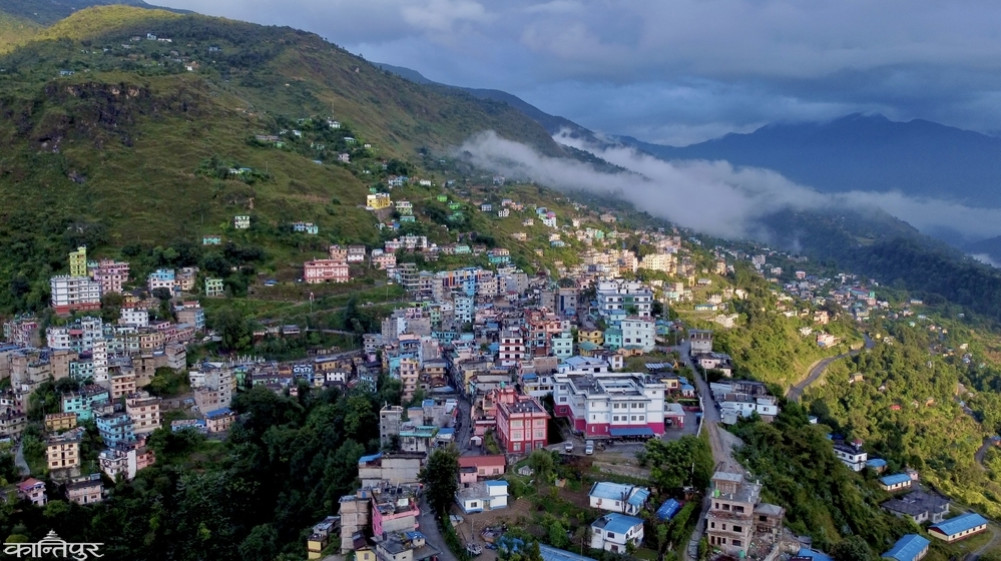
Due to dry weather and lack of spring management, residents of Musikot Municipality-1 Khalanga, 3 Pipalneta, and 5 Serigaun have to face daily water problems.
We use Google Cloud Translation Services. Google requires we provide the following disclaimer relating to use of this service:
This service may contain translations powered by Google. Google disclaims all warranties related to the translations, expressed or implied, including any warranties of accuracy, reliability, and any implied warranties of merchantability, fitness for a particular purpose, and noninfringement.
There is a shortage of drinking water in the district headquarters area of Rukum West. As the dry season progresses, the main market area of the district headquarters, Musikot Municipality-1 Khalanga, Ward No. 3 Pipalneta and Ward No. 5 Serigaun, is experiencing a shortage every year.
The previous drinking water project was developed and expanded through a large-scale project in 2071 BS under the Musikot Khalanga Drinking Water and Sanitation Consumer Organization. Currently, there are a total of 1,195 customers under this, of which about 800 customers are using the service regularly.
According to Mahendra Gautam, Secretary of the Consumer Committee, although there is a minimum demand of about 400,000 liters of water per day, the problem is that only about 100,000 liters of water is being supplied daily due to the decrease in the water level in the source during this season.
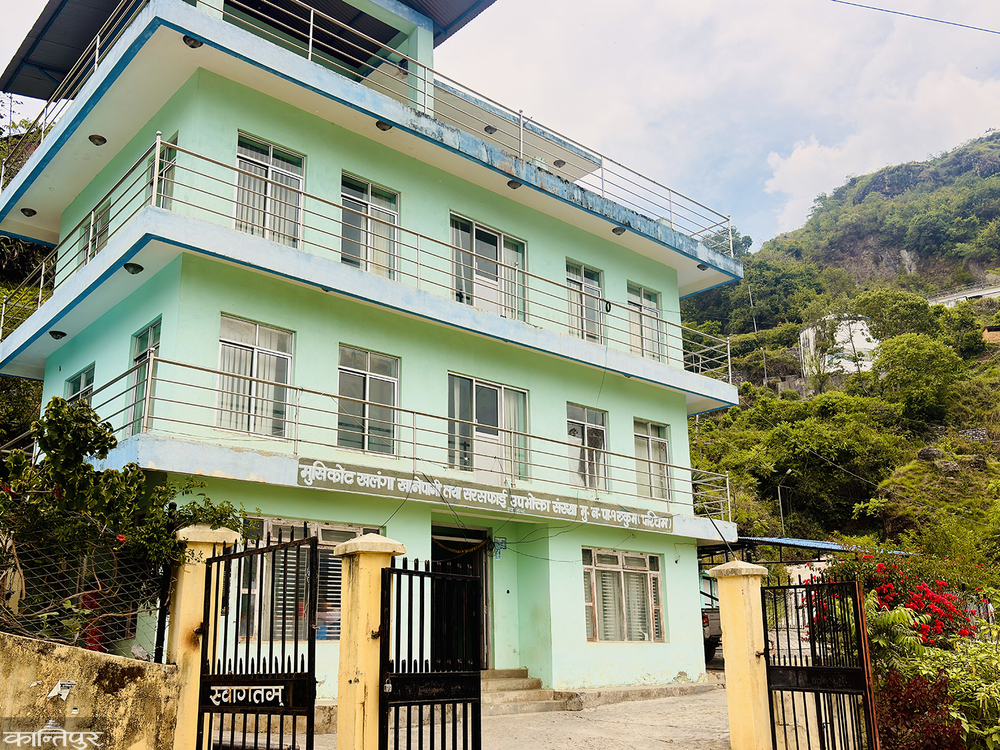
‘Especially from Chaitra to the first week of Shrawan, it is difficult to supply water as per the demand.’ The main reason for this is the decrease in water at the source,' says Secretary Gautam, 'We are now distributing it for one hour in the morning with a gap of one day to avoid water shortage.'
Water has been collected and distributed from four sources in Musikot, namely Panakhola, Sijarikhola, Lehara Bhikhaunekhola and Ghiukhola. When the water level increases in these sources during the rainy season, about 400,000 liters of water comes in and although it can be supplied according to demand, the water level has been decreasing at present. In addition, another reason for the problem in water supply is its lack of proper management.
Since small pipes have been laid in many places in the main line of the drinking water project and now it has to be distributed to many customers from there, when the water decreases, it does not reach its speed and there is a problem in the supply, says Yubaraj Adhikari, a drinking water construction technician.
'When there is a lot of water, its speed also increases and water reaches everywhere. Right now, the water is coming slowly. That is why the water is not reaching the customer's tank,' he said.
Elaborating on the problem, the organization's secretary Gautam said that the problem is increasing year by year due to the failure to carry out timely maintenance and necessary development and expansion. He said that customer complaints are increasing due to the lack of coordination between demand and supply. At present, although it is said that water will be distributed in shifts of one day, customers are complaining that there is no regularity in it. Bishwanath Khatri, a consumer from Khalanga, said that although it is said that water will come every two days, there is no regularity.
'Water does not rise up (on the roof) during this season. Even if it is lowered down, we have been able to collect as much as we can for daily use,' he said. Another consumer, Bagbir Bohara from Serigaun, said that there is inequality in shifts of two days as well and demanded that the committee clarify the matter.
‘It is said that water will come in a gap of one day, but sometimes it does not come for three-four days . Sometimes it comes continuously . Therefore, a solution should be found for this and water should be distributed equally to everyone,’ he said .
Admitting that there is a shortage of water now, Secretary Gautam expressed disappointment that the negligence and arbitrariness of consumers could not be stopped . ‘We have brought the pipeline to the house . But we are facing problems due to wrong actions such as disconnecting it from the meter and using it arbitrarily, not paying the bill on time, and laying a private pipe from our source to bring it to the house . The committee alone is not able to control and prevent this,’ he says . ‘Consumers should be aware of this . In addition, since it is a local government and district headquarters area, the local administration also had to support us.'
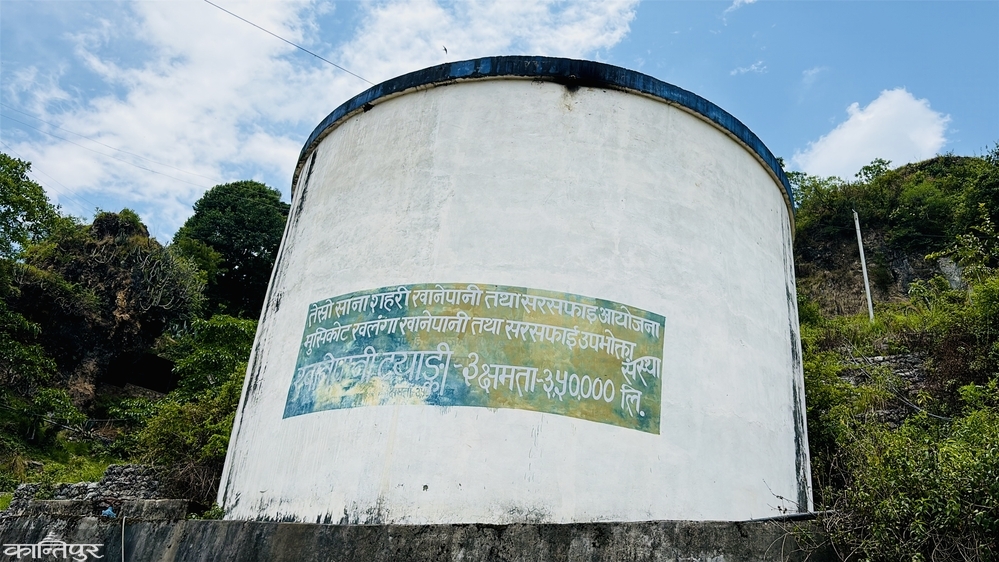
Currently, customers here are charged a minimum of Rs 175 if they use up to 5,000 liters of water per month, Rs 45 per unit for 5,000 to 10,000 liters, Rs 65 per unit for 10,000 to 20,000 liters, and Rs 100 per unit for customers using more than 20,000 liters of water.
The main election agenda of Mahendra KC, who was elected as the mayor of Musikot Municipality in the last local election, was the issue of drinking water. He had mentioned in his commitment letter that 'minimum drinking water and electricity services will be provided free of charge'. But as he said, drinking water is far from free, and it is difficult to get water even after paying a fee this season.
Clarifying his commitment, Mayor KC said that despite taking initiatives in the executive to make the minimum tariff free, he has not been successful.
‘First, we could not implement the election commitment exactly because we did not have a majority in the executive. Second, looking at the work done by other municipalities on giving discounts on the minimum water supply fee, it is not legal. Even if we give discounts, we could not do it even if we wanted to because there was a risk that the Auditor General’s Office would find it invalid,’ he said.
Consumers’ Committee in a tangle of problems
The Musikot Khalanga Drinking Water Consumers’ Committee is itself entangled in a tangle of problems. This drinking water project was constructed and operated through the Municipal Development Fund with a loan from the Asian Development Bank (ADB).
The Municipal Development Fund provided 70 percent of the total construction cost and the remaining 30 percent was collected from local consumers and paid within 25 years. But Gautam says that even after 12 years, the committee has not been able to repay the loan.
‘We collect Rs 350,000 per month as a fee from consumers. We have 14 employees. This amount is being spent on them. On the other hand, about 50 million rupees are still to be paid to the Municipal Development Fund, he says. 'On the one hand, the debt that should be decreasing every year is increasing, while on the other hand, the needs of the consumers have not been met.'
In addition, even though it is time to reconstitute the committee, there is a problem of insufficient attendance of consumers when the general meeting is called twice so far. Due to which, the water supply management in this area seems to be becoming chaotic.
The committee complains that government support is not enough to solve this problem and facilitate water supply in the district headquarters area. 'The source is the same, the pipeline is the same, but the number of customers is increasing every year. How can the problem be solved like this?' Secretary Gautam asks, 'The current situation cannot continue unless some level of the local, state or federal government takes this seriously and tries to solve it.'
Although there are abundant water sources in the vicinity, the expected results have not been achieved due to the lack of a sustainable plan to make water supply effective in the district headquarters area.
On this issue, Mayor KC says, ‘The first thing to make drinking water supply easier is to bring as much water as possible from the source to the tank, which the committee is currently unable to do. Water is not coming as planned because various individuals, tols and organizations are laying pipes, running the dam and generating electricity in their own ways.’
He added, ‘To resolve this, we have been making efforts for the necessary coordination and cooperation with the committee on behalf of the municipality since the past. In addition, a plan has been made by the provincial government this year to collect water from nearby sources through a lift system. I believe that if that is implemented, the situation will be easier.’