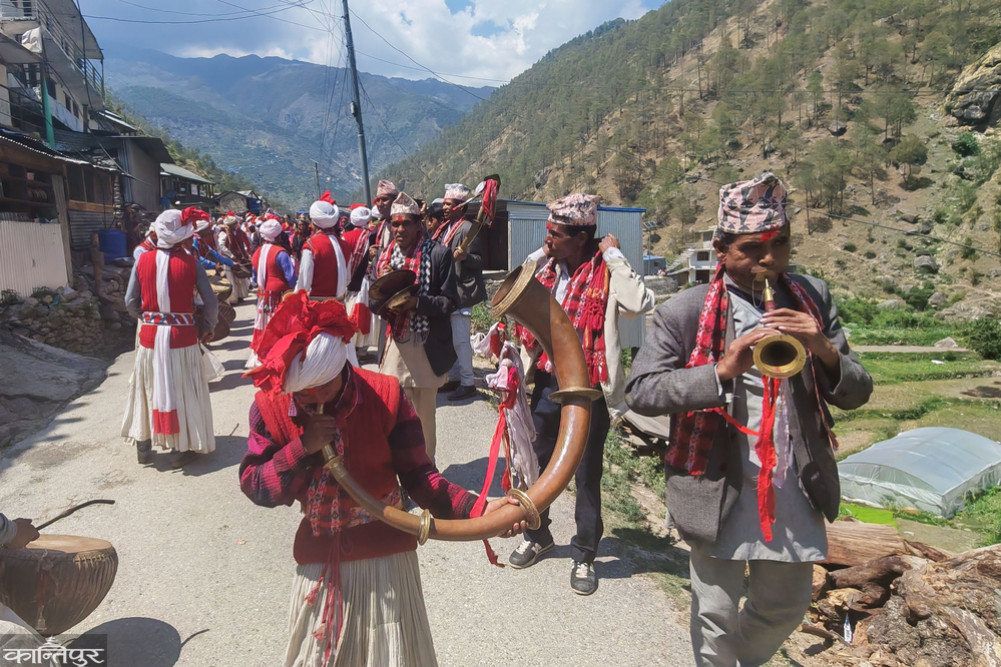
Artists carrying damaha, tamko, sahnai, jhyali, tal, madal and hoodko had reached Galje. They not only displayed their art, but also told the story of the cultural heritage that has been preserved for generations.
We use Google Cloud Translation Services. Google requires we provide the following disclaimer relating to use of this service:
This service may contain translations powered by Google. Google disclaims all warranties related to the translations, expressed or implied, including any warranties of accuracy, reliability, and any implied warranties of merchantability, fitness for a particular purpose, and noninfringement.
The resonant sound of the damaha, the melodious melody of the sahanai, and the original rhythm of the cymbals and drums. Artists dressed in traditional daura-suruwal and special costumes of the hood were roaming the market playing and dancing. Women were singing Magal, somewhere the circle of the deuda was frozen. For a few moments, it seemed that time had gone back many years.
This was the scene of the municipal-level folk instrument exhibition organized by the Tilagufa Municipality of Kalikot.
The exhibition organized with the aim of preserving, promoting and passing on the panchebaja instrument made the Galje market buzz. More than a hundred folk artists from different wards participated. The artists had reached Galje carrying damaha, tamko, sahanai, cymbals, taal, madal and hoodko. They not only displayed their art, but also told stories of cultural heritage that has been preserved for generations.
This event was special for folk artist Maisige Damai. He was thrilled to get the opportunity to present the instrument that he has been playing in his village for years on such a big stage for the first time.
'I got the opportunity to show the instrument and art that has been played since my ancestors in the municipality,' he said. 'Today, I feel that instrument players also have importance in society.'
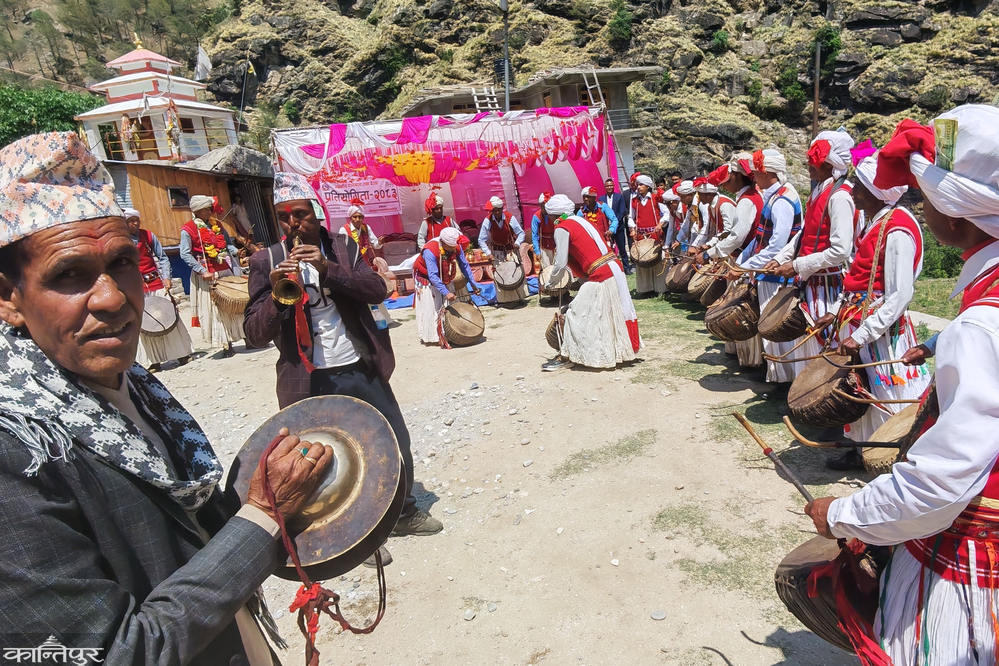
Gorkha Damai's experience is no different. According to him, in recent years, the younger generation has been losing interest in traditional instruments. It is difficult to procure the leather and materials required to make a damaha, the effort is great, but the respect and income are low. But the municipal exhibition has given them new energy. 'It has given them the courage to make better and more durable instruments than before,' he said. 'I realized that our skills are still needed.'
Tilagufa Mayor Shankar Prasad Upadhyay said that the preservation of traditional musical instruments played on births, marriages, deaths, the inauguration of new jobs and various auspicious occasions and the artists who preserve them has become a necessity today. 'Folk artists and folk musicians not only entertained in the past, but also provided information and communication,' he said. 'If we do not preserve them, there is a risk of losing these heritages.'
With this in mind, the municipality invited artists scattered across all 11 wards to the center last Tuesday and gave them an opportunity to showcase their skills and art.
Tilagufa is also the birthplace of famous Hudke artists Chine Damai and Lauke Damai of Karnali. Their art was once famous in Kalikot, Jumla, Mugu, Surkhet and Kathmandu. But after their deaths, the number of artists of the same level has been decreasing, says Upendra Prasad Neupane, spokesperson for the municipality.
However, Lauke Damai's two daughters, a daughter-in-law and a son participated in the program this time. Ward Chairman of Tilagufa-4 Khadkaraj Shahi says that their presence sent a message that the tradition is still alive. 'It has increased my enthusiasm to see the new generation taking over the art preserved by the older generation,' he said.
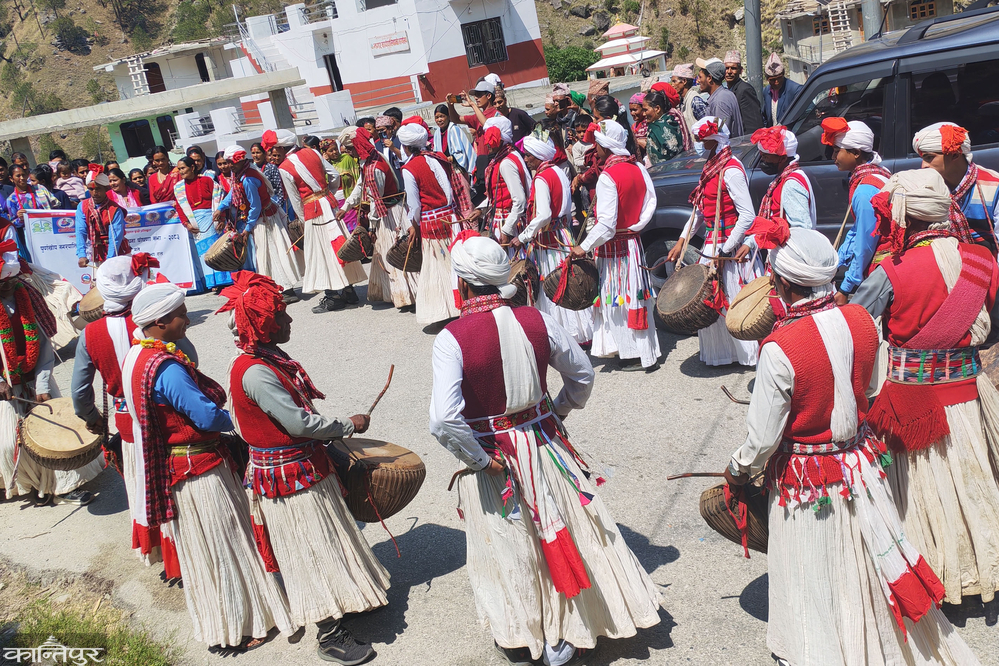
According to Deputy Mayor Mahendra Bahadur Shahi, the plan to preserve folk instruments and folk culture was included in last year's policy and program. A budget has also been allocated for that. 'Traditional culture is a subject of learning for the new generation,' he said. 'Such programs not only preserve culture but also prepare the basis for generational transmission.' The municipality, which allocated Rs 300,000 for the preservation of folk instruments and culture last year, has said that it will propose additional budget for the upcoming program as well.
According to him, folk culture is also a means of uniting society. Folk art and culture can play an important role in ending caste discrimination, increasing mutual harmony, and connecting communities.
Recently, due to the influence of modern songs and music, the exodus of youth in search of economic opportunities, and the lack of a generation of musicians, traditional musical instruments have been in crisis. Keeping this challenge in mind, the municipality has come up with a plan to encourage local musical groups, conduct skill development training, assist in the purchase and repair of musical instruments, and make the labor of artists respectable.
According to Chief Administrative Officer Bishnu Prasad Kafle, the panchebaja is the identity of Karnali. Therefore, such exhibitions are necessary to attract the younger generation and introduce our original culture. 'I really enjoyed it,' he said with a smile, 'folk musical instruments and folk culture will also attract the youth.'