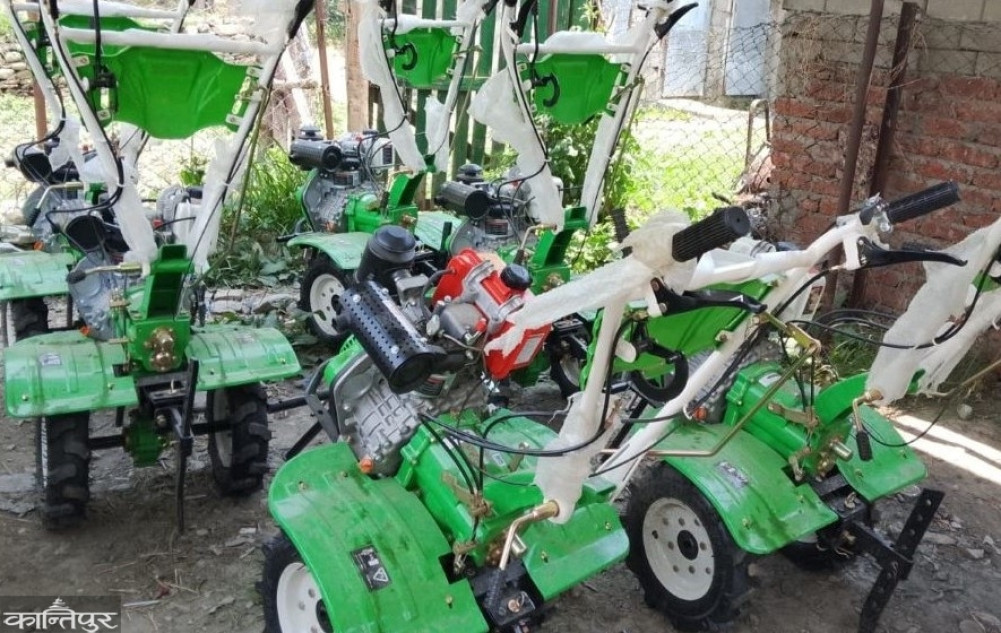
Khemraj Shahi, head of the Apple Superzone Office, said that under the Agricultural Mechanization Support Program, mini tillers are provided to farmers every year at a 50 percent subsidy.
We use Google Cloud Translation Services. Google requires we provide the following disclaimer relating to use of this service:
This service may contain translations powered by Google. Google disclaims all warranties related to the translations, expressed or implied, including any warranties of accuracy, reliability, and any implied warranties of merchantability, fitness for a particular purpose, and noninfringement.
The district-based National Agricultural Modernization Project Implementation Unit, Syawu Superzone Jumla, has been distributing subsidized mini tillers to farmers every year. Superzone Jumla has data that 319 farmers have been given mini tillers in the last seven years. Although this shows that Jumla's agricultural sector is moving towards modernization, the mini tillers that have been given every year are being stored due to lack of necessary technical knowledge. Farmer Gopal Rokaya of Hima Rural Municipality-1 emphasized the need to provide technical knowledge to farmers for maintenance along with the mini tillers. He said, "It has become easier for farmers to farm with subsidized mini tillers, but when they break down, there is a big problem due to lack of necessary equipment and technical knowledge. Most farmers are unable to repair their mini tillers and have to keep them stored." Currently, a few Nepalis from Tatopani-5 are working on mini tiller maintenance across the district. But due to lack of sufficient manpower, mini tillers in remote areas have no choice but to be abandoned after breaking down. Mini tillers have been provided to combine traditional agricultural systems with modern technology, increase agricultural production and manage labor shortages to bring barren fields into use, but it seems that the necessary knowledge and skills are needed for this.
Khemraj Shahi, head of the Apple Superzone Office, said that mini tillers are provided to farmers every year at a 50 percent subsidy under the Agricultural Mechanization Support Program. According to him, there is a provision to provide subsidies to farmer groups, cooperatives, agricultural farms and entrepreneurs. Out of the 46 mini tillers planned to be provided to farmers in the current fiscal year, agreements have been reached with 43 entrepreneurs. 18 farmers are starting to plow with them. Farmers from eight local levels of Jumla and Raskot and Tilagufa municipalities of Kalikot are receiving this service.
This year alone, Rs. 1.244 lakh has been arranged. Farmers have experienced that using mini tillers can facilitate easy tillage, especially in paddy fields and fields. Farmers are starting to be attracted to mini tillers, which operate on fuel, as they can till fields in less time and with less labor. According to the office, mini tillers were distributed to 22 people in the fiscal year 074/075, 48 people in 075/076, 46 people in 076/077, 42 people in 077/078, 58 people in 079/080 and 60 people in 080/081. ‘It seems that the attraction of farmers has been increasing in recent years,’ said Office Chief Shahi, ‘However, it is also necessary to provide the necessary knowledge and skills.’
According to the Agricultural Development Office Jumla, out of the total area of 253,100 hectares of the district, 38,486 hectares of land is cultivable. This is 15.21 percent of the total area. Of this, 12,051 hectares or 31.31 percent of the cultivable land is barren, according to the data. Irrigated land is only 3,650 hectares or 13.81 percent, while 22,785 hectares or 86.19 percent of the cultivation is still dependent on rain water. Currently, cattle breeding has been abandoned due to lack of pasture land. In this situation, even though mini tillers are necessary, farmers in remote areas are very difficult to maintain.