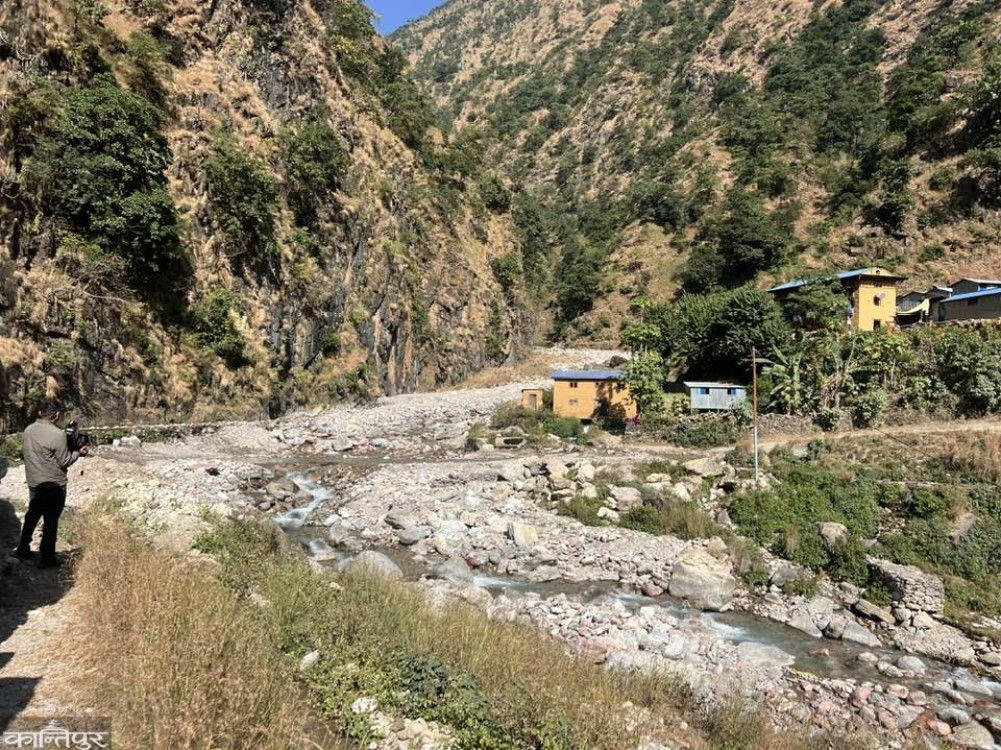
Nine bridges have not yet been built in the Karnali Corridor.
We use Google Cloud Translation Services. Google requires we provide the following disclaimer relating to use of this service:
This service may contain translations powered by Google. Google disclaims all warranties related to the translations, expressed or implied, including any warranties of accuracy, reliability, and any implied warranties of merchantability, fitness for a particular purpose, and noninfringement.
Caravan/Hirachan JV won the contract on 2077 Magh 2 for the construction of bridges at Nalgad and Jhirmekhola in Nalgad Municipality of Jajarkot under the Bheri Corridor. On the same day, Rayamajhi/Caravan JV had signed a contract agreement for the construction of bridges at Tatrakhola, Maidkhola and Tasukhola. Caravan has taken responsibility for the construction of 5 bridges at a cost of Rs 184.3 million. It has extended the deadline 3 times so far. But the bridge construction work is not yet complete.
Construction Due to which, passengers traveling on the Jajarkot-Dolpa road have been suffering for a long time. ‘Five bridges within the same municipality are abandoned,’ said Nalgad Municipality Mayor Dambar Bahadur Rawat, ‘Even though vehicles operate as usual in winter, transportation is disrupted during the rainy season. Passengers are forced to push vehicles stuck in the river to get out.’ According to him, due to the lack of bridges, people are forced to get out and get on their vehicles at places. He said that in places where there are no bridges, they are forced to carry their luggage over suspension bridges.’
After the Nepali Army opened 113 kilometers of the 118 kilometers of the Jajarkot-Dolpa road in Kartik 2076, transportation began to operate on the Bheri Corridor. Local Dayaram Dagi said that despite the long time since the road was built, the lack of construction of the bridge has made travel difficult. ‘We have been waiting for the bridge for years, but there is no indication when it will be built,’ He said, ‘If the bridge was built, vehicles would have been able to run for twelve months, our journey would have been easier.’ He said that due to the lack of a bridge, transport is being operated only during the winter season. ‘If the bridge was built, we could go directly from Nepalgunj to Dolpa in a single vehicle, and the fare would have been cheaper,’ he said. ‘When luggage is transferred, problems such as delayed arrival, breakage, and loss have started.’ He said that children, women, the sick, and senior citizens are suffering from walking on foot.
Even though the distance from Nepalgunj to Dunai is 272 kilometers, local commander Khadka said that they are forced to pay up to Rs 5,000 for the fare. According to him, due to the lack of a bridge, businessmen are charging arbitrary fares at various sections, and additional money is spent on carrying heavy loads to porters in between.
According to the Bheri Corridor Planning Office, the physical progress of those bridges is only 20 to 50 percent. Project Chief Naresh Prasad Keshari said that an agreement is being reached to give the responsibility of constructing 3 of the 5 bridges to another company and to construct two bridges by Caravan. According to him, resources have been ensured for the construction of 14 additional bridges in the section. The National Planning Commission, through the Ministry of Finance, has given its approval for the construction of bridges at Phulbari Khola, Chisapani, Khahar Khola, Ghatte Khola, Manak Khola, Rijigar, Usum Khola, Kapargad, Khadang, Khadang Bheri Bridge, Chugad, Tripurakot, Galligad, and Khorkhola under the road section.
Similarly, the construction of 9 bridges is pending in the 269-km Karnali Corridor connecting Hilsa on the China border. With the completion of the construction of the corridor, Humla was connected to the national road network since last Ashar. Separate work is being done on the corridor through the Khulalu-Sallisalla and Hilsa-Simakot projects. Of which, 9 bridges out of 15 bridges in the 123-kilometer section of the Khulalu-Salisalla section are under construction, while bridges are yet to be built in 6 places.
Bridges have not been constructed in Bhukkakhola, Serukhola, Bandukhola, Tusarekhola, Paimakhola and Makaikhola. According to project chief Visundas Lama, in this section, the Nepali Army has yet to break rocks in the 14-kilometer section from Ghatchaur to Bhukka, while road upgrading work is underway in the 23-kilometer section from Pilichaur to Kuwadi and 27-kilometer section from Kuwadi to Tumcha. He informed that the Ministry of Finance has already approved a multi-year contract agreement worth Rs 315 million for additional road upgrading.
Similarly, in the 146-kilometer section of Hilsa-Simkot, 3 bridges have been constructed, while work on 3 bridges has not been completed. The construction of bridges in Sallisalla, Chuwakhola and Gothikola in this section is stalled. Acting Project Chief Bel Bahadur Nepali said that the contract management work for the construction of bridges in Sallisalla and Chuwakhola has been completed in the current fiscal year. According to him, road upgrading work is currently being carried out in 4 sections, namely Simkot-Hilsa, Simkot-Hekpa, Chhyachhada-Yalbang and Yalbang-Iring, at a cost of about Rs 640 million this year.
Local Kamal Rokaya said that due to the lack of bridges in places along the corridor, they have to travel in a difficult manner. According to him, it takes two full days to cover the 334-kilometer distance from the district headquarters Simkot to Surkhet due to the unpaved road. ‘If a vehicle gets stuck in a river where there is no bridge, the passenger has to push the vehicle,’ he said. ‘We are forced to get off the vehicle at places and get back on.’
Mohan Rokaya of Simkot Rural Municipality-7 said that the road has not yet become reliable due to the long, risky and tiring journey on the unpaved road. ‘Without a bridge, transport services are always disrupted during the rains,’ he said. ‘During the rains, we are forced to travel painfully by crossing the river on foot and riding vehicles in sections. During the rainy season, vehicles are always disrupted.’