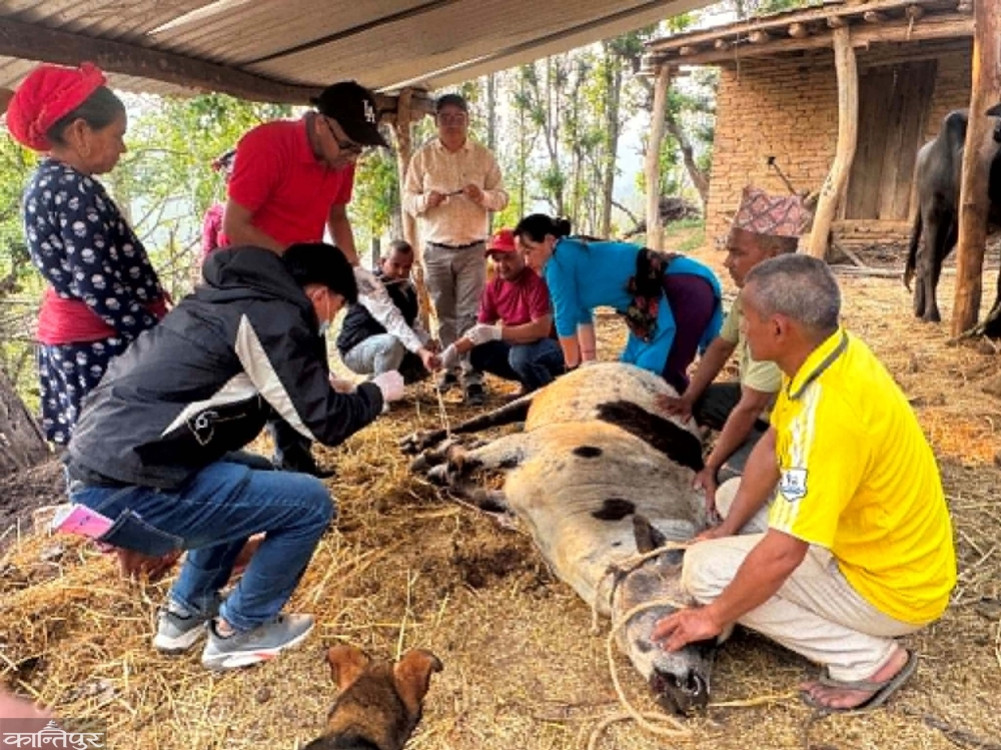
Farmers in the municipality have become concerned about the increasing risk of an epidemic as the disease is transmitted from one animal to another through the air.
We use Google Cloud Translation Services. Google requires we provide the following disclaimer relating to use of this service:
This service may contain translations powered by Google. Google disclaims all warranties related to the translations, expressed or implied, including any warranties of accuracy, reliability, and any implied warranties of merchantability, fitness for a particular purpose, and noninfringement.
In Kumakh Rural Municipality, it has been found that the infection of Khoret disease is increasing in livestock kept by farmers. As the infection of the disease increases, the livestock kept by farmers have started falling ill.
Kumakh farmers have been earning income by raising goats, buffaloes and cows and used them to meet their household expenses. As Khoret disease is transmitted from one animal to another through the air, the farmers in the municipality have become worried as the risk of it becoming an epidemic has increased.
Kali Bahadur Budha, a farmer from Kumakh Rural Municipality-4, Syanipipli, said that his two bulls, one buffalo and 10 goats have fallen ill due to Khoret disease. He informed that the disease has started spreading to others. 'The livestock affected by the disease have stopped eating grass.' Due to which they are getting weaker,' he said, 'After informing the municipality's animal branch, the veterinary hospital and animal branch office Salyan and the municipality's technical team have come and vaccinated them, but the disease has not been completely controlled.' He said that not only his own but also more than 20 families in the settlement have now been affected by the disease. Nar Bahadur Budhathoki, a farmer from Kumakh Rural Municipality-1, said that many farmers' goats, buffaloes, cows and bulls have fallen ill due to the disease. 'Many families were earning 15 to 25 thousand rupees a month by raising buffaloes and goats,' he said, 'This was the main source of household expenses for most of them. Farmers are worried that they will lose their livelihood if their animals fall ill due to the disease.'
Dr. Bishnu KC, head of the Kumakh Rural Municipality Animal Branch, said that since last week, more than 300 livestock raised by farmers in Wards No. 1, 4 and 6 of Kumakh Rural Municipality have been infected with the disease. He also informed that since it is a contagious disease, the risk of spreading everywhere has increased. He said that with the technical assistance of the Animal Hospital and Animal Branch Salyan, they have been going to the houses of farmers and treating the sick livestock, as well as administering vaccines and collecting samples and sending them to Kathmandu for testing.
Birendra KC, Information Officer of the Animal Hospital and Animal Branch Office Salyan, said that the disease was transmitted to the livestock raised by farmers from goats brought from India and that many animals raised by farmers have fallen ill because it is transmitted through the air. "The office has vaccinated sick animals to control foot and mouth disease, which is caused by a virus in the middle of the animal's hooves," he said. "After 2052 BS, there has been a surge in foot and mouth disease in Salyan."