Children showed their creative talents through videos, stories, and letters according to their interests and abilities.
We use Google Cloud Translation Services. Google requires we provide the following disclaimer relating to use of this service:
This service may contain translations powered by Google. Google disclaims all warranties related to the translations, expressed or implied, including any warranties of accuracy, reliability, and any implied warranties of merchantability, fitness for a particular purpose, and noninfringement.
At first glance, the word fair brings to mind markets, cultural, industrial and religious festivals. However, the Khandachakra Municipality here has organized a municipal-level reading fair to improve public education. The reading fair was organized to increase the speed of children's reading and improve their writing skills.
Teachers, parents and children actively participated in the reading fair organized at Panchadev Secondary School in Manma, the center of the municipality, with the slogan 'Today's reading, tomorrow's destination'. The fair was organized with the aim of developing reading and writing habits in children, accustoming teachers to creative power, making parents responsible for their children's learning, and promoting local language, culture and creativity through writing, said Jasi Prasad Chaulagain, Head of the Khandachakra Municipality Education, Youth and Sports Branch. ‘The reading fair is also important for reading skills and the use of new technology,’ he said. ‘It will boost students’ self-confidence and develop the habit of understanding and writing instead of the traditional rote reading style.’
The reading fair was organized in collaboration with SAC and SOSEC Nepal in Khandachakra to improve the situation where learning achievement is poor despite ample government investment in public education.’ ‘We have taken the reading fair as a means of learning and teaching,’ he said. ‘The reading fair will be a competition between schools and will teach them to learn from each other.’
Deputy Secretary Joshi, who was transferred from the Ministry of Home Affairs a week ago and became the Chief Administrative Officer of the city, said that the teaching community will play a role in making children moral and patriotic from an early age.’
Discussing that the school dropout rate can be reduced if children are interested in studying, Mayor Kamal Bahadur Shahi also said that Khanda Chakra has prepared a 10-year education plan for improving school education. 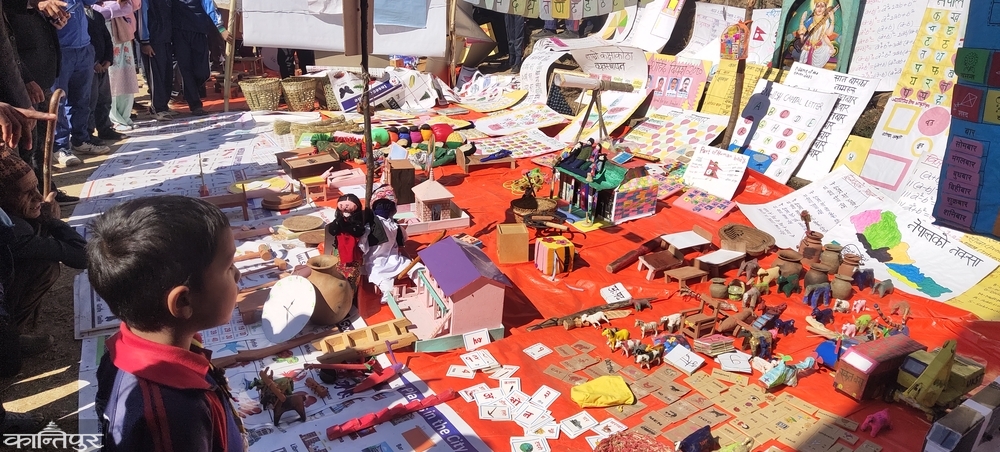
Tikaram Acharya, an educational activist from Karnali Province, said that investment from the state and parents is necessary for free and quality education. 'Although the government has declared education up to secondary school free, it has not been implemented in practice,' he said, 'For this, the state should allocate at least 20 percent of the budget to the education sector.' Acharya, who is also the executive director of the Social Awareness Center Surkhet, said that his organization is working with local levels to enhance the capacity of educational stakeholders and advocate for budget in Dolpa, Mugu, Kalikot, Dailekh, Surkhet, Salyan and Jajarkot in Karnali.
Amarjyoti Secondary School School Management Committee Chairman and civil society leader Purna Poudel said that the fair has been successful in making children competitive, teachers aware, and parents sensitive to children.
Chandra Prasad Koirala, the principal of the organizer Panchadev Secondary School, said that the fair was organized to develop a reading culture by introducing them to local materials and to exchange experiences among teachers about the materials used in inter-school teaching.
Acting School Management Committee Chairman Lokul Bahadur Shahi said that eight schools, including secondary schools and primary schools, participated in the fair. A letter game was held for grades 1 to 3, original story writing and recitation for grades 4 to 8, and a digital media video production competition was held for schools 8 to 10. He said that other participating schools observed the educational and physical environment of their schools and exchanged learning.
As students showed great interest in digital media, a video editing competition was organized among secondary school children at the fair venue, said the fair's facilitator and education officer Jagat Bham. According to him, Indira Mahat, a student of Panchdev Secondary School, who made a video on the issue of menstruation, Santosh Shahi of Janajivan Secondary School, who made a video on child marriage, cause and effect, came in second, Anuska Shahi of Mahadev Secondary School, who made a video on gender and sexual violence, and Tapendra Bishwokarma, a student of Panchdev Secondary School, who made a video on drug abuse, won consolation prizes.
Similarly, in the original story writing and recitation competition, Bhumika Thapa of Mahadev Secondary School came in first, Bharat Pariyar of Panchdev Secondary School came in second, Tapendra Bik of Bhavani Secondary School, who came in third, and Dhanshoba Pandey, a student of Janajivan Secondary School, who made a video on child marriage, cause and effect, won consolation prizes.
In the letter game competition organized for the development of reading skills of children from grades 1 to 3, Mahadev Avika Manavhadur Shahi won first place, Bhavani Avika Megra won second place, Naineldev Avika Anjali Baral won third place and Chinari Avika Shivani BK won consolation prizes.
The municipal-level reading fair organized at the initiative of the local government in Kalikot, which always hosts political fairs, has become a special attraction, said Dan Bahadur BK, a teacher at Janajyoti Avika Gaira. 'The fair has created an environment for competition for reading among schools,' he said, 'This will also help make the classrooms more vibrant.'
The fair has also helped identify the talents of the brothers and sisters of the remote areas, said Nanda Bahadur Malla, the coordinator of the municipality's social committee and chairman of Ward No. 8. He informed that investments have been made in areas such as menstrual hygiene, drinking water and sanitation in schools, including teacher management, regular school monitoring, and physical infrastructure improvements to improve the deteriorating educational quality of the district. Kamal Shahi, a member of the school's evaluation team, said that the fair was very fruitful.

