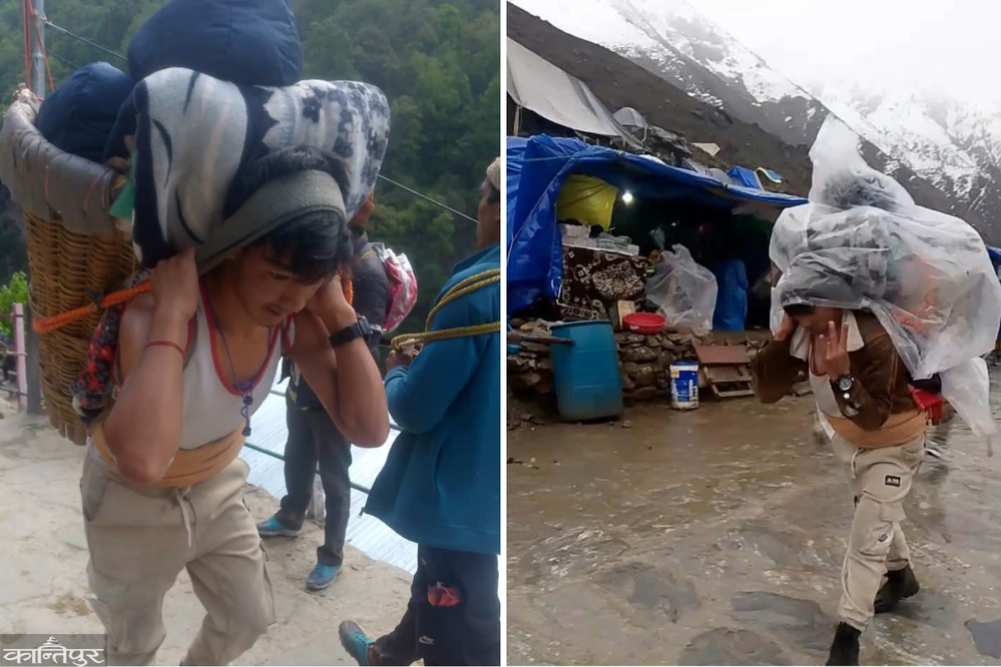
Bhim Bahadur wakes up early and looks for passengers. He carries passengers according to the weight he can carry. He has to walk 22 kilometers uphill from Gaurikund, where he lives, to Kedarnath.
We use Google Cloud Translation Services. Google requires we provide the following disclaimer relating to use of this service:
This service may contain translations powered by Google. Google disclaims all warranties related to the translations, expressed or implied, including any warranties of accuracy, reliability, and any implied warranties of merchantability, fitness for a particular purpose, and noninfringement.
Bhim Bahadur Rawat of Sinja Rural Municipality-6 in Jumla has now reached Kalapahad, India. Having passed class 12, he reached there in the first week of Baisakh to earn money for his graduation. He carries pilgrims who come to visit Kedarnath.
Since it is the season of Kedarnath, it is difficult to carry devotees. Bhim Bahadur wakes up early and looks for passengers. He carries passengers according to the weight he can carry. He has to walk 22 kilometers uphill from Gaurikund, where he lives, to Kedarnath. He says that he earns between 5,000 and 15,000 rupees daily by carrying people. ‘At this age, you have to carry books to college,’ he said. ‘I am carrying people abroad due to financial constraints.’
Along with Bhim Bahadur, other students from the village are also in Kedarnath. Bhim Bahadur said that they are paid according to the weight of the person. According to him, they charge 22,000 rupees for carrying 80 kg people, 15,000 rupees for 70 kg people, and 10,000 rupees for carrying 50 to 60 kg people. ‘I can only carry people weighing 45 to 70 kg,’ he said, ‘This work is not easy.’ Bhim Bahadur said that he barely earns two to three thousand rupees when returning from Kedarnath.
‘I studied higher education in Surkhet,’ he said, ‘I could not afford to stay for long after paying the room rent. That is why I have come to Kedarnath to carry people.’ This season, he will be in Kedarnath from Baisakh to Asoj. And he has planned to return in winter to study tuition.
Hari Bahadur Rawat from his village is also found in Kedarnath. Hari Bahadur, who has passed class 12, also has a dream of completing his graduation. That is why he has come to Kedarnath to earn money. ‘If you don’t work, you won’t be able to eat,’ he said, ‘Education has become a distant subject, and after earning some money, you plan to return home in Dashain.’ He says that he has to go to another district for higher education and has come to Kalapahad to earn money for that.
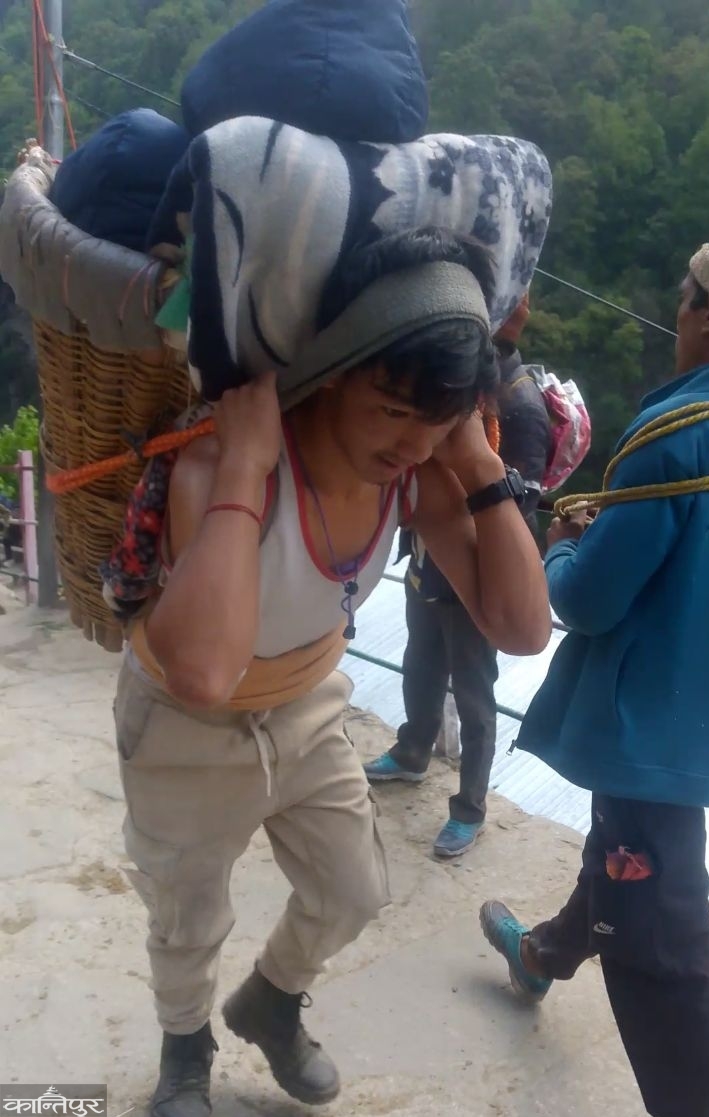 Their friend Ramesh Rawat has also reached Gaurikund to earn money to study. He wants to earn money and study. According to the Nepalis who have come to work from here, Kedarnath earns more than other areas of India. In the end, the income that is earned in a year is earned here in a month. However, there is a lot of risk. Nepali youth are attracted because they get the job of carrying elderly people and children who cannot walk uphill.
Currently, youth from Jumla, Kalikot, Mugu, Dolpa, Surkhet, Jajarkot, Salyan, Rukum, Humla, Bajura, Rukum East and other districts are involved in various jobs in Kedarnath. More than 30,000 Nepalis have reached Kedarnath, a major pilgrimage site in India where special prayers and fairs are held from Baisakh to Asoj, as wage laborers. According to Nepalis living there, there are 8 to 15,000 from Jumla alone. It is estimated that more than 35,000 pilgrims visit Kedarnath temple, one of the four major pilgrimage sites in India for Hindus, every day. Pilgrims who cannot walk to Kedarnath have been using dandi (a doli carried by four people), kandi (a doli carried by one person after cutting the rope) and horses.
Mim Bahadur Rawat of Jumla says that youth are forced to go abroad due to the lack of employment opportunities in the village. He, a 12th-grader, is also working in Kedarnath. His wife is preparing for public service in Surkhet. ‘It is not possible for both of us to study together,’ he said, ‘I have decided to return home after earning for 5-6 months.’
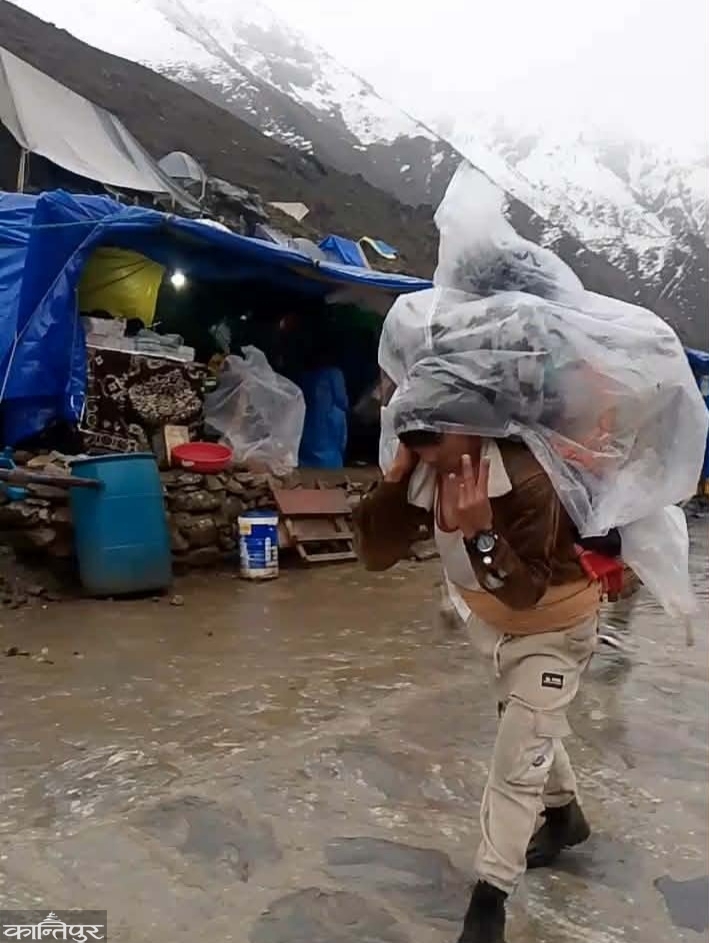 In 2080, when a landslide occurred in Kedarnath, 9 people, including 7 from the same house, went missing from Patarasi-3 Chaurgaun in Jumla. ‘There is an opportunity to earn here, but there is also a risk to life,’ said Min Bahadur, ‘Every year we keep crying out that we will never have to come. We will be forced to come again.’