In Karnali, 41 percent of women work in the formal sector, such as various government offices and organizations, while 58 percent of women are active in the informal sector, such as sewing, knitting, agriculture, domestic workers, small shops, or cart businesses, staying at home.
We use Google Cloud Translation Services. Google requires we provide the following disclaimer relating to use of this service:
This service may contain translations powered by Google. Google disclaims all warranties related to the translations, expressed or implied, including any warranties of accuracy, reliability, and any implied warranties of merchantability, fitness for a particular purpose, and noninfringement.
Usha Bik of Birendranagar Municipality-7 in Surkhet had dreamed of earning her own living since she was a child. But she got married at a young age. She dropped out of school while studying in grade 11. As she got older, the relationship did not work out. After that, Usha became alone. She did not want to add her own responsibility to her parents, who were not in a good financial condition.
‘I was always told that I had to do something, but what to do? How to do it? I was always in a dilemma,’ she said, ‘It was mentally difficult to sit without doing anything. I used to play with many things in my mind and get frustrated. I was thinking about doing something myself and becoming self-reliant. But, I did not have the money for that. ’ Her mother connected her with the organization. And Usha’s life began to take a new turn.
After taking a three-day entrepreneurship training course provided by the Dalit Women's Association Fedo, she was inspired to do something. She said, 'I learned that you can't live with violence, you have to become self-reliant.' I also got the opportunity to live in a group run by the organization.'
After living in the group, she got a loan of 35 thousand. And she started doing brisk business on a cart. She said that she is now earning a good income. She is also happy that she does not have to ask her parents for expenses. Now, she said that she is saving some money by helping with household expenses.
'This business has helped me a lot, I had nothing, now this is also a big thing for me. I felt like I could do something since I was young. Now it feels like a dream has come true,' she said, 'There are still many dreams, they will also be fulfilled gradually! Now I don't have to back down from what I like to wear and eat. That's why it has given me happiness.'
Some time ago, she had learned the work of a parlor. She also thought of starting this business. However, due to her weak financial condition, she could not afford it. Now, her relatives in Nepal have selected her for a year's free beauty parlor training and taken her to Chitwan. The cart is being looked after by her mother.
She said that she got this opportunity after joining the organization. After returning from the training, she plans to switch from the cart business to a shutter business and open a parlor, even if it is small.
The skill-based training provided by the government and various organizations in Karnali, which is lagging behind in terms of socio-economic development, has helped not only Usha, but also marginalized women with weak financial conditions to move forward on the path to self-reliance.
Secretary of Dalit Women's Association Surkhet Khagisara Wali said that women are benefiting a lot from the support provided by NGOs in collaboration with the government or on their own. According to her, there is support and coordination from international development partners as well as all three levels of government in this. Which has seen some changes not only in Surkhet but also in Karnali compared to before.
She said, 'Women have become able to run their own businesses instead of having to ask their husbands and in-laws for money. As they become financially stronger, they are also able to speak up for their rights.' 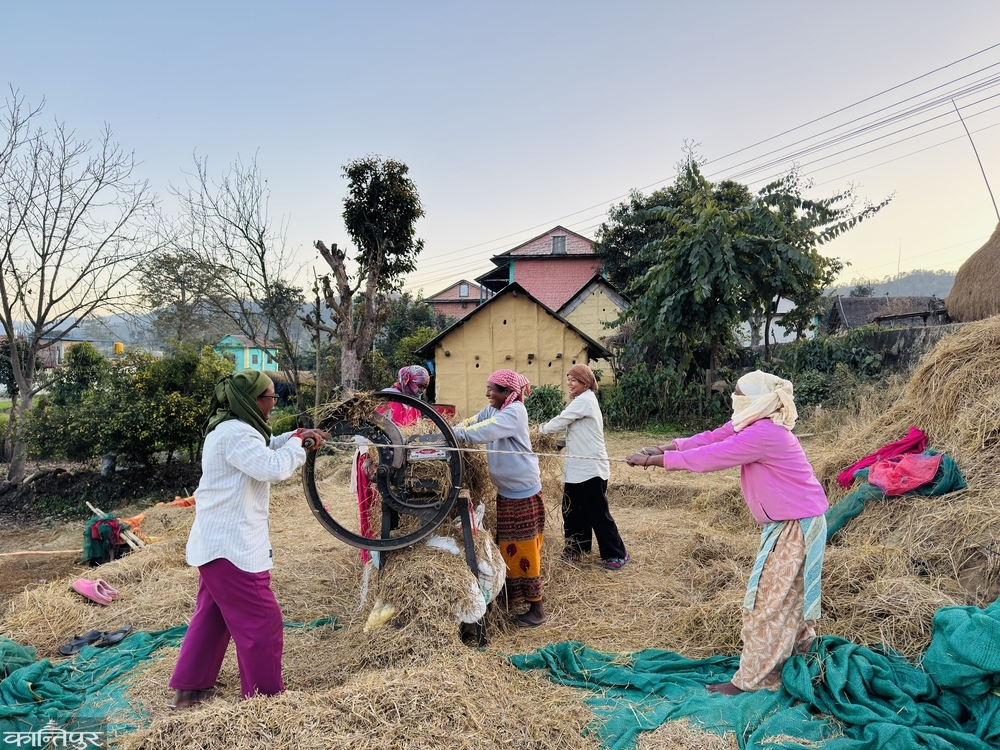
The provincial government does not have any separate data on the economic status of women in Karnali. The economic status of women has to be based on the National Census 2078. According to the census data, 33 percent of women contribute financially to the family. 32.4 percent of women are in various professions. The data also shows that 8.6 percent of women in Karnali are employers.
41 percent of women work in the formal sector such as various government offices and organizations. 58 percent of women are active in the informal sector such as sewing, knitting, agriculture, domestic workers, small shops or cart business while staying at home. Similarly, 82 percent of women are engaged in agriculture.
In the census conducted four years ago, Radhika Chaudhary and her 17 friends from Birendranagar Municipality-2 in Surkhet were counted among traditional farmers. Since December last year, they have started collective commercial farming. Currently, they are cultivating mushrooms. They have formed a group and are working on mushroom cultivation and making incense sticks.
Initially, the NGO Sosek Nepal supported them in collective farming. It also managed everything from seeds to tunnels and fertilizers. After that, they are continuing . Everyone works in 5 tunnels based on their needs .
Radhika said that lately, the income from this has been good . According to her, mushrooms have been produced four times . They produced three and a half quintals more from the first lot . They also earned 120 thousand after deducting all expenses .
They keep the amount they earn in the group . They give it to those who need it . They also distribute some of the profit . She said that after starting commercial mushroom cultivation, it has helped them meet their needs from meeting their household expenses .
‘It has become very easy,’ she said, ‘On the one hand, we have earned our own income . On the other hand, we have also saved . After earning, I will have the courage to do something and speak up.'
41-year-old Leela Chaudhary expressed her happiness saying that after starting to earn money by sitting in the group, she did not have to ask her husband for money at any time. With this, she said that she started to manage the household expenses with her own money. 'After I also started earning, it has become easier to manage the household with the income of two people,' she said. She used to have enough to eat, usually growing vegetables and other crops. Now she has also become an earner. Along with being financially independent, she has also become confident.
'If someone asked me what my name was, I would not be able to say it. I would feel shy and embarrassed.' After starting to work in the group, I also earned money, and I have gradually been able to introduce myself with confidence,' she said, 'This is also something that seems great to us.'
Not only them, experts say that the economic capacity of women in Surkhet and other parts of Karnali is gradually increasing after they are active in making agriculture a means of earning their income. The Karnali provincial government is also working to connect women to commercial agriculture through women's groups or cooperatives. Tilak Pandey, spokesperson for the Ministry of Land Management, Agriculture and Cooperatives, informed that programs such as entrepreneurship promotion and targeted programs are being implemented through women's groups or cooperatives. According to him, programs targeting marginalized groups along with women are being implemented by the ministry. Women benefit more from such programs. He says that women are more involved in agriculture in Karnali.
‘Since men are out of the house for employment, women who are at home are in agriculture,’ he said. Chitra Bahadur Rokaya, acting director of the Agricultural Development Directorate, Surkhet, said that women in Karnali are becoming active in income-generating activities. According to her, women’s participation in various programs run by government/non-governmental bodies is higher than that of men.
‘Women’s participation in programs including interest, grants and others is high even in places where budgets are not focused on women,’ he said. According to her, 70 percent of those who take advantage of government programs and are involved in agricultural programs are women and 30 percent are men. Payments also go to women.
Bina Thapa, an officer of the Social Security and Women Development Branch of the Ministry of Social Development, said that almost all ministries have started running programs targeting women according to their subjects. Moreover, she said that women are becoming active as participation in programs run by non-governmental organizations has also increased.
Social Development Minister Ghanshyam Bhandari said that the provincial government is also promoting women's economic development and entrepreneurship.
'To promote women's entrepreneurship, the government is distributing district-wise 'Excellent Women Entrepreneurs for Development' awards, women entrepreneur incentive programs, technology support to women entrepreneurs, and youth talent incentive programs,' he said. 'I believe that these programs have played an important role in helping women become self-reliant and in promoting their leadership development and entrepreneurship.'
The Ministry of Social Development has been implementing capacity and skill development programs in collaboration with various NGOs and local levels to empower women. Officials say that the women empowerment programs conducted by NGOs in collaboration with the government have sent a good message. One of these programs is ‘Empowered Women, Prosperous Nepal’. The ‘Empowered Women, Prosperous Nepal’ program has been implemented in 10 municipalities in Karnali, including Narayan Municipality in Dailekh.
Through this program, women have been provided with skills development, employment creation, entrepreneurship development, concessional loans and credit, strengthening women’s groups and cooperatives, leadership development, and violence reduction.
Kham Bahadur Thapa, Economic and Social Development Section Officer of Narayan Municipality in Dailekh, says that after the implementation of this program, women’s issues, capacity development, and economic aspects have improved compared to the past.
This program has also been implemented in Narayan Municipality of Dailekh, Birendranagar Municipality, Chaukune Rural Municipality of Surkhet, Dullu Municipality, Bhairavi Rural Municipality and Mahabu Rural Municipality of Dailekh, Shubhakalika Rural Municipality and Khadachakra Municipality of Kalikot, Sanibheri Rural Municipality of Rukum Paschim and Thulibheri Municipality of Dolpa.
Surwan Kumar Khadka, Head of the Educational Development and Social Development Division of the Ministry of Social Development, says that more than 1 billion rupees are spent by various organizations in Karnali for the economic and social empowerment of women.
He said that so far there is no clear data on how many women have benefited from women-targeted programs conducted by government or non-government organizations. Government officials say that such data could not be kept due to lack of coordination.
Bina Thapa, an officer at the Social Security and Women Development Branch of the Ministry of Social Development, says that the lack of coordination is not only causing problems in data collection, but also in duplication of programs by government and non-government organizations. “Due to the lack of coordination, problems are arising such as the same person getting multiple opportunities and some being left out,” she said.

