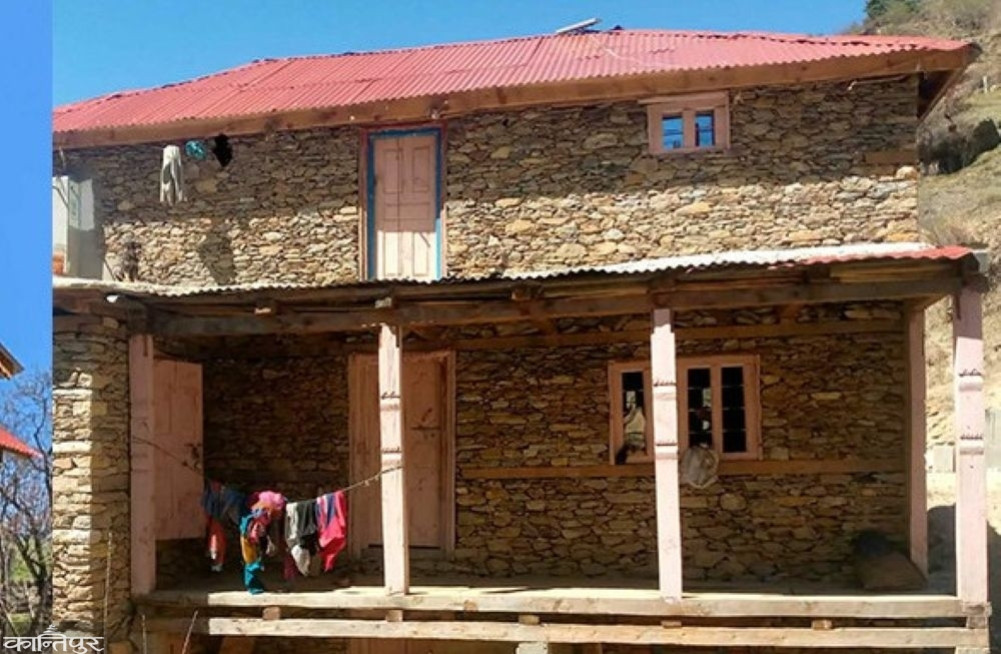
Dozens of families in Jumla whose homes were razed three years ago have received the first installment of relief, but have yet to receive the second installment.
We use Google Cloud Translation Services. Google requires we provide the following disclaimer relating to use of this service:
This service may contain translations powered by Google. Google disclaims all warranties related to the translations, expressed or implied, including any warranties of accuracy, reliability, and any implied warranties of merchantability, fitness for a particular purpose, and noninfringement.
Three years ago, Padam Bahadur Rokaya of Sinja-6 was displaced after a flood washed away his house. After his five-room house, clothes and food were washed away, his family stayed at his brother's house for a month and a half. Since they lived in a pasture near the lake, there was no human loss, but the house was not destroyed.
The government announced that it would provide Rs 500,000 to the landslide victim's family. After waiting for a year and a half, he took out a loan of Rs 600,000 and built a six-room house. After building the house, the first installment of Rs 95,000 came.
He said that he had to face a lot of hardships due to the delay in providing the government's money for the reconstruction of the house. His family of five has moved to a new house. 'The landslide took away the house. I have become indebted because the state has delayed in providing relief,' he said. This time, he said that after three years, he heard that the second installment of Rs 150,000 has been deposited in the rural municipality's account, but the relief has not been deposited in his account yet.
After the landslide swept away the two-room house of a surviving old man from Sinja-6, his family of five lived in an apple orchard for a year, seeking another house. Five of his cows and oxen died in the landslide. Even though all the food, clothes and household goods were destroyed, the family was in trouble.
After the delay in receiving the money promised by the state, he took out a loan of Rs 300,000 and built a house in Ashar last year. Now, he has a four-room house. He has a loan of Rs 100,000 to pay. He said that even if he chooses a place that is not prone to landslides and builds a house, he will still be stuck with the loan of Rs 100,000. The survivors, who received the first installment of Rs 95,000, are not even aware that this time the relief has arrived. ‘We received clothes and food after the landslide. We were hoping that relief would come very soon, but when it was delayed, we were forced to bear the burden of debt,’ he said.
According to the District Disaster Management Committee, the floods from Asoj 19 to 26, 2079 caused great damage in Sinja, Tatopani and Guthichaur. At that time, 146 houses were swept away by the flood across the district. Jumla Chief District Officer Deepak Poudel said that 102 houses in Sinja, 34 in Tatopani and 10 in Guthichaur were completely damaged.
Rs 21.9 million has been paid to 146 households completely damaged by the landslide. Poudel said that now the second installment of Rs 150,000 will be provided to each household. He said that the amount received has been sent to the rural municipality account.
Bishnu Bahadur Mahat, Chief of the Disaster Branch of the District Administration Office, Jumla, said that Rs 15.3 million has been released in Sinja, Rs 5.1 million in Tatopani, and Rs 1.5 million in Guthichaur. He said that the amount arrived late while completing the process.
The grant distribution process had been initiated as per the recommendation of the Provincial Disaster Management Committee and the decision of the Karnali Provincial Government Council of Ministers on Jestha 13. The District Administration Office has stated that the provincial government is going to pay 30 percent of the amount through the concerned local level as per the Monsoon Disaster-Affected Private Housing Reconstruction and Rehabilitation Grant Procedure 2077 and the Fire Disaster-Affected Private Housing Reconstruction and Rehabilitation Grant Distribution Procedure 2078. He said that the decision to pay was made on the basis of the measurement report submitted by the technicians of the Intensive Urban and Building Construction Project.
The district disaster management fund has a standard of 20 percent for the local level, 30 percent for the provincial government, and 50 percent for the federal government. There is a provision to provide Rs 500,000 for the construction of new houses for those affected by complete house damage and Rs 50,000 for those with partial damage. There is a provision to become a beneficiary only after the recommendation of the local level and the necessary documents are completed.
Sinja-6 Ward Chairman Lal Bahadur Budha said that the first installment was Rs 50,000 from the rural municipality and Rs 45,000 from the federal government, making it Rs 95,000. But now, he said, Rs 150,000 has been received per household as the second installment. He said that the victims have been even more affected by the delay in providing relief by the government. He said, ‘Landslide victims have built houses by taking loans, but they are carrying a huge debt.’
According to the District Administration Office, there is a provision for flood and landslide victims to receive Rs 545,000 per household. The administration has also informed that a demand for Rs 300,000 has been made to the federal government for the third installment. At that time, the floods and landslides had damaged 18 hectares of marshy fields, more than 400 irrigation canals and about 1,200 private structures in the district, both completely and partially.
Sinja Rural Municipality Chairman Purna Prasad Dhital said that the second installment, although delayed, has provided relief to the victims. He said, "We will send the second installment directly to the accounts of the beneficiaries who have already built houses with the first installment and worked on loans." The said flood had damaged the marshy fields of 1,200 farmers in Jumla. 18 hectares of marshy fields had become barren. After the government sent a budget that provided relief of Rs 412 per farmer, the farmers of Jumla had rejected the relief amount.