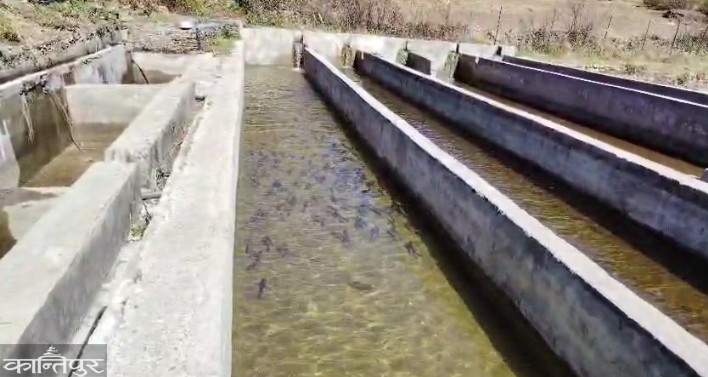
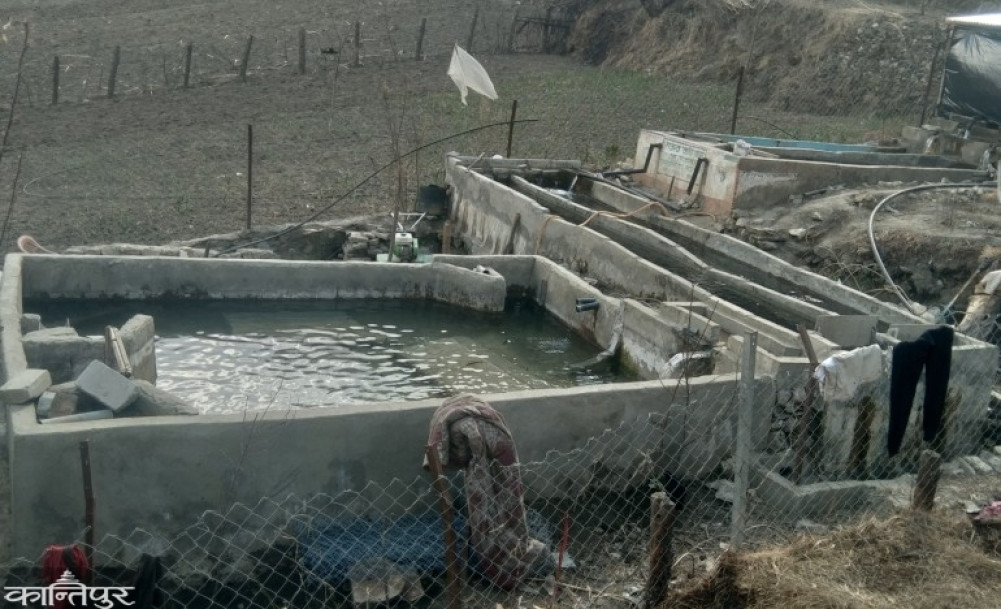
Farmers from villages including Chandannath and Patarasi have been increasing their investment in trout fishing, making fish available at affordable prices in the local market.
We use Google Cloud Translation Services. Google requires we provide the following disclaimer relating to use of this service:
This service may contain translations powered by Google. Google disclaims all warranties related to the translations, expressed or implied, including any warranties of accuracy, reliability, and any implied warranties of merchantability, fitness for a particular purpose, and noninfringement.
The district has become self-reliant through fish farming. They have started it after acquiring the necessary knowledge for fish farming. Devendra Raj Giri of Chandannath-9 and Dilli Bahadur Rawal of Ward No. 6 have been farming rainbow trout for the past 6 years. In 2077, they brought 15,000 fry from Nuwakot. Since it was their first time, they could not save the fry. ‘They did not have any technical knowledge,’ Rawal said. ‘At that time, it cost Rs 19 to bring a fry to Jumla.’ After that, after acquiring knowledge, they have been releasing the fish fry into the pond every year. According to Giri, the first year was just an experience. In the second year, they were able to sell some fish. ‘Now, big fish are brought from Pokhara and kept in the pond,’ Giri said. ‘We have brought one and a half quintals of fish from Pokhara and kept in the pond.’ Now the goal is to produce fry from these.'
So far, more than 90,000 fry have been placed in the pond. However, they say that they are not making much income because they are still in the trial period. Rainbow trout costs 1,800 rupees per kilogram in the market. They are selling it for 1,300 rupees. 5 canals have been made in a large pond. Up to one and a half quintals of fish are produced in one canal.
Giri said that he brought fry to a canal near his house seven years ago. After a few years of testing, all the fish died due to frost after they grew well. He said that he immediately went to the website and studied about rainbow trout fish. ‘We have started raising rainbow trout commercially because they grow in cold climates,’ he said. ‘So far, more than Rs 5 million has been invested in fish farming, purchase of fry, feed, and construction of structures.’
He said that at some point, land was even rented for 10 years to build a hotel in the same place where the fish is raised. The fish is consumed in the district headquarters Khalanga and surrounding markets. If it can be raised well, it can be taken to the markets of Surkhet, Nepalgunj, Mugu, and Kalikot, Rawal said. ‘The fish is delicious because it is grown in cold weather. There is also a lot of demand,’ he said. ‘However, there is a problem because there are no fish experts in Jumla.’
Gyanendra Singh Budthapa, the head of the Animal Hospital and Animal Services Office, Jumla, said that there is no separate fish expert in the office. He said, ‘There should be employees with technical knowledge for fish farming, but there are none.’ Currently, common knowledge is being shared with fish farmers. But it is not easy to provide technical knowledge. He said, ‘So far, no major disease has been seen in fish. If a disease is found, it seems that the farmers will have to bear a big loss.’ He also said that a program will be formulated to encourage fish farmers next year. According to him, farmers are currently getting technical knowledge from wherever they are bringing their fry. Trout is a high-value fish in Nepal that is raised in cold, clean and flowing water. Rajendra Budha of Patarasi-6 has been raising fish for five years. He said that there is potential for fish farming in the cold climate. ‘You can earn money from this,’ he said. ‘There was no shortage of people in the village who would talk to you when you built a pond.’ Now, even the neighbors are laughing when they produce fish and take it for sale.’ In 2077, 15,000 fry brought from the gold mine in Nuwakot did not grow up. Budhra says that out of the 30,000 brought from Rasuwa for the second time, 20,000 fry have grown up.
‘Out of those 20,000, there are 10,000 fry in the pond,’ he said, ‘I have already sold 10,000 in the market.’ It has been two years since he started earning income from fish farming. He said that he has sold fish worth 732,000 rupees during this period.
There are now 15,000 fish in the pond that can be sold. So far, 1.775 million rupees have been invested. He says that there is a good possibility of earning good income from fish farming as the income is increasing every year. The fish produced are sold in the Khalanga market in the district headquarters, to employees and hotels. Since the fishpond is about 8 kilometers away from the district headquarters, Khalanga, not everyone can go to the pond to get fish. 'They order from the headquarters,' said Budha, 'I have made arrangements to carry the fish and deliver it to their homes.'
Budha is encouraging farmers to engage in fish farming by sending fish fry to Dolpa and Sinja. He had started fish farming by providing 10,000 fry in Gidikhola of Tatopani. A family of 6 is engaged in fish farming. Fish farming is also sending a message that it will create employment in the country. He says that he considers this a good achievement.
Ganesh Budha of Patarasi-7 also started fish farming in 2077 BS. After farming fish for a year and a half only as a test, he is now doing it professionally. For the first time, he put 160 fry in the pond. All survived. From there, he became passionate about fish farming. Last June, he built two ponds and released 5,000 fry. They are now well-grown.
He has already sold 45 kg of fish to the market at the rate of Rs 1,800 per kg. Ganesh said that he takes the fish to the market in Khalanga and the local municipality center. Now, there is 1 quintal of 70 kg of fish left in the pond. This is also ready to be taken to the market. In 2012, Ganesh went to Saudi Arabia for the first time for foreign employment. From there, he returned home in 2014 and went to Kuwait again in 2015. From there, he returned home in 2020.
‘After that, the idea of farming fish in the village arose,’ he said. After returning from Kuwait, he chose water and soil. "I don't always have work to do abroad," he said. "I chose the fishing business in my own village with the thought of doing something at home."