This year's festival, which began on Saturday, ended on Monday.
We use Google Cloud Translation Services. Google requires we provide the following disclaimer relating to use of this service:
This service may contain translations powered by Google. Google disclaims all warranties related to the translations, expressed or implied, including any warranties of accuracy, reliability, and any implied warranties of merchantability, fitness for a particular purpose, and noninfringement.
On the third day of the seventh edition of the Karnali festival ‘Kuda Karnali’ organized in Birendranagar, discussions ranging from women’s leadership, tourism, local culture to cinema were held.
The speakers who spoke in the first session ‘Ghumifiri Karnali’ on the last day pointed out that despite Karnali having immense tourism potential, tourists are not returning due to the lack of ‘hospitality’. Gurans Rural Municipality Chairman Top Bahadur VC said that tourists have suffered due to hardships on the road, expensive transportation, risky roads, lack of guides, food and accommodation. ‘The trend of feeding tourists noodles and biscuits brought from the city instead of local millet, phapar and beans has not benefited the local economy much,’ he said, ‘The situation where tourists only leave garbage here but do not spend money should end.’
Tourism entrepreneur Devraj Jaishi said that although the Karnali and Bheri rivers are among the best rafting destinations in the world, they have not been able to benefit due to lack of infrastructure. ‘The era of thick books and brochures is over,’ he said, ‘Karnali needs to be promoted through modern means with brands like Discover Karnali or Adventure Karnali.’ 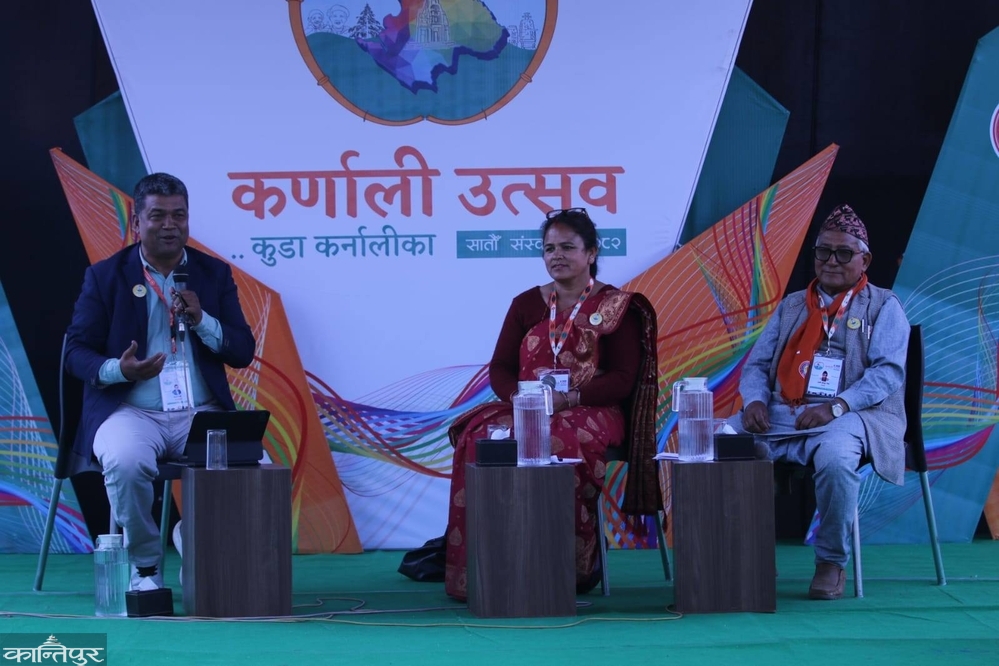
Activist Radha Poudel said that tourism is not just about traveling but is also linked to a person’s physical, mental, spiritual, emotional, social and environmental health. ‘Karnali’s clean environment, herbs and natural beauty are exemplary in Nepal,’ she said, ‘A lot can be gained from health tourism through Karnali’s herbs.’ Secretary of the Ministry of Industry, Tourism, Forest and Environment of Karnali Province, Ajit Kumar Karna, informed that a 10-year long-term master plan has been prepared for the development of tourism in Karnali.
Speaking in the most attractive session ‘Nakhichieka Cinema’, actor Rajesh Hamal said that he has the possibility of entering politics when the time comes. ‘I am a person who is interested in politics, who understands it,’ he said, ‘so one day that may also be possible.’ He says that the library of an artist is the life he has experienced and the acting he has done.
Although the story of Nepali cinema is the same, Hamal said that the presentation style is changing. ‘At one time, when a new cinema was released, it was like a festival, most of the audience would argue for months about how such a cinema was made,’ he said, ‘Now everyone has a movie in their hands, people are making movies in some way or the other, earlier only artists used to act in films, now everyone is acting through TikTok.’ He said that now, when going into a cinema hall, acting should be different from what the common people do. 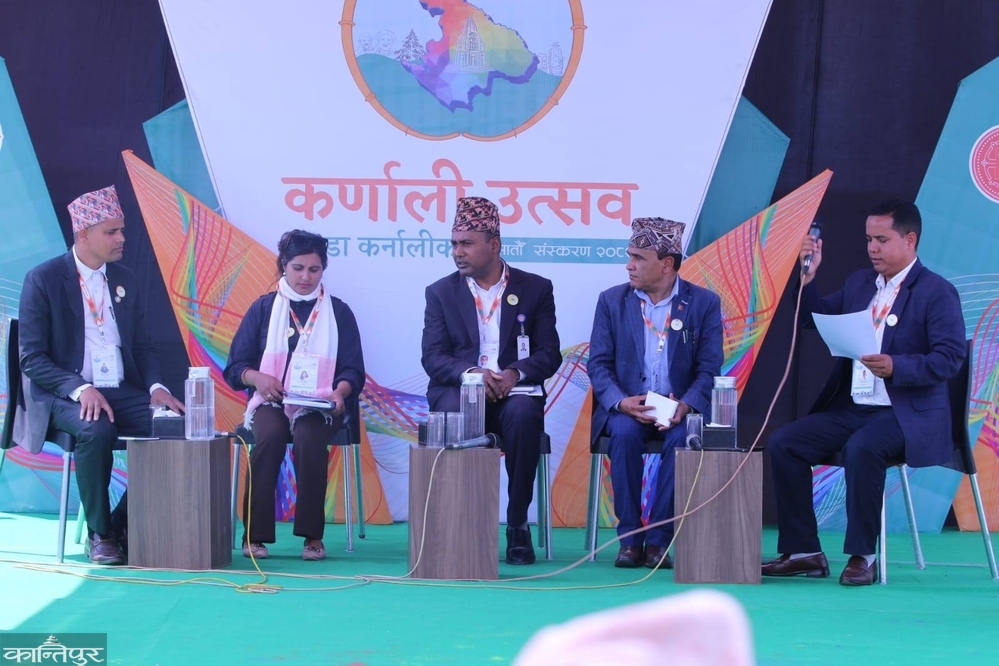
Hamal says that while acting, an artist should immerse himself in the depth of the character as much as possible. He complained that although in the past, the lifestyle, appearance and lifestyle were portrayed on the screen as they were, now the lifestyle has started to be normalized. ‘In the cinema of that time, there was a deep connection between people's lives and the screen, songs, acting, conflicts all conveyed different messages,’ he said, ‘Now only entertainment has been conveyed, messages are often not found in new films.’
Speaking in the next session ‘Himalayan Medical System: Soba Rigpa’, Amchi Pema Lama Yankar said that the science of treatment is in the words of the Buddha. ‘Soba means treatment and ‘Rigpa means science,’ she said, ‘This system has developed as a question and answer session between the Buddha and the sages.’
The public representatives participating in the next session ‘Women's Heads’ emphasized that women should reach decision-making positions for the real transformation of society. Dhansara Bohara, Deputy Mayor of Bheriganga Municipality, said that society will not change unless women are economically empowered. ‘There is a lot of pressure when working in the judicial committee, but we always stand for justice,’ she said, ‘Even when women are given only a supporting role, they are still missing out on women’s leadership.’
Gaindakot Municipality Deputy Mayor Shanti Koirala said that women have recently been oriented towards self-reliance. ‘Nowadays, women are committed to standing up and serving wherever society seeks them,’ she said, ‘Despite the challenging political environment and social obstacles, women are maintaining judicial impartiality.’
This year’s festival, which began on Saturday, ended on Monday, according to the organizer, the Riti Foundation.

