”Earlier, we used to walk home, but now we can reach our doorstep by car in a day,” said Dr. Dipendra Rokaya, a resident of Humla and former member of the Karnali Provincial Planning Commission. ”With the construction of the road, the compulsion to go to the market and the country is being eliminated.”
We use Google Cloud Translation Services. Google requires we provide the following disclaimer relating to use of this service:
This service may contain translations powered by Google. Google disclaims all warranties related to the translations, expressed or implied, including any warranties of accuracy, reliability, and any implied warranties of merchantability, fitness for a particular purpose, and noninfringement.
After the construction of the Bheri-Karnali Corridor, the lives of the people of the remote areas here have become easier. The Nepali Army has built the road by removing the rocky terrain on both the routes. Even now, the army is building the road by overcoming the difficult terrain.
The construction of the Karnali and Bheri Corridor routes has reduced the suffering and hardship of the common people. It has also opened the door for trilateral trade between Nepal-India-China. Therefore, the army has considered these routes as roads of national strategic importance.
The Karnali Corridor route starts from Jamuna in Nepalgunj and ends at Hilsa in Humla. Its length is 682 kilometers. The Bheri Corridor route starts from Banke and passes through Surkhet, Salyan, Jajarkot, Rukum West and Dunai Tinje in Dolpa to the border of the Tibet Autonomous Region of China. Although the Karnali civilization is old, the locals are equally burdened with deep pain when it lags behind in development. The construction of the Karnali Corridor has helped to alleviate the pain. This road is connected to the future of the residents here. Despite the challenges in construction due to difficult terrain and high rocks, the army is working continuously. 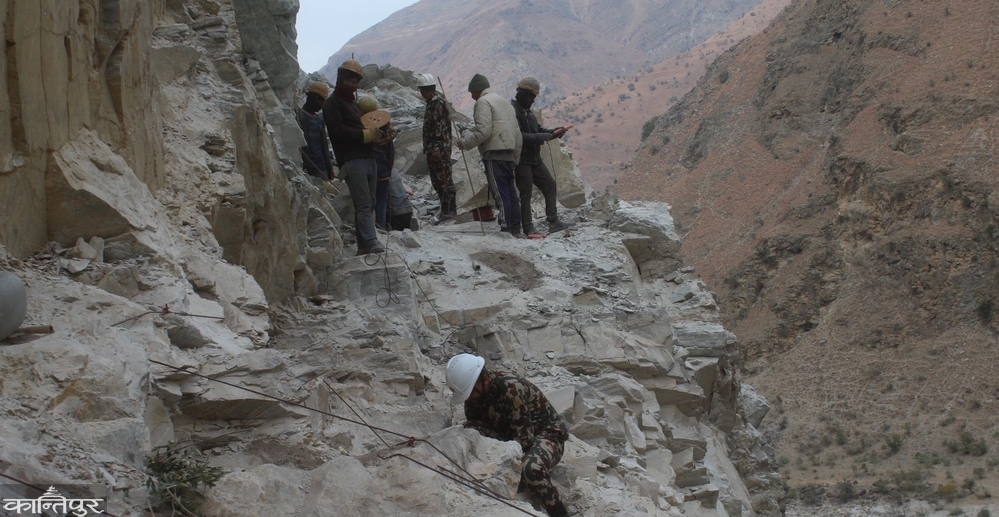
Nearly 80 percent of the land under the corridor in both areas is rocky. Corridors are currently being built under the Karnali Corridor in Kalikot and Bajura districts. In the absence of roads, the residents of the hills used to travel 17 days from Humla across Karnali to Rajapur in Bardiya. They would buy clothes and household necessities there and return.
‘Earlier, we used to walk home, now we can reach our doorsteps by car in a day,’ said Dr., a resident of Humla and former member of the Karnali Provincial Planning Commission. Dipendra Rokaya said, ‘After the construction of the road, the compulsion to go to the market and the country is being eliminated.’ He said that this change is not normal for citizens like him who grew up in the mountains. He said that the hardships they had to endure to buy essential goods including salt, oil, and clothes have reduced. According to him, now vehicles have started delivering goods to the courtyard.
He said that due to the lack of roads, patients are dying prematurely because they cannot be taken to the hospital. ‘With the road in Humla, many settlements in Karnali have been connected to the national highway,’ Rokaya said, ‘The road has not only saved time, but also reduced costs.’ He said that the Nepali Army has made a great contribution to providing roads in Karnali. He said that the Nepali Army lost its life while breaking large rocks. According to him, Vijay Lama of Humla is the first businessman to provide food, roads, and vehicles to the district. 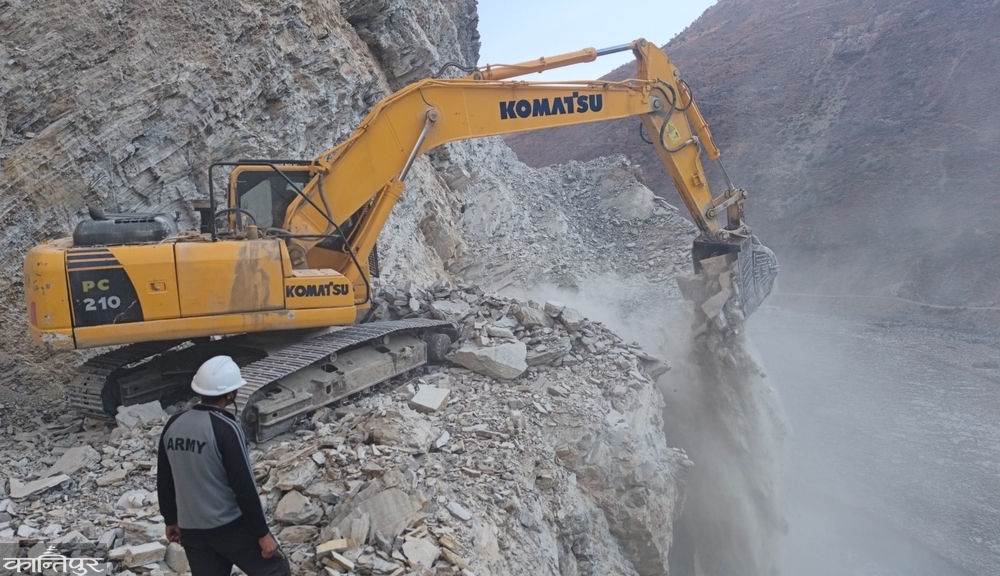
He said that tourism was being promoted in the district, and rice was also being transported by helicopter and ship. ‘We suffered a lot,’ he said, ‘now a lot has changed.’ Earlier, patients would die due to lack of medicine. They had to be carried to the hospital. He said that salt, which costs Rs 250, was available at a cheap price because the army had connected Humla to the road network. ‘The army has not only broken rocks, but has drawn a roadmap for the development of Karnali,’ he said, ‘They have broken rocks on road sections that have been blocked for years and carried out construction work.’
He said that earlier, due to the hard rocks, steep terrain and the risk of landslides, there was no sense that the road had been built. According to businessman Lama, the construction of the road has had a positive impact on tourism and overall economic activity.
After the construction of the corridor, Yarsagumba, Jatamsi, apples and walnuts produced in districts including Humla, Dolpa and Jumla have found national and international markets. Now, one can travel from the Indian border town of Rupaidia in Nepalgunj to the Chinese border town of Hilsa via the Karnali Corridor in a single vehicle. ‘After the construction of the road, development and change are becoming possible even in remote settlements,’ said Jas Bogati of Kalikot, ‘We used to carry patients to the hospital in a cart, now ambulances arrive right in the courtyard.’
Former Chief Minister of Karnali Province, Jeevan Bahadur Shahi, said that the Bheri-Karnali Corridor has connected the people of the Himalayas with the Terai. Shahi said that it will become a strategic trade route as it connects the hills and the Terai with two neighboring countries. ‘The Karnali Corridor is a strong route with potential,’ he said, ‘It is linked to the fate and future of thousands of citizens.’ He said that due to this route, the residents of remote areas have started dreaming of prosperity. 17 Nepali Army personnel have lost their lives during the construction of the route. So far, Rs 661.756 crore has been spent on the Lalibagar-Dullikunna, Ghatparichaur, Badrigaun-Bhukka Khola sections under the corridor.
According to the decision of the then Council of Ministers on Chaitra 2071, the army had started work on the Karnali Corridor by forming a task force. The army is responsible for constructing 122.75 kilometers from Bajura in Humla to Sallisallah in Kalikot via Khulalu. Of which, 40 kilometers in Kalikot, 44 in Bajura, and 38.75 kilometers in Humla have been completed and handed over to the Road Department on Asad 18, 2078. Then, on Asoj 2078, the Council of Ministers gave the army the responsibility of constructing 11.5 kilometers of Bhukkakhola in Bajura via Ghatapanichaur in Kalikot and 7 kilometers of Humla.
On Falgun 16, 2078, 4 kilometers were added to it. After completing the work on this section, the army handed over the Hilsa-Simkot road project on Mangsir 29, 2081. On Poush 19, 2081, the Council of Ministers also gave the army the responsibility of constructing 800 meters of rocky road.
Nepali Army Assistant Lieutenant General and Spokesperson Rajaram Basnet said that according to the constitution of Nepal, the army can also be deployed in development construction. According to which, the army has been working on the construction of road networks in geographically remote and difficult terrain and places of strategic importance, he said. ‘80 percent of the road we were entrusted with in the Karnali Corridor was covered with hard rocks,’ he said, ‘I am proud to be working on the road that is the vehicle of Karnali’s prosperity.’
14 years in the Bheri Corridor
Due to the poor accessibility of the Bheri Corridor route, the residents of Dolpa were forced to travel via Manang-Mustang. This route starts from Banke and goes through Surkhet, Salyan, Jajarkot, Rukum West and Dunai Tinje in Dolpa to the border of Tibet Autonomous Region of China. It is also considered an important trade route connecting India and China.
The Karnali and Bheri corridors are equally important for expanding trilateral trade. The Nepali Army had set up camps for 14 years to build the Bheri Corridor route. It had set up 12 camps in Jajarkot and Dolpa and worked. The army has stated that it has completed the work of the Bheri Corridor using 20/22 compressor machines daily.
In 2061/062, the army set up camps to build a road from Sallibazar in Salyan to Chaurjahari in Rukum and from Jajarkot to Dunai in Dolpa, and worked regularly for 14 years, said Assistant Lieutenant Colonel Bishwabandhu Pahadi, commander of the army's Jajarkot-Dolpa Road Construction Task Force. He said that 12 camps were set up in Jajarkot and Dolpa. During this period, not only roads were built, but also 7 bridges were built in Kalikot, Bajura and Humla. 'After the road reached Dolpa, the lives of the people there have changed,' he said, 'Dolpa is very large in terms of terrain.'

