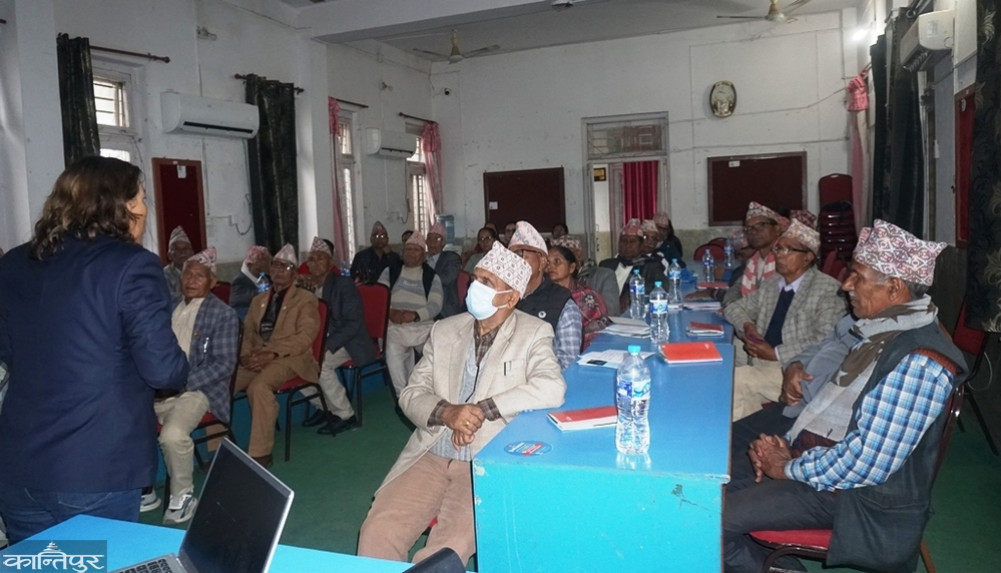
A team of psychiatrists, psychologists, and administrators led by the Ministry of Social Development is reaching every local level and interacting with public representatives, health workers, and local leaders.
We use Google Cloud Translation Services. Google requires we provide the following disclaimer relating to use of this service:
This service may contain translations powered by Google. Google disclaims all warranties related to the translations, expressed or implied, including any warranties of accuracy, reliability, and any implied warranties of merchantability, fitness for a particular purpose, and noninfringement.
Considering the growing mental health problems, the Karnali provincial government has started working by giving priority to mental health. A team of psychiatrists, psychologists and administrators led by the Ministry of Social Development is reaching every local level and interacting with people's representatives, health workers and local leaders.
The provincial government has been allocating a budget of around 6 million to 10 million rupees every year to institutionalize mental health. The budget has been spent on mental health-related programs, service expansion, public awareness raising and capacity building activities.
Programs have been organized in every village according to the 'Mental Health and Psychosocial Strategic Action Plan 2079' to promote mental health. Interactions have been held at every local level to provide information about mental illness at the local level by including mental health in local level policies, programs and budgets.
Mental health focal person under the Ministry of Social Development, Khagendra Prakash Gaire, said that mental health training is being provided to officials and health workers of all 79 local levels of Karnali. According to him, programs have been conducted in 43 local levels since the fiscal year 2079/80.
Recently, in an interaction held by the ministry in Chingad Rural Municipality of Surkhet, the participating public representatives expressed their commitment to allocate a separate budget in each ward and run the program by prioritizing mental health.
In the program, Dr. Pooja BC Koirala, a psychiatrist working at Karnali Provincial Hospital, Surkhet, clarified the treatment process related to mental illness and the existing misconceptions and myths in the society. ‘There is a tendency in our society to mistreat, belittle, and belittle people with mental health problems,’ she said, ‘That is why we are running such programs so that you can reach your community and provide correct information.’ You work closely with the local citizens, so it is necessary to inform them about this.'
According to her, the treatment of mental illness is not limited to medication alone but is also possible through counseling and therapy. She emphasized the need for gentle behavior, sympathy, and patience towards people with mental problems. She also urged the community to take the initiative to provide counseling to people with such problems and take them to the relevant agencies for treatment.
Dr. Koirala informed that the Government of Nepal has been providing 12 types of mental health-related medicines free of cost, and said that most problems can be treated at the initial stage. Participants in the program also pointed out the need to increase public awareness about mental health and to allocate a separate budget for the local level to run the program.
At the program, Khagendra Prakash Gaire, the focal person for mental health at the ministry, said that the suicide rate due to mental problems is increasing and that the active role of the local government is necessary. According to the National Health Research Council, 42 percent of Karnali residents suffer from anxiety and 23 percent from depression. According to the data, 11.7 percent of people suffer from some kind of mental illness. Gaire emphasized that in order to prevent suicide, people with mental problems should be identified at the community level and timely treatment should be carried out, and access to services should be expanded at the local level.
Psychologist Laxmi Tamang conducted various exercises with the participants to talk about the importance of psychosocial support. She emphasized the need for balanced health in terms of physical, mental, social and spiritual aspects and stressed the need to create a supportive environment in the community. Tamang is the first psychologist in Nepal to be appointed to a government position and working in Karnali Province. She came to Karnali a year ago. Although she was already a psychologist at the provincial hospital, she is working through non-governmental organizations.
Ward Chairman Bir Bahadur GC of Chingad Rural Municipality-3 said that his ward has been working by allocating a budget since last year. He said that such programs related to mental health will make it easier to work at the community level. Chairman GC said that all public representatives and health workers need to know about this. He expressed his commitment to take the initiative to allocate the budget by prioritizing mental health in the upcoming budget and programs.
Chief Secretary Birendra Kumar Yadav said that mental health problems are not only in rural areas but also in urban areas and said that public awareness is needed. He said that mental problems are increasing due to people seeking only rights but not focusing on duties in any matter. Chief Secretary Yadav urged people to reach the local level and teach other citizens the subjects they have learned about mental health. He said that while formulating the budget for the coming year, the budget should be allocated in such a way that such public awareness programs should be conducted in local schools and other areas as well.
Secretary of the Ministry of Social Development, Dholak Raj Dhakal, said that the program was organized to inform the public that the government provides free mental health services and to encourage local people to refer such patients to provincial hospitals. He urged that mental health should not be prioritized while formulating the budget for the upcoming fiscal year. Secretary Dhakal pledged that the provincial government would provide additional support if the local level allocates even a small budget.
The ministry has also trained public health inspectors, senior AHEBs, AHEBs, etc. working in basic, primary, urban and other health institutions in all 10 districts of Karnali province under the implementation of the mental health strategy. After the training, health workers will be able to identify, diagnose and treat mental problems and refer complex patients, the ministry said.