He said that using Newton 'B' hives, bees can be taken to the Terai during the winter season. He said that if the government is interested, bee production, hive construction and even technological skills can be provided in Jumla itself.
We use Google Cloud Translation Services. Google requires we provide the following disclaimer relating to use of this service:
This service may contain translations powered by Google. Google disclaims all warranties related to the translations, expressed or implied, including any warranties of accuracy, reliability, and any implied warranties of merchantability, fitness for a particular purpose, and noninfringement.
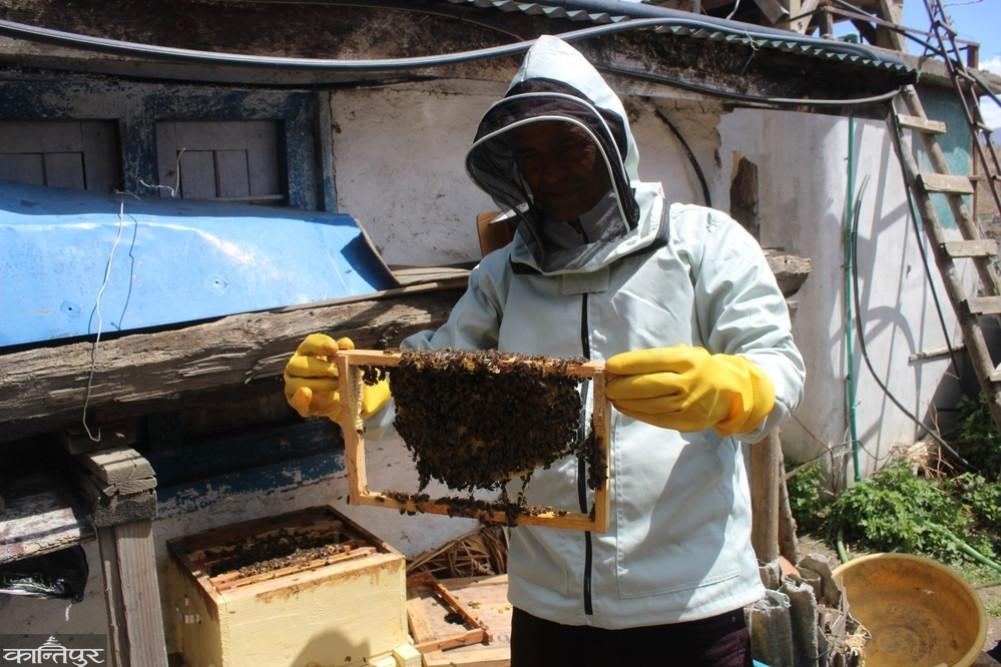
Narayan Chaulagain of Chandannath-4 has been active in beekeeping for 40 years. He has been providing care, protection and encouragement to farmers for beekeeping. ‘Karnali’s geography is suitable for beekeeping,’ he said, ‘However, raising bees in the traditional way is not making the expected progress.’
Having studied the methods adopted by his ancestors, he is now understanding the current state of beekeeping. He said that he is studying new skills that can be adopted in beekeeping in the future. He has been keeping bees around his house. The humming of bees can be heard as soon as you enter his yard. He is keeping bees in traditional mudhe, jumla topbar, jumla new topbar and Newton ‘B’ hives.
He built Jumla Topbar and Jumla New Topbar hives. Now these hives have reached other beekeepers. He, who started beekeeping from Mudheghar, built Jumla Topbar hives himself.
He said that after beekeeping in this hive was good, he built a new Jumla Topbar. He said that he built the new hive with the aim of saving bees. ‘Bees were dying due to an unknown disease,’ he said, ‘Since honey production was low, there was no way to take bees to the grazing area.’ After developing the new hive, the bees are surviving.’ He is also not completely satisfied with the hives he has developed now. He says that these hives are not comfortable for bees to live in, they cannot be monitored for diseases in bees, and they are not mobile.
‘To solve that, a hive called Newton ‘B’ has been used,’ said trainer Chaulagain. ‘This hive was designed by a scientist named Newton,’ he said, ‘It has the same shape all over the world. This hive is easy to feed bees, extract honey, increase the number of bees, and even make two hives from one hive.’ According to him, most of the hives have been used as a test. Everyone is giving good feedback.
He started beekeeping in a hive called Newton ‘B’ last year and kept a swarm of bees in 6 hives in the first year. ‘It grew well during the winter. It has lived peacefully so far,’ he said, ‘In the month of Vaishakh/Jeshtha, the swarm can be separated and placed in another hive called Newton ‘B.’ Earlier, there was no equipment. There was no means of transportation. ‘We used the traditional technology,’ he said, ‘now we had to commercialize bees. It was seen that they should be taken to the grazing area. For that, the Newton ‘B’ hive seemed to be the best.’
He says that using the Newton ‘B’ hive, bees can be taken to the Terai during the winter season. He said that if the government is interested, bee production, hive construction and even technical skills can be provided in Jumla. Bees are currently pollinating apples. It seems possible to rent hives in apple farms for beekeeping and take them to pasture. The Newton ‘B’ hive is not easily available. Workshops are not everywhere. Training in making this hive also seems necessary. Four people from Jumla have been trained by the National Bee Development Center but are unable to implement it.
According to the data of the Beekeeping Cooperative Organization, there are 1,600 beehives in the district. Jumla earns Rs 20 million annually from selling honey alone. Farmers who extract a minimum of 5 kg of honey from a beehive are selling honey in the market for Rs 2,500 per kg. The District Agricultural Development Office has also stated that it is preparing to introduce a bee promotion program in the coming year.