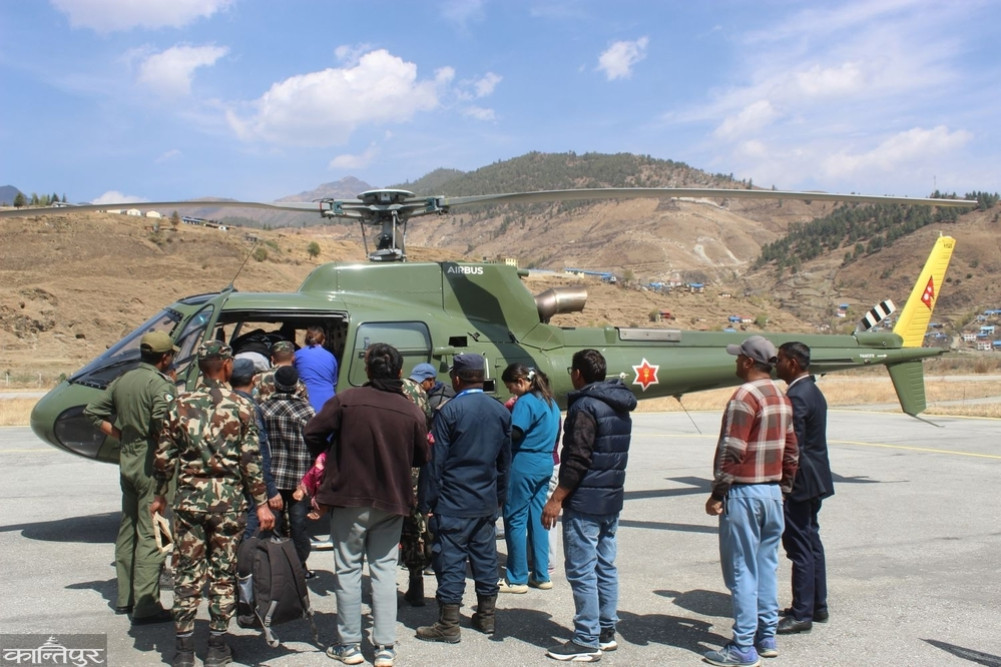
Due to geographical remoteness, traditional thinking, and lack of effective maternity services, pregnant and postpartum women in Karnali have been losing their lives for years.
We use Google Cloud Translation Services. Google requires we provide the following disclaimer relating to use of this service:
This service may contain translations powered by Google. Google disclaims all warranties related to the translations, expressed or implied, including any warranties of accuracy, reliability, and any implied warranties of merchantability, fitness for a particular purpose, and noninfringement.
Asmita, 18, of Tila-3, reached the Karnali Health Sciences Academy Teaching Hospital on Falgun 10 for maternity services. Her health condition was critical when she was taken to the hospital after a long period of pain. Asmita gave birth to a baby but was forced to lose her life.
After her health became more complicated, she was taken to the Provincial Hospital in Surkhet by a Nepali Army helicopter last Thursday, but her health did not improve. The Provincial Hospital declared her dead that same night.
Kamal Thani, Director of the Karnali Health Sciences Academy Teaching Hospital, said that despite many efforts, Asmita could not be saved. ‘There was a problem with her kidneys and lungs,’ he said, ‘She was kept in the ICU for three days for treatment.’
According to locals, instead of taking her to the hospital as soon as she was in labor, her relatives went to Dhamijhakri. They said that due to which she had health problems at home.
A month ago, 30-year-old Muga Shahi of Tatopani-1 Rakagaun died on the way to the hospital. Even the newborn baby did not survive. An attempt was made to deliver her at home after she started having labor pains. She was taken to the hospital after she suddenly fainted and was treated in the ICU, but her life was not saved. According to doctors, even when she was put on a ventilator, nothing worked. The baby had already died on the way.
It is not customary in the district to take a woman to the hospital for delivery as soon as she starts having labor pains. Hospital director Thani said that the health condition becomes more complicated when she relies on Dhamijhakri. ‘The mother and the child are at risk when a pregnant woman is taken to the hospital,’ he said.
Mayalakshmi Mahatara, 22, of Patarasi-6, lost her life in Shrawan last year after suffocating in smoke from a fire lit to cook the mother and child. She was on the 11th day of labor . She died during treatment at the Institute of Health Sciences after suffocating in coal smoke.
Due to geographical remoteness, traditional thinking and lack of effective maternity services, pregnant women and newborns in the district have been losing their lives for years . Even now, most of them give birth at home . The service is not effective even in settlements near birthing centers . Since some birthing centers are far away, there is a tradition of not taking women to health institutions to give birth, saying that they will be haunted by ghosts .
Director Thani Hospital says that it becomes difficult to treat a woman only when her health condition is complicated. He said that in such a situation, the facilities available here are not sufficient. He said that those who do not undergo regular pregnancy check-ups are facing complex problems.
Kali Bahadur Thapa of Tila-9 says that pregnant women in remote areas are living in faith. ‘There are no health institutions nearby in remote areas, nor are health workers available on time,’ he said. ‘If health workers are not available on time, there will be problems due to lack of medicines.’
He said that more than half a dozen pregnant women from the village have given birth on the way to the birthing center. According to the Karnali Provincial Health Service Directorate, 172 women have died in the last 9 years.
Savita Khadka, head of nursing at the Karnali Institute of Health Sciences, said that the health condition of the mother and child is always at risk due to geographical remoteness. She said that pregnant women in Karnali have to take risks due to not taking necessary medicines regularly during pregnancy, women not being able to make their own health-related decisions, and having to wait for their families to decide to go to a health facility.
Pregnant women in Humla, Mugu, Dolpa, Kalikot, and Jumla in Karnali are at the highest risk. They cannot reach the hospital on time, nor can they take timely rescue measures. Instead, local Basmati Rokaya said that they feel like they are waiting for the right time. The government has made a provision that every pregnant woman must undergo regular pregnancy check-ups and give birth at a health facility. But this arrangement is not being implemented in remote areas.