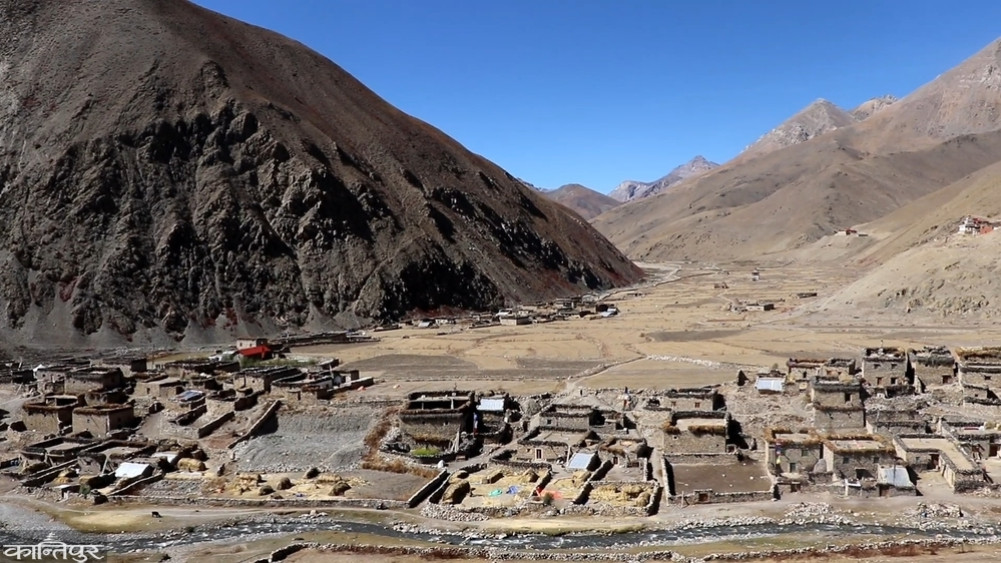
From carrying wood needed for building houses to transporting food, clothes, and other materials from the district headquarters, Dunai, carts and horses and mules have been used.
We use Google Cloud Translation Services. Google requires we provide the following disclaimer relating to use of this service:
This service may contain translations powered by Google. Google disclaims all warranties related to the translations, expressed or implied, including any warranties of accuracy, reliability, and any implied warranties of merchantability, fitness for a particular purpose, and noninfringement.
As the road does not yet reach Upper Dolpa, which borders China, even building a normal house has become a challenge.
The residents here are still forced to rely on yaks (yaks) to transport the wood needed to build houses. Not only that, but horses and mules are also being used to transport food, clothes and other materials from the district headquarters, Dunai.
The yaks purchased from Chotra village in Jumla at a rate of Rs 100,000 per yak are being brought to Upper Dolpa. According to Ramesh Rokaya, a young man from Bantada, Kaike Rural Municipality-6, after about a month of hard work, 35 yaks were purchased for Rs 3.5 million. 'Now these yaks will be brought to Upper Dolpa via Tripurasundari Municipality,' he said.
Rokaya said that since ancient times, the sable has been used to transport wood for building houses in Upper Dolpa since ancient times because it walks very carefully even on narrow roads and is also strong. He said that now, as people have started enjoying the city market, the number of farmers raising sable has also started to decrease.
In Dolpobuddha Rural Municipality, Charkatangsong Rural Municipality and She-Phoksundo Rural Municipality in Upper Dolpa, wood is not available due to the extreme cold in the high mountainous areas. Since there are no large trees except small shrubs, the wood required for windows, doors and furniture for the construction of houses and public structures has to be transported by sable from Lower Dolpa.
Since Upper Dolpa is not connected to the national road network, transporting construction materials here has become very expensive and costly. Carrying wood by sable has become the main option today.
Pema Chhewang Gurung, a local taxi driver in Dolpobuddha Rural Municipality, says, 'Without roads, it takes years to build a house. The cost of transporting goods is high, which has made it difficult for ordinary citizens to build houses.'
According to him, the lack of roads has also seriously affected health, education and business. 'When you fall ill, you cannot get timely treatment, and students also have problems with their studies,' he said. According to locals, until the road reaches Upper Dolpa, they have to rely on carts, horses and mules to transport everything from wood for building houses to daily necessities.
Upper Dolpa residents complain that they have to walk for 4/5 days to reach the district headquarters from the border settlements of Upper Dolpa. They say that if the road network is connected to Upper Dolpa quickly, development will also accelerate and people's lives will also be much easier.
Although the contract was awarded three years ago for the construction of a 25-kilometer road from Dunai to Lasikap under the Bheri Corridor that connects Upper Dolpa to the road network, the work has not been completed. About 35 kilometers of the Lasikap-Sisaul road section are yet to be opened. Once these two road sections are completed, Upper Dolpa will be connected to the national road network. The 40-kilometer road track from Morimla, a border checkpoint between Nepal and China, to Sisaul has already been opened.