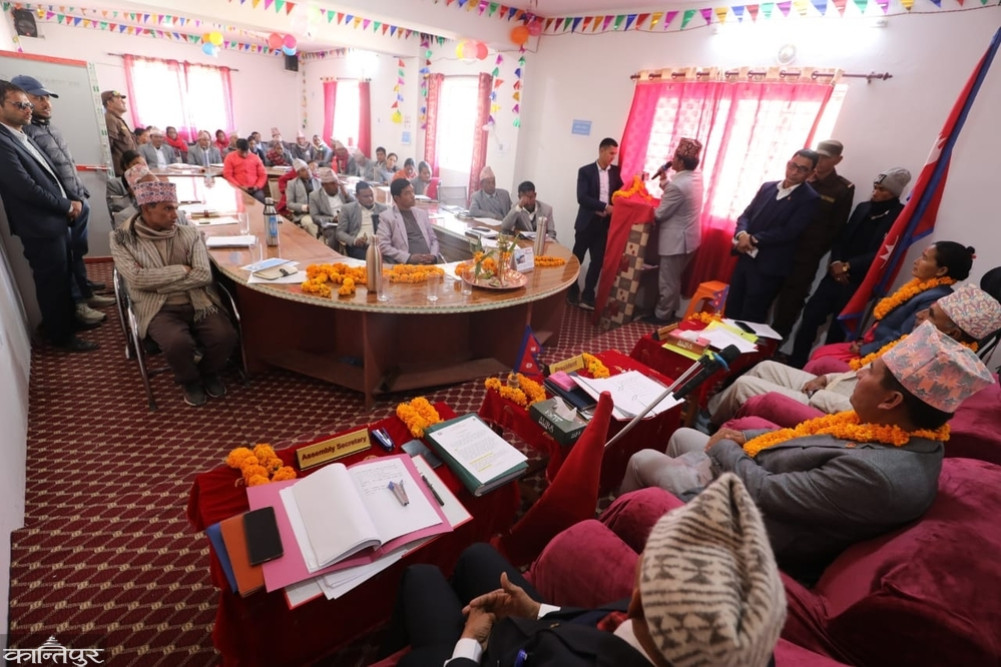
Raskot Municipality, which has a climate suitable for agriculture and animal husbandry, has decided to increase the livestock service fee.
We use Google Cloud Translation Services. Google requires we provide the following disclaimer relating to use of this service:
This service may contain translations powered by Google. Google disclaims all warranties related to the translations, expressed or implied, including any warranties of accuracy, reliability, and any implied warranties of merchantability, fitness for a particular purpose, and noninfringement.
The 17th winter municipal assembly of Raskot Municipality has decided to eliminate the road service fee (patke vehicle tax) that has been levied for the past 3 years.
Raskot Municipality had been collecting money from vehicles going from Sannigad to Raskot. Complaints about the municipality collecting vehicle tax from vehicles plying on the 18-kilometer Sannigad-RCP Serachaur road section built through the third phase of the Rural Access Program had reached the Ministry of Home Affairs via the district administration.
As per the suggestions of city residents and intellectuals and politicians from various fields, it has been decided to remove the vehicle entry tax under Schedule 3 of the Municipality's Finance Act 2082, said Mayor Dharmaraj Shahi.
The municipality used to collect road toll of 250 per day for large buses and 150 for commercial jeeps. He said that despite the municipality's internal income, the decision to remove it was made due to complaints from all sides. He informed that after reviewing the budget and expenditure so far, it was decided to encourage productive and employment-oriented programs.
According to him The winter municipal assembly has fixed fees for animal treatment and sterilization, and Raskot has been approved for the digital municipality declaration campaign. Raskot, which started digital attendance of all municipal employees from November 21, has also launched an integrated government office management system.
Raskot Municipality, which has a suitable climate for agriculture and animal husbandry, has decided to increase the animal service fee. On the proposal of the livestock department, the municipality has fixed fees for animal sterilization, wound dressing, stuck calf, and testicle testing, among other things, for internal revenue improvement.
According to the municipal office, a fee of Rs. 50 will be charged for goat sterilization, Rs. 100 for cows and bulls, Rs. 250 for dog and cat sterilization, Rs. 500 for horses and mules, and Rs. 350 for pig and boar sterilization.
Similarly, the fee for wound dressing of cattle and buffaloes is Rs 350, cattle and buffaloes Rs 250, pigs and pigs Rs 200, dogs and cats Rs 200, sheep and goats Rs 100, wild animals Rs 500, all wild birds Rs 50, and all domestic birds Rs 20. Similarly, it is mentioned that a fee of Rs 1,500 will be charged for removing stuck hooves of buffaloes, Rs 500 for cows, and Rs 400 for sheep and goats.
The municipality has fixed a fee of Rs 50 for testing cow dung, Rs 20 for sheep and goats, Rs 30 for pigs and pigs, and Rs 10 for testing all bird dung.
The municipal council has also fixed a minimum fee of Rs 10 to a maximum of Rs 250 for testing samples of cattle, cattle, sheep, goats, dogs, cats, pigs, pigs, and birds. There are two commercial cattle farms in Raskot Municipality, while all wards have livestock.
Farmer Jaya Tiruwa said that the municipality, which should provide free services to farmers, has set high fees. ‘It is difficult to get services in the village. That is why we have to pay high fees,’ he said. UML leader Dayaram Simkhada says that the municipality has discouraged livestock farmers by charging fees instead of making a policy of waiving fees to encourage farmers.