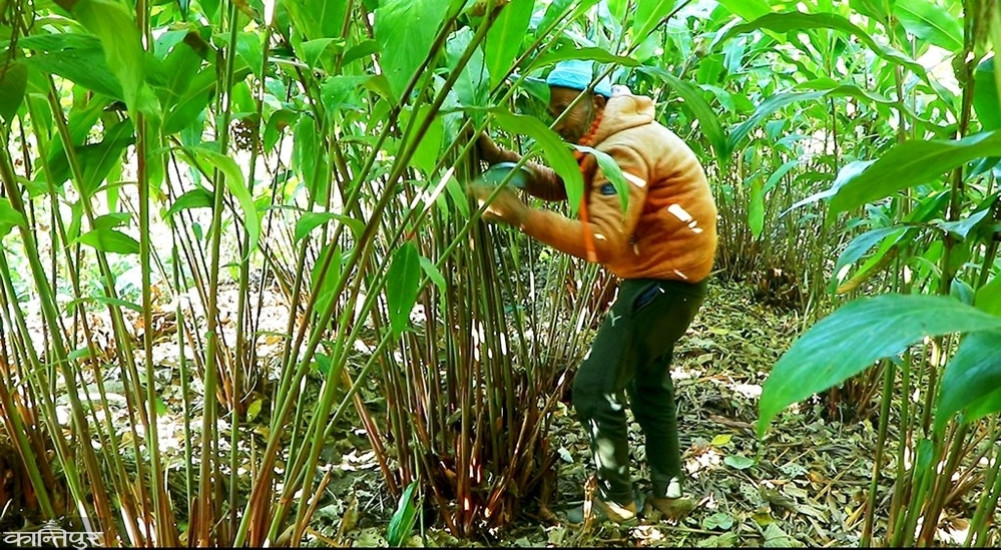
Farmers in Siddhakumakh, Kumakh, and Darma rural municipalities of Salyan have turned to cardamom cultivation as an alternative after wild animals started damaging food crops.
We use Google Cloud Translation Services. Google requires we provide the following disclaimer relating to use of this service:
This service may contain translations powered by Google. Google disclaims all warranties related to the translations, expressed or implied, including any warranties of accuracy, reliability, and any implied warranties of merchantability, fitness for a particular purpose, and noninfringement.
Dal Bahadur Budhathoki, 70, of Kalalek, Siddhakumakh Rural Municipality-3, used to plant rice in a 16-ropani field.
Since he could not bring in rice due to damage from wild animals, he has now cultivated cardamom on that land. This year alone, he has earned Rs 400,000 by selling cardamom at the rate of Rs 2,500 per kilo.
Bhadra Bahadur Budhathoki of Siddhakumakh has also planted cardamom in a field that grows 12 acres of rice. He has earned Rs 200,000 this year by cultivating cardamom as it provides good income and does not require much effort.
As the problem of not being able to bring in food crops due to wild animals like wild boar, ghoral, ratuwa, and monkeys destroying them is increasing, 25 families of Kalalek have planted cardamom in cultivable, barren land, and places with water sources.
Recently, farmers of Siddhakumakh, Kumakh, and Darma rural municipalities of Salyan have become enthusiastic about cash crop cardamom cultivation. As wild animals have started destroying the food crops in the fields, farmers here have taken up cardamom cultivation as an alternative.
Amrit Khatri of Kumakh Rural Municipality-7, Churaneta, said that he is earning Rs 3/4 lakh annually after cultivating cardamom on 10 ropanis. ‘When we planted crops, wild animals used to eat them and when we brought them in, we had to return empty-handed. We were forced to work as laborers to support our families. Now, after planting cardamom, there is no fear of animals eating us. With an annual income of Rs 3/4 lakh, it has become easier to support our families,’ he said. ‘Cardamom production is good, but the problem of irrigation has caused some difficulties.’
Dhanbir Budhathoki of Darma Rural Municipality-5 said that he has planted more than 100 cardamom plants in irrigated fields and other barren land since they do not need to be maintained frequently after planting. He said that after cultivating cardamom, it is now easier to manage household expenses.
Khim Bahadur Budhathoki of Kumakh-6, who planted 50 cardamom plants in fields and orchards, said that after getting good yields, he has now planted them on 6 ropanis. He informed that he is earning 150,000 rupees a year by selling cardamom. ‘It has been good since planting cardamom on empty land. There is no fear of animals eating it and there is no obligation to guard it day and night to protect the crop,’ he said.
Shiva Prakash Oli, the rural municipality’s agricultural technician, said that more than a hundred farmers from Kumakh-3, 6 and 7 have cultivated cardamom on more than 200 ropanis. He said that farmers have shown interest in cardamom cultivation in recent times and the municipality is also supporting them.
Mahesh Acharya, the head of the District Agricultural Development Office, said that cardamom is being cultivated on 15 more hectares of land in Salyan after getting good prices. He said that 9 metric tons were produced in the district last year.