There are 4,993 vacancies for teachers from grades 1 to 10 in Karnali Province. There is an acute shortage of English, mathematics and science teachers. Despite repeated advertisements, teachers have not come and education has been affected.
We use Google Cloud Translation Services. Google requires we provide the following disclaimer relating to use of this service:
This service may contain translations powered by Google. Google disclaims all warranties related to the translations, expressed or implied, including any warranties of accuracy, reliability, and any implied warranties of merchantability, fitness for a particular purpose, and noninfringement.
Rupadevi Secondary School located in Narharinath-7, Kalikot, advertised for the 19th time for a mathematics teacher on Kartik 30. The school has been advertising for the federal grant quota at intervals of 15/15 days since Baisakhi.
‘No matter how many applications are opened, no one is invited,’ said Dan Bahadur Budha, the school’s principal, ‘the course is never completed without teachers, students are forced to take SEE exams based on tuition.’ Established in 2035, the school has 375 students studying, while the school is running on the basis of 3 permanent positions. After problems in teaching and learning, the school has been kept in the school with the help of rural municipality grants and private sources.
Kalika Secondary School in Shubhakalika Rural Municipality-2, Balachaur, Kalikot, did not get a teacher for the science subject at the secondary level for the last academic session despite advertising 5 times. The federal grant for science subject received by the rural municipality for the academic session 2081/82 was frozen after no one applied.
There are 4,993 vacancies for teachers from grades 1 to 10 in Karnali Province. There are only 11,865 teachers in 2,931 community schools across the province. The Education Division of the Ministry of Social Development has stated that the posts of 644 teachers in primary schools, 2,600 in lower secondary level and 1,749 in secondary level have not been filled.
‘There is an extreme shortage of English, mathematics and science teachers,’ said Balbir Sunar, Senior Education Officer of the Division. ‘Due to the shortage of teachers, some or the other courses are incomplete in all schools, which directly affects the SEE results every year.’ According to him, the approved posts in secondary level (9 and 10) are 1,414. Of which 1,360 teachers are working. According to the Division, 854 teachers are working from temporary, relief and private sources.
Due to the shortage of teachers, students have to rely on tuition. Of the 33 students studying in class 10 at Kalika Secondary School in Rachuli, Tilagufa Municipality-4, Kalikot, most of the students have already gone to Surkhet to study tuition after Tihar, said the school’s principal, Chakra Bahadur Shahi.
‘Due to the lack of subject teachers, we are teaching secondary level classes from lower-level teachers, the course is not even half completed,’ he said, ‘Due to the lack of students, teaching has been stopped, going to Surkhet and the district headquarters Manma for tuition has become like a fashion for us here, now students return to the district only to give SEE in Falgun-Chait.’ According to him, out of 34 students who gave SEE from the school last year, only one passed in the regular stream. The number of permanent secondary level teachers in the school is zero, while 2 relief and one Janapalik grant teachers are teaching.
Sameer Shahi, a class 10 student at Shivalay Secondary School in Tilgufa, said that he went to Surkhet to study tuition in the first week of Mangsir. ‘When I studied in the village, I did not see any way to complete the course, and then the Dashain and winter holidays stopped my studies,’ he said. ‘Now that I saw that I would not be able to prepare for SEE while living in the village, I came here and started tuition.’ Along with him, Kamal Dhakal, a class 10 student, is also studying tuition at an institute. Dhakal said that about a dozen students from the school are studying tuition with him.
Students from the Himalayan districts of Kalikot, Mugu, Jumla and other districts are currently filling up the tuition centers in the provincial capital, Birendranagar. The tuition centers are charging Rs 3,500 per student per subject and are offering tuition. Tilak Prasad Neupane, principal of Mahadev Secondary School in Kalikot, said that while 30 students used to come to school regularly before the Dashain holidays, most of the students have now gone out to study tuition.
According to him, about 60 to 80 percent of the course has been completed in class 10. ‘If additional classes could be arranged in the village for students who are taking SEE, the parents’ expenses would be saved, and the academic quality of the students would also increase,’ he said, ‘The school’s efforts alone cannot stop the students.’ According to him, there are 4 secondary level teachers working in the school.
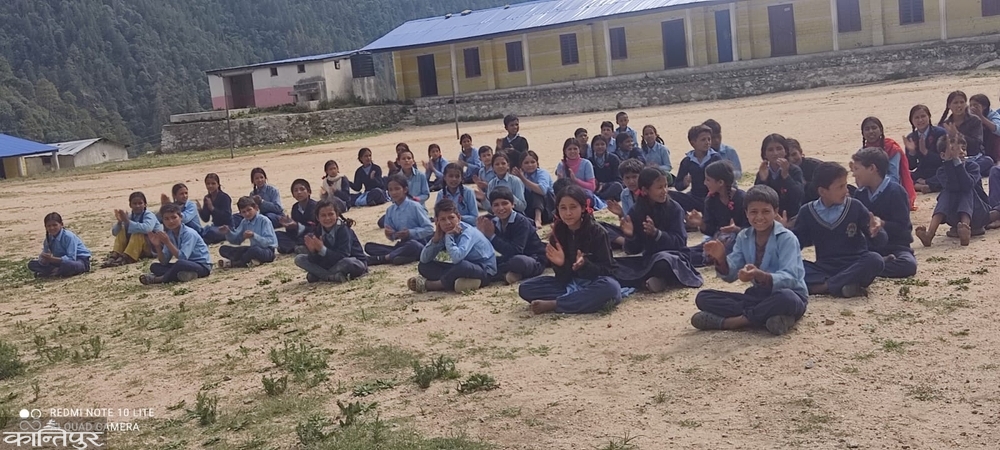
The lack of subject-specific teachers, cold weather, appearance, and the mentality of students who have to study outside have not stopped the students from going to the village, said Shankar Prasad Upadhyay, the mayor of Tilagufa Municipality. ‘Students study tuition in Surkhet for at least 4 months, and the student spends at least 10 to 12 thousand in a month,’ he said, ‘Most of the parents here are poor, due to which they are forced to send their children to Surkhet even after seeking loans.’
He informed that an action plan has been prepared to stop the tendency of students taking SEE going out for years. According to the Education Development and Coordination Unit, 59 out of 336 schools in Kalikot do not have a single post.
Some local levels have arranged coaching classes to eliminate the compulsion of students to go outside for tuition. Jumla's Hima Rural Municipality decided to set up centers at Kalika Secondary School Badki, Jyoti Secondary School Odi and Rahdev Secondary School Mofla through a meeting of the principals of all schools on Mangsir 1 and provide free coaching, said Acting Chief Administrative Officer Bam Bahadur Shah.
'Now the compulsion of students to go to Surkhet and the district headquarters for tuition has been eliminated, coaching classes are now being conducted by making good use of the winter vacation,' he said, 'in which the municipality will bear the teachers' salaries.' According to him, the municipality has given winter vacation from Mangsir 15 to Poush 15.
According to a study conducted by the Directorate of Education Development in 110 schools last year, it was concluded that barely 60 percent of the courses were completed by the end of the academic session. Devkala Acharya, principal of Nigasaini Secondary School Dashala in Kalikot, said that it is difficult to complete the course in the Himalayan district due to winter and summer holidays, Dashain-Tihar, farming season, and students going out to pick herbs with their parents. Her school is currently conducting additional classes in English, science and mathematics from 5 am to 8 am for students appearing for the SEE. The school, which has only 3 relief teachers at the secondary level, has 33 students appearing for the SEE this year.
Acting Education Director Deepa Hamal said that the quality of education in Karnali is deteriorating due to lack of teachers and physical infrastructure, non-arrival of textbooks on time, and students and teachers not attending regular classes. Out of 35,061 candidates from Karnali participated in the SEE last year, 20,384 failed. According to the directorate's data, out of 730 community and private schools across the province, not a single student from 46 schools failed to pass. Last year, the number of students who scored 3.61 to 4 GPA was only 402.
In last year's SEE results, 82.6 percent of students from Dailekh, 66.4 percent from Surkhet, 61.65 percent from Kalikot, 57.2 percent from Dolpa, 56.7 percent from Mugu, 53.81 percent from Humla, 50.85 percent from Salyan, 40.31 percent from Jumla, 44.57 percent from Jajarkot, and 35.78 percent from Rukum West failed, according to the directorate.
Narayan Poudel, branch officer of the Education Development and Coordination Unit, Surkhet, claims that the responsibility of school education was not handled by the local level after federalization. "As much of the budget goes to the local level, the local government should be responsible for infrastructure construction, staffing, and measuring and regulating quality education," he said. "But the local levels have not been able to create a blueprint for school education reform, which has led to a mess in the quality of education."

