Spread over an area of 3,700 square meters, Ganga's poultry farming is now one of the largest businesses in the district. It employs more than 150 people annually.
We use Google Cloud Translation Services. Google requires we provide the following disclaimer relating to use of this service:
This service may contain translations powered by Google. Google disclaims all warranties related to the translations, expressed or implied, including any warranties of accuracy, reliability, and any implied warranties of merchantability, fitness for a particular purpose, and noninfringement.
Ganga Upadhyay of Tatopani-4 is currently busy with bird farming. She is busy feeding and caring for the birds since morning. Ganga, who is also the former vice-chairman of Tatopani Rural Municipality, has now become a center of attraction for her bird farming business. Ganga, who said that she got inspiration for bird farming from watching YouTube, said that the same business has given her happiness now.
Ganga, who started her poultry farming business in Gautam in November 2078, is now known as a model poultry farmer in the district. She raises ducks, local breeds of chickens, and kalij.
‘I had thought of raising poultry while I was the vice-chairman of the village council,’ she said, ‘I couldn’t do it by doing politics alone.’ My experience has been that it is easier to get involved in politics by embracing business.’ Initially, she took a loan of Rs 600,000 from the Diyalo Multipurpose Cooperative Society and brought 250 kalij from Dang district. By the time they reached Jumla, the price per kalij had gone up to Rs 4,000.
Initially, the villagers did not believe her when she told them about the poultry farming plan. ‘How could a person who has become the vice-chairman of the village council do poultry farming,’ she said. ‘Even those who said that earlier are now seeing a future in poultry farming.’
She said that she was drawn to it by her childhood hobby of poultry farming. In 2080 BS, she had 1,200 Kalij. The clucking and moving of Kalij in the field gave her more encouragement. ‘I had a lot of desire for poultry farming but no experience,’ she said. ‘I consulted with many farmers engaged in poultry farming.’ They advised me not to take up this profession, saying it would be complicated and very painful. But still, I did not agree.’ Kalij had just started raising chickens, so the market was not good. The market had already been taken over by cheap boiler meat from outside.
‘But, now the demand for Kalij is high,’ she said. ‘I have more than 140 Kalij. I have more than 300 local breed chickens. I have raised more than 50 ducks.' She also said that customers now come to the farm to buy ducks. There is a competition to buy ducks at every auspicious event. 'Most of my customers here are soldiers, police, and employees,' she said. 'I have to rush to get ducks to me.' 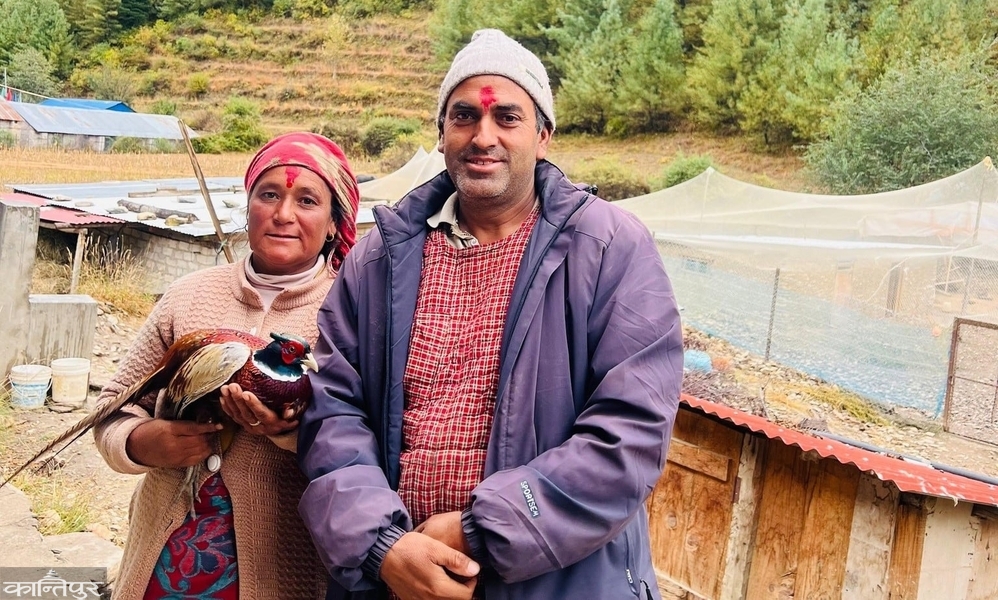 Ganga Upadhyay with her husband
Currently, female ducks cost Rs 2,000 and male ducks Rs 3,000. The price of local chickens is also similar. Female ducks are being bought and sold for Rs 2,000 to 2,500 and male ducks for Rs 3,000 to 3,500. Ganga said that at least 150 people come to observe the poultry farming business every year. 'Farmers who are thinking of raising poultry come to me a lot.' Chickens and liver chicks are sold a lot from here,' she said. She said that more than 20 million rupees have been invested so far. Ganga's poultry farming, spread over 3,700 square meters, is now the largest business in the district. 'Now I have become involved in the identification and diagnosis of diseases in poultry,' she said. Ganga, who was honored with the Best Farmer Award, has a family of six. The eldest daughter is studying nursing in the US. The younger daughter is in Nepalgunj and the youngest son is studying at a private school in Jumla. Ganga, who employs more than 150 people annually, says that her poultry farming business generates around 2 million rupees. 'There is a lot of expenditure on feed, water and medicines for the birds,' she said. 'There is also an equal expenditure on workers.' Even though the benefits are small, I am very happy in this profession.’

