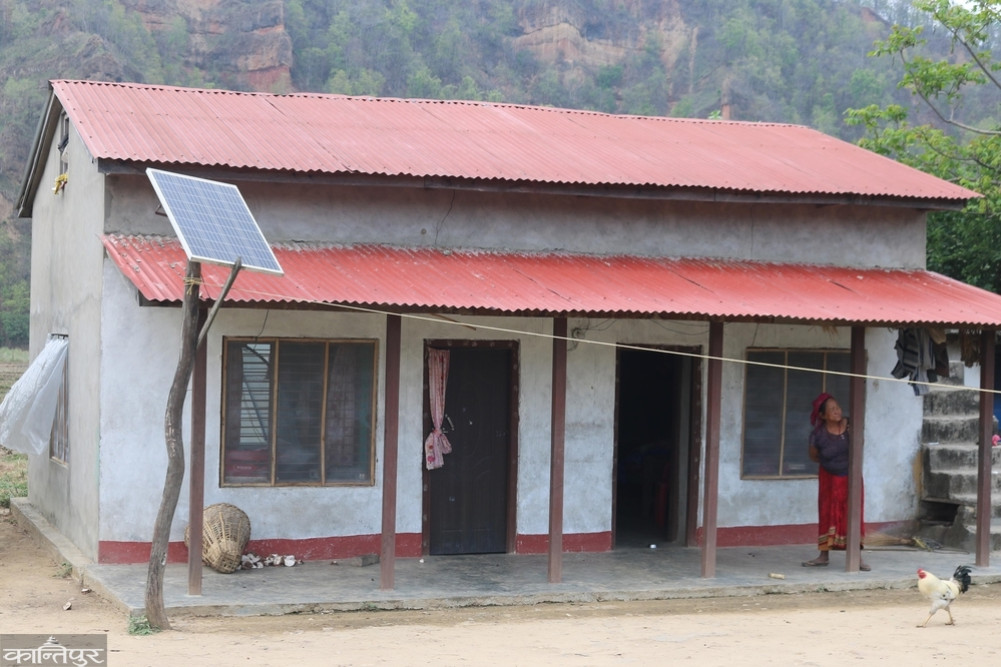
In five years, Kalimati Rural Municipality has replaced thatched roofs with thatched roofs in the homes of 1,074 poor families in seven wards.
We use Google Cloud Translation Services. Google requires we provide the following disclaimer relating to use of this service:
This service may contain translations powered by Google. Google disclaims all warranties related to the translations, expressed or implied, including any warranties of accuracy, reliability, and any implied warranties of merchantability, fitness for a particular purpose, and noninfringement.
Tek Bahadur Nepali of Kalimati Rural Municipality-1 had been living in a thatched-roof house for a long time due to his poor financial condition. He used to face a lot of problems due to water leakage during the rainy season, and if there was a forest fire during the summer, he would be forced to leave his house and go to a safer place.
After Kalimati Rural Municipality provided thatch roofs two years ago, he has been freed from the worries of water leakage during the rainy season and forest fires during the summer.
Similarly, Bir Bahadur Gharti of Ward No. 2 also had the same problem as Tek Bahadur. Since his house is thatched in the middle of the forest, he had wanted to install thatch roofs on his roof for a few years to protect it from fires. Due to his weak financial condition, he was forced to work as a laborer and support his family. Kalimati Rural Municipality has now fulfilled his wish.
After Kalimati Rural Municipality started the thatch roof free campaign in 2077, not only these two but also 1,074 houses of economically weak families in seven wards within the municipality have been freed from thatch roofs in the past five years. As part of the campaign launched by the municipality to protect against fire and other risks, 1,074 houses of poor families have been freed from thatch roofs in the past five years.
Under the thatch roof free scheme, the municipality installed thatch in 127 houses of the economically weaker sections of the society in 2077/078, 176 in 2078/079, 390 in 2079/080, 224 in 2080/081 and 157 in 2081/082. The poor families who have been facing various problems during the rainy and summer months are happy to have thatch roofs installed. Now they have felt a lot of relief.
Chitra Bahadur Nepali of Kalimati Rural Municipality-1 said that after the municipality provided thatch roofs, their houses, which were previously hut-like, have now been renovated. He informed that after installing thatch roofs on the roofs of the houses, not only water leaks during the rainy season, but also the obligation to collect water in pots all night and throw it outside and find a damp place to sleep has ended. According to him, the obligation to collect thatch from the forest every year to cover the roofs of the houses has been eliminated.
Bir Bahadur Nepali of Kalimati Rural Municipality-5 said that the area around the house has become cleaner after installing the tin roof. ‘When there was a thatched roof, rats used to get in and cause trouble. When rats made nests on the thatched roof, they would even damage crops and cause trouble. It was a problem if it rained from the sky, but now it is not like that,’ he said, ‘After installing thatch on the roof, it has become easier to dry the rice.’
Since poor families with weak financial conditions have built their houses in the middle of the forest and on the slopes, and Kalimati Rural Municipality is at high risk of fire, not only will all the settlements around the forest be destroyed, but there will also be human casualties, he said that a budget of Rs 5 million to Rs 30 million has been allocated every year to start a thatched roof-free campaign and have started installing thatch on all houses. He informed that the campaign has brought a lot of relief to the poor families.
According to him, out of the approximately 5,000 households in the municipality, 2,200 of the poor have thatched roofs. Every year, the roofs of 200 to 300 houses are being replaced. So far, the roofs of 1,074 houses have been replaced. The program to replace the thatched roofs of the remaining 1,100 families is ongoing.