Farmers who have been able to raise their economic standards by growing oranges are worried after various diseases began to appear in the past few years.
We use Google Cloud Translation Services. Google requires we provide the following disclaimer relating to use of this service:
This service may contain translations powered by Google. Google disclaims all warranties related to the translations, expressed or implied, including any warranties of accuracy, reliability, and any implied warranties of merchantability, fitness for a particular purpose, and noninfringement.
Lok Bahadur Dangi of Kotmaula, Bagchaur Municipality-9, has more than 1,000 orange trees on 40 ropanis of land. He has been selling oranges worth 2 to 2.8 million rupees annually, but is under stress this year.
Since last Ashar, most of her orange trees have been experiencing yellowing, drying up and fruit falling problems.
Parbati Oli of the same village, who has registered the Jaya Bageshwori firm and is cultivating oranges commercially, has also seen the same problem in her garden. The problem of falling leaves and seeds of fruit trees in her garden is increasing. She said that despite many efforts to prevent the problem, she could not save it.
Bagchaur Municipality-8 and 9 Kotmaula are a pocket area for orange production. More than 700 farmers in the two wards have been planting oranges on 380 hectares and have been doing a turnover of Rs 250 to 300 million annually. The farmers, who have been able to raise their economic status by surviving on oranges, are worried after various diseases started appearing in the past few years. They say that despite various efforts to control the disease, the problem has not been solved.
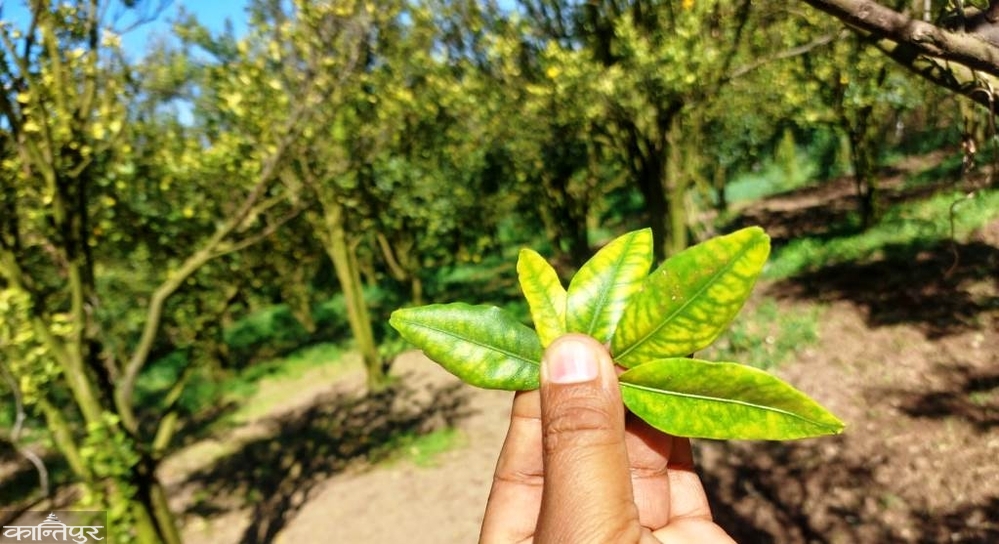
The greening and pink diseases that have been seen for 5/6 years have not been resolved, and farmers worried about losing their source of income have requested the municipality and the Agricultural Development Office for disease control after the root, base rot, and base and branch rot appeared.
Bharatnath Yogi of Kotmaula Dangi Gaun, who sells oranges worth up to Rs 3.5 million annually, said that half of the 1,000 orange trees in his garden are constantly being damaged by various diseases. 'First, the greening disease wiped out the oranges in the lower part.' Then came the problem of pink and blight diseases. It was controlled to some extent by various treatments. Now, there is a disease called Kotre, which causes root rot and wounds on leaves, shoots and branches,' he said. 'As the disease is spreading, there is a risk of destroying the garden.'
Lok Bahadur Dangi, who has continued orange farming along with politics, said that the problem became worse when he adopted methods for diagnosing diseases in oranges at the agricultural school run by the Agricultural Development Office last year. He informed that last year, when the treatment process was increased in more than 100 of his plants under the agricultural school, all the plants were destroyed. 'All the oranges cultivated in their own way are fine. Last year, when organic fertilizers were used under the agricultural school, all the oranges were destroyed,' he said.
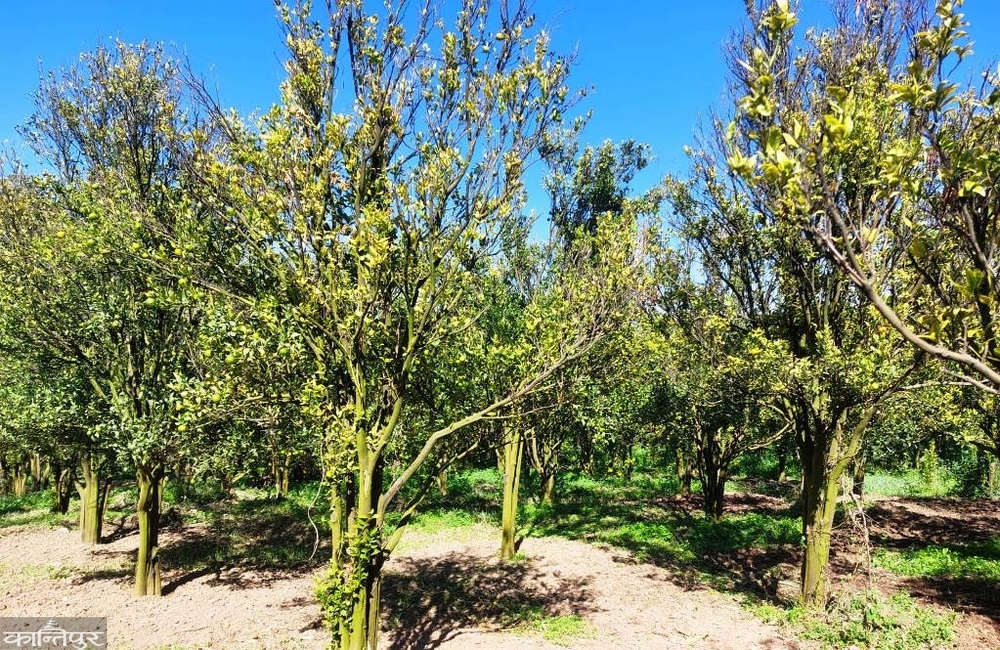
Ghanshyam KC, head of the agriculture branch of Bagchaur Municipality, said that 20 percent of the orange plants in the district were destroyed due to greening, root rot and Kotre diseases. He said that the municipality has made all possible efforts to control the disease and has sent it to the Agricultural Research Council (NARC) for further testing.
Oranges have been planted on 1,06 hectares across the district. Mahesh Acharya, head of the Agricultural Development Office, Salyan, said that when a technical team visited the orchards in Kotmaula and inspected them, many types of diseases were found and investigations are underway to identify them.
He said that the most damage was seen in Ward 8 out of Bagchaur Municipality-8 and 9. According to him, the disease is likely to reduce orange production this year. He said that similar problems have been seen in some other places besides Kotmaula.

