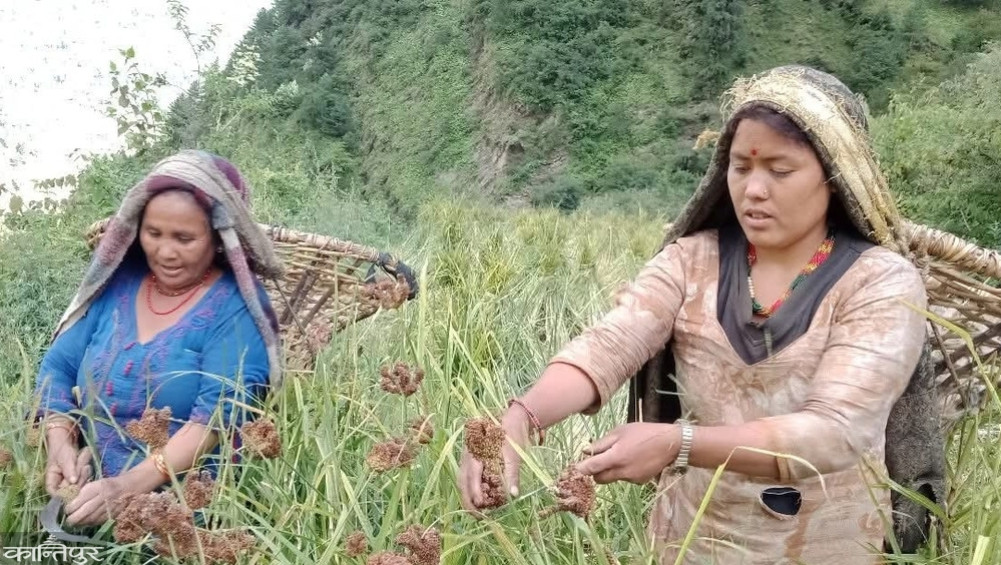
He said, ”The demand and price of millet is high, but farmers are not paying attention to the expansion of cultivation.”
We use Google Cloud Translation Services. Google requires we provide the following disclaimer relating to use of this service:
This service may contain translations powered by Google. Google disclaims all warranties related to the translations, expressed or implied, including any warranties of accuracy, reliability, and any implied warranties of merchantability, fitness for a particular purpose, and noninfringement.
It has been more than a decade since Jaiprasad Sharma of Jumla Sinja Rural Municipality-2 stopped planting millet. He stopped planting millet saying that the importance of millet in the village is decreasing and there is no export market. But now, as the demand for millet flour is high in the market, he is regretting it.
Millet cultivation is done in all 60 wards of one municipality, seven rural municipalities of the district. Local Jeevan Bahadur Budha said, "The demand for millet in the market is high, but the area of millet cultivation in the village is decreasing." Because millet is also very beneficial in terms of health, its demand and price are high in urban areas.
Arjun Budha of Tila 1 Raragaon, who has been trading organic products for a long time in Jumla headquarters Khalanga, said that the demand and price of millet is high. He said, "The demand and price of millet is high, but the attention of farmers is not being able to focus on the expansion of farming."
Now domestic and foreign tourists who come to see Khalanga through Raratal take millet flour from his shop. He says that millet flour is being sold at a price of 200 rupees per kg.
Earlier, the remote fields were full of millet cultivation, but now millet cultivation is not found. According to the data of the District Agricultural Development Office, Jumla, millet is cultivated only in an area of 2,740 hectares. In which 3 thousand 850 metric tons of millet was produced.
According to Ram Bhakta Adhikari, Head of Agriculture Development Office Jumla, this production is very less compared to previous years. Millet is also known as a crop with medicinal properties. The generation that is coming up with
has grown old. The young generation is not interested in farming. Although millet is healthier than other crops, its attractiveness is decreasing. Due to the effect of increasing urbanization, the land that grows millet in the village is becoming barren.
This crop is considered to be important in terms of nutrition as it produces more with less effort. In the traditional style, millet, which is planted as an intercrop with maize using seeds of local varieties, is mostly found in all the villages of the district.
Locals have said that millet, which is used as food, is only used to make alcohol in recent times. Along with the expansion of the road network, the nutritious millet crop is disappearing after rice, wheat and other food crops started entering the villages from the city market.
Now the big hotels, restaurants, homestays of the headquarters of Khalanga are cooking millet dishes. Millet wine, roti, cake, dhindo, selroti and other dishes are made.