We use Google Cloud Translation Services. Google requires we provide the following disclaimer relating to use of this service:
This service may contain translations powered by Google. Google disclaims all warranties related to the translations, expressed or implied, including any warranties of accuracy, reliability, and any implied warranties of merchantability, fitness for a particular purpose, and noninfringement.
Chandra Bahadur Bhandari of Kankasundari Rural Municipality-1 Marphangaon of Jumla spends most of his time in the maintenance and protection of bees. He has 35 hives. There are bees everywhere.
The buzzing of bees makes him happy. Beekeeping and selling honey is his work. He is also trying to add beauty to the environment by keeping more bees.
Chandra Bahadur, who suffered a huge loss due to lack of knowledge of beekeeping, has now become like a parent of bees. It seems that if he does not go near the beehive, there will be no peace in his heart. He sells honey worth up to one lakh rupees every year. His beekeeping skills are discussed throughout the village.
Jai Bahadur Budha of Bumr village is a beekeeper farmer. He used to spend time in the beehive in the morning and evening, but now he is engaged in commercial beekeeping. He has 24 hives. Jai Bahadur, who has been doing traditional beekeeping, is now seen as a leader in commercial beekeeping.
According to him, recently food has become the main challenge for bees. He is supporting his family by selling honey every year. His annual income ranges from 50 thousand to 1 lakh rupees. "There are many challenges in beekeeping," he said, "Farmers are also getting a lot of income from this." He has 22 hives. He, who gets excited at the mention of bees, is now encouraging other farmers about beekeeping. He said, 'As long as bees exist, humans exist. If the bees don't exist, we won't either.
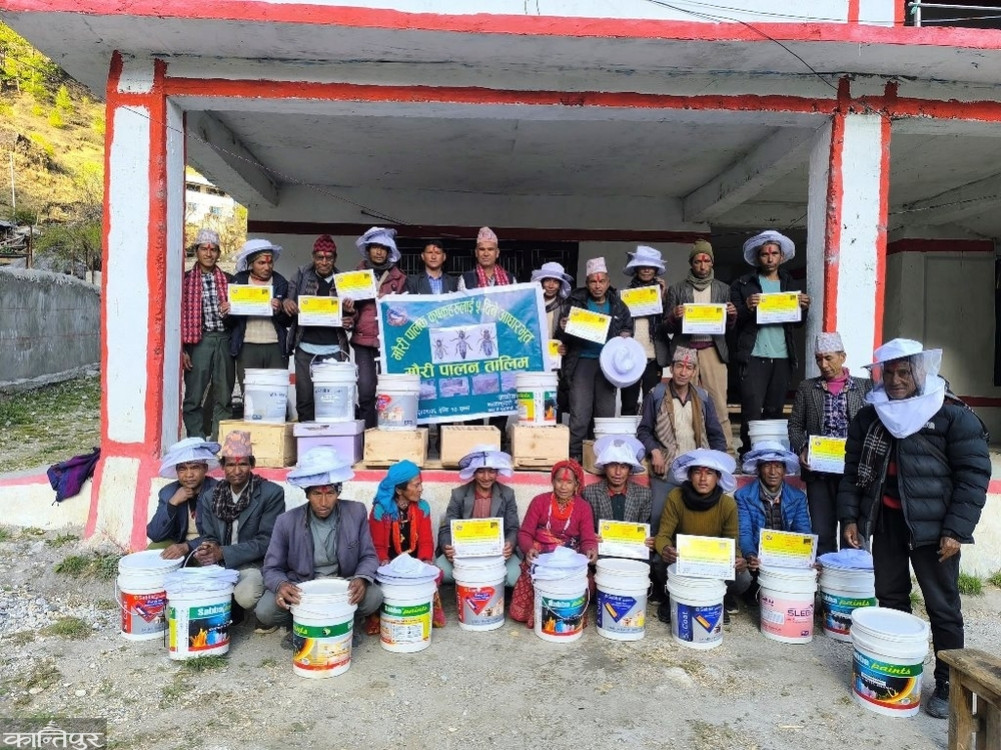
Kanakasundari 1 has given five days of basic beekeeping skills after seeing the farmers' interest in beekeeping. Narayan Prasad Choulagai, Secretary of Karnali Beekeeping Cooperative, informed the farmers about beekeeping. He said, 'The hard work of remote farmers in beekeeping is very attractive. But it is difficult for the farmers to save the bees due to insufficient food and infection of unknown diseases.
He trained the farmers about the opportunities, challenges, processing, labeling and packaging of quality honey production. On this occasion, the farmers were also given buckets to collect honey and nets to protect them from insects. Choulagai, who is also a trainer, said, 'Farmers are more interested in beekeeping in Jumla. Lack of sufficient knowledge and resources is also a big challenge.
Bhim Bahadur Bhandari, ward president of Kankasundari 1, said that the number of farmers making a living from beekeeping is increasing. He said, 'Farmers are showing interest in beekeeping. Now honey production and quality improvement is a matter of priority. In the first phase, a budget of one lakh has been allocated to farmers and beekeeping skills and materials have been given to them. Most of the villages in the ward are leaders in beekeeping.
He said, 'Preparations are being made to declare the ward as a beekeeping pocket area. For which the farmers are being trained. Every farmer has a minimum of 5 to a maximum of 25 beehives. He presented the data that there are 504 beehives in the ward.
For the first time, 20 farmers from 10 villages of the ward gathered together and started talking about bees. Ward president Bhandari said, 'Beekeeping is like the main business here. Now the ward government has come together for honey processing and marketing. Now internal and external tourists going to and from Raratal via Nagm Gamagadi are seen buying honey. Some have directly contacted the headquarters of Khalanga and sent honey. The market price of honey per kg is 2 thousand five hundred rupees.
Serana breed of bees are kept in Jumla. There is beekeeping in all 8 localities including one municipality of the district. The honey here reaches Kathmandu, Surkhet, Nepalgunj, Butwal, Chitwan, Pokhara and local markets. According to Karnali beekeeping statistics, there are 8,400 bee farms in the district. According to Karnali Beekeeping Cooperative, 50,000 kg of honey is produced in a year and the annual income is about 120 million rupees.