We use Google Cloud Translation Services. Google requires we provide the following disclaimer relating to use of this service:
This service may contain translations powered by Google. Google disclaims all warranties related to the translations, expressed or implied, including any warranties of accuracy, reliability, and any implied warranties of merchantability, fitness for a particular purpose, and noninfringement.
Farmers of Jumla have sown the seeds of the world's highest black rice paddy in the paddy field on Wednesday. The rice seeds soaked on Chait 12th were taken out on the 16th and dried for four days, and the farmers sowed them on Wednesday.
The practice of keeping rice seeds is different from Jumla. In other places, paddy is taken directly to the bed and sown, but in Jumla, it is taken to the bed and sowed only after it has grown at home.
For centuries, rice seeds are soaked in Jumla on the 12th of Chait. It is soaked in copper pots, large dekchi, etc. In the past, the rice seeds were soaked in river water.
But now farmers from all over the district soak it at home at the same time . Paddy soaked in this way is taken out on the 16th of Chait. Covering the side of the kitchen with a tablecloth, warm clothes etc., water is sprinkled in the morning and evening for four days.
After the seeds kept like this for four days have germinated, they are taken to the beds prepared on the 20th and sown. The seeds kept in this way are ready for sowing by the first week of May.
But due to the various diseases seen in Marsidhan recently, its cultivation is decreasing . Divanand Choulagai of Chandannath Municipality 4 Malavid said that despite the disease infection in Marsidhan, the farmers are planting. He said, "This is a practice that has been done since before". Accordingly, on 20th of Chait, we took the seeds in the bed and sowed them. At this time it cannot be done above .'
Divananda took 10 times soaked marshidhan seeds and sowed them in the bed . He is ready to plant 8 muri in the field . He said, "Marshidhan production is not much". Next, it takes about 8 months from planting the seeds to ripening. Even so, we are also planting to preserve the traditional cultivation.'
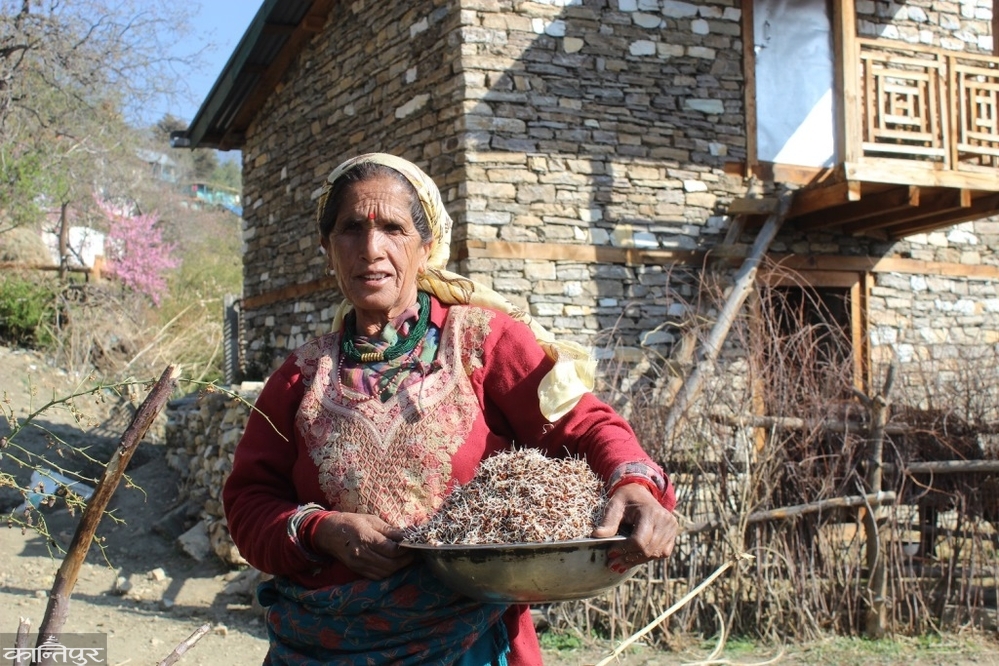
The paddy grown in eight moors hardly ripens in three to four months . But the locals eat it mixed with rice found in the market. In Jumla, it is customary to celebrate the day of sowing the seeds of rice paddy as Vishuva festival.
Bikram Samvat 1198 years, experts say that Bishuva has been celebrated as the day when Chandannath Baba and Lachalkriti Paikla produced Marsidhan. Here, the paddy cultivation cycle starts from the 12th of Chait. The seeds placed in the bed on 20th of Chait are planted in May. After the paddy is cut and brought in in Kattik, the 8-month cycle of Marsidhan ends .
It is believed that on the 1st of Baisakh, the Marsidhan sown in the bed will be thrown with Visepani . Women enjoy playing Deuda on the day of sowing seeds because they have to be busy in farming. Marsi paddy grows more in Tirkhu Jumla, Sheradab, Lachu and Sinja jumla.
Ram Bhakta Adhikari, Head of Agricultural Development Office Jumla, said that the method of soaking and sowing Marsidhan is traditionally deeply connected with religious, cultural and environmental beliefs. He said, "Marsidhan has its own unique identity as cultivation starts only after adopting good weather, pure water, worship and traditional storage methods."
According to him, awareness has been being given to the farmers from the pocket area for the protection of Marsidhan. In Jumla, 2,850 hectares of paddy are cultivated, while only 950 hectares of rice are cultivated.

