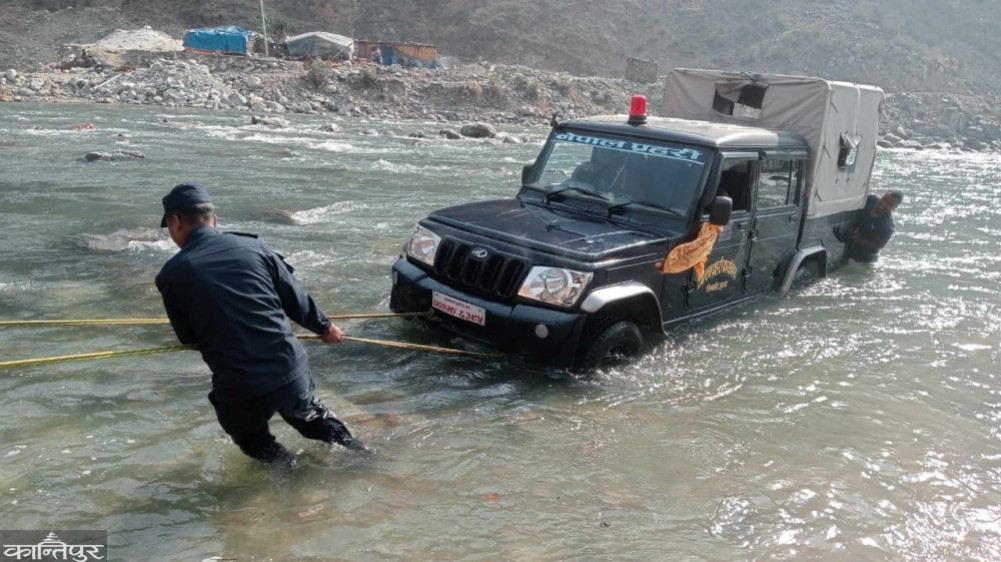
Due to the absence of bridges, passengers are hit by high fares, and the price of daily consumables has not yet decreased
We use Google Cloud Translation Services. Google requires we provide the following disclaimer relating to use of this service:
This service may contain translations powered by Google. Google disclaims all warranties related to the translations, expressed or implied, including any warranties of accuracy, reliability, and any implied warranties of merchantability, fitness for a particular purpose, and noninfringement.
Although the road track was opened to Simkot in the last week of March, the Humla headquarter has not yet been connected to the national road network as it has not been rebuilt at the Karnali river at Chuwakhola in Kharpunath Rural Municipality. If it is not rebuilt, the 12 km road towards Simkot is still not connected.
3 months ago when there was no bridge, around 40 vehicles of various government offices and passengers were taken to Simkot via Surkhet with the help of ropes and dozers. Now those vehicles are operating in Simkot section.
The federal government had been mentioning connecting the Humla headquarters with the national road network every year since the financial year 2063/64 through the budget. But even as the 18th financial year is about to pass, Simkot is still not connected to the national road network. On October 14, 2078, Swachhand/Mount/Pumri JV signed an agreement for the construction of a bridge on the river with a budget of about 110 million. For which he also took a salary of 1 crore 10 lakh rupees and last year the work period was fixed till 30th of February. But if the company did not work for a long time, it was seen that the design should be changed when the construction work of the bridge started about 1 year ago.
'We entrusted the company to build a 55-meter long motorized steel trust bridge, but when the company tried to dig the foundation for the foundation on the left side, the source of hot water was found underground,' said Bel Bahadur Nepali, head of the Simkot-Hilsa road construction project, 'according to the current design. It was not seen that the bridge would be sustainable while working, for that we changed the design of the bridge and sent it to the bridge division, it was approved only 2 weeks ago, now the bridge construction work will proceed from July.''
However, the locals demanded that the bridge be built because it would take time to build the bridge, said Vinod Kumar Pokharel, the chief district officer of Humla. "Not only has the bridge not been built, the travel time has been prolonged, the passengers have also been facing unnecessary hassles, the passengers have also been hit with expensive fares," he said. In order to solve the problem, the locals have demanded that the Beili Bridge be installed until a concrete bridge is built to transfer it to another place.
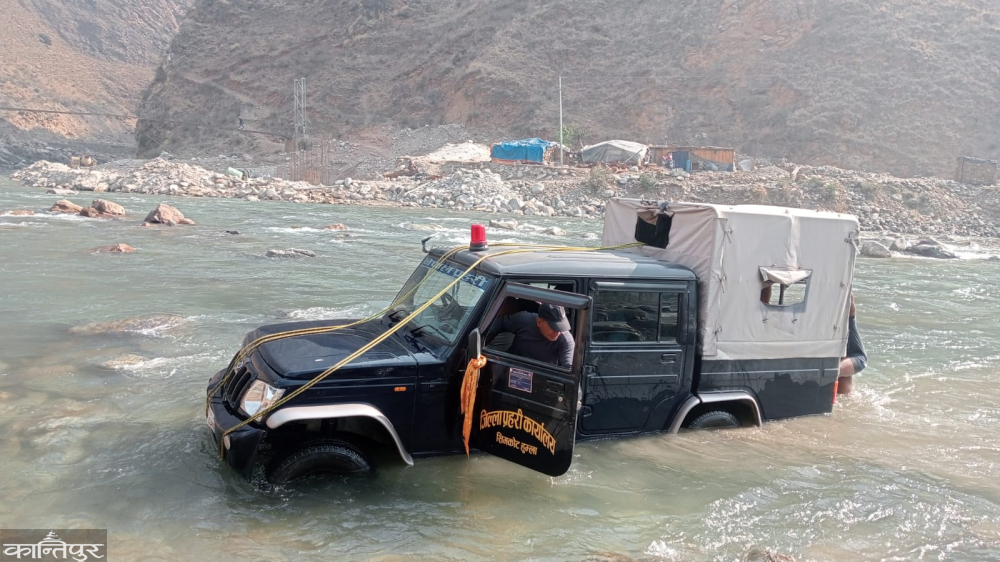 Until last year, transport facilities were in operation from Khulalu in Kalikot to Sallisalla in Humla via Mugu, Bajura. The head of the Simkot-Hilsa road project said that 39 kilometers of road tracks have been opened this year. Out of that, 8 and a half kilometers of road tracks were opened by the Nepali Army, while the rest was dug through the project office, he said. For this, 28 crores have been spent this year through the project and 20 crores through the Nepali Army. According to him, the distance of the road from Khulalu in Kalikot to Hilsa on the China border is 268 km under the project. In which the means of transport are being operated for 95 km from Simkot to Hilsa to the north. But if the bridge is not built, the passengers coming from Simkot to Kharpunath village are forced to cross the suspension bridge and board another vehicle.
Local leader Dan Bahadur Shahi said that because there is no bridge, passengers are forced to pay high fares. According to him, now only small jeeps are operating in the 12 km section from Simkot to Kharpu. They used to charge rent from 700 to 1000 rupees in the name of reserve. He complained that even the vehicles operating from Kharpu to Surkhet via Sallisalla charge up to 7 thousand rupees per person in the name of reserve. "Without the bridge, we have to get off the vehicle and change the suspension bridge, we have to pay a wage to the local porter when the goods are turned over," he said In the capital Simkot, the prices of daily necessities have not decreased yet. "Big and cargo vehicles do not run, it is okay for small vehicles to carry only passengers, even if there is no bridge in the middle, the price has not yet decreased due to the need to carry goods by porters," said Bhim Bahadur Rokaya, a businessman from Simkot. According to the Chief District Officer Pokharel, only the route permit from Khulalu to Sallisalla has been given, so the fare has not been maintained. "Instructions have been given to the Transport Management Service Office Jumla for the management of route permits and fares," he said . Swamikartik, Badimalika, Visit Karnali, Mansarovar and other transport companies are operating vehicles in that section. Chairman of Kharpunath Rural Municipality, Karna Bahadur Rawal, says, "Passengers are forced to suffer because of the negligence of some transport companies. We have submitted a letter of attention to the Prime Minister to solve the problems of bridge construction, fare rate determination, end of syndicates etc.' About 12 years after that, after the federal government established the Karnali Corridor project, the road construction work was accelerated. Some difficult and hard rock sections of which have been done by the Nepali Army.