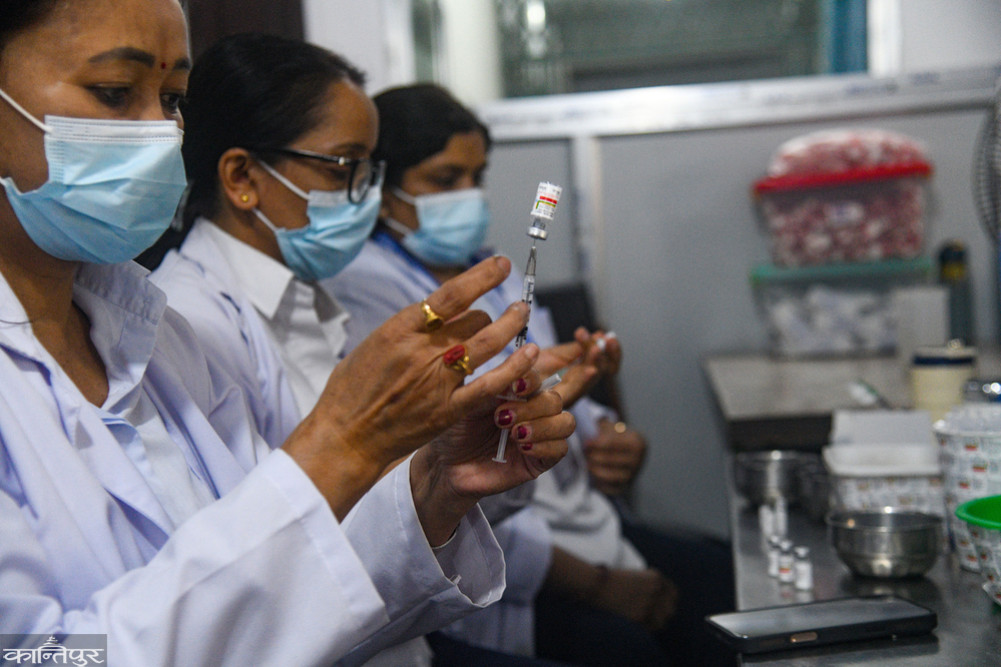
Epidemiology and Disease Control Division urges World Health Organization to provide vaccines immediately
We use Google Cloud Translation Services. Google requires we provide the following disclaimer relating to use of this service:
This service may contain translations powered by Google. Google disclaims all warranties related to the translations, expressed or implied, including any warranties of accuracy, reliability, and any implied warranties of merchantability, fitness for a particular purpose, and noninfringement.
Gayatri Pandey, 55, of Kavrepalanchok Nala, walked nearly 35 kilometers to reach Shukraraj Tropical and Infectious Diseases Hospital in Teku on Wednesday. The purpose of walking this far was to get vaccinated against rabies.
Pandey was bitten by a community dog near her home a week ago. She initially went to the nearby Shir Memorial Hospital to get vaccinated against rabies. After learning that there was no such vaccine there, she went to a government health facility in Dhulikhel. The vaccine was not available there either. After learning that there was also a shortage of vaccines in other government health facilities in the district, she paid Rs 1,000 for one dose of the vaccine at a private pharmacy.
The rabies vaccine must be administered four times within 28 days. Paying Rs 1,000 each time at a private pharmacy, it cost a total of Rs 4,000. She came to Teku after hearing that it was available free of charge at a government hospital. "I had also reached the district government health institution to get the second dose, but they turned me away saying they had no information about when the vaccine would arrive. Then I rushed here," she said, who was met in Teku.
According to doctors, rabies can be prevented by getting the vaccine on time. The patient dies when symptoms of the disease begin to appear. To protect citizens from this deadly disease, the government had been purchasing about 300,000 vaccines every year and distributing them free of charge through government health institutions. But after the Gen-G movement, the government could not complete the vaccine procurement process, resulting in an acute shortage of vaccines in government health institutions across the country. Vaccines are available in private institutions, but they have to pay a high price. Those who cannot afford private ones are forced to travel far to get vaccinated.
When Kantipur reached Shukraraj Tropical and Infectious Diseases Hospital in Teku on Wednesday, hundreds of people were waiting for the vaccine against rabies. According to doctors at the hospital, more than 500 people who have been bitten by dogs come to Teku every day for vaccination. According to the hospital, this number has increased further as people have started coming from Sindhupalchowk, Dhading, Kavrepalanchowk, Nuwakot, Rasuwa and other districts.
‘If bitten by a dog, you either have to pay for the vaccine at a private pharmacy or come to our hospital,’ said Senior AHEB Shankar Pandey of Shukraraj Hospital, ‘We also have only a few hundred doses left, which will not last for many days.’
Senior AHEB Pandey says that those who cannot afford private vaccinations and cannot go to Teku may be taking risks. He said, ‘The death rate from rabies may increase due to the lack of vaccines.’
After the Ministry of Health and Population failed to provide the vaccine, Teku Hospital wrote a letter to Kathmandu Metropolitan City on Wednesday requesting immediate provision of the vaccine. Earlier, the hospital had requested the vaccine from the Gandaki Province government. Senior AHEB Pandey informed that the Gandaki government had promised to provide 1,000 doses of the vaccine. He said that the 1,000 doses provided by the Bagmati Province government a week ago were exhausted in two days. “The 2,000 doses purchased through the Hospital Development Committee have also been exhausted. If supplies are not received immediately, people bitten by dogs will be deprived of vaccination,” he said.
Teku Hospital used to provide rabies vaccine services around the clock, but as the shortage increased, the second dose of the vaccine has been stopped from the emergency room. Such people have been asked to take the second dose only during OPD.
After the federal government failed to provide the vaccine, the Bagmati Province Health Supply Management Center had purchased 7,000 doses of the vaccine a month ago. Nelson Mahat, the center’s information officer, said that the center is also running out of vaccines. “We have a very low stock of rabies vaccine. Hospitals ask for 1,000 doses, but we can only send 30/40, and we receive dozens of calls daily,” he said.
The Epidemiology and Disease Control Division is responsible for supplying rabies vaccine to health institutions across the country. But the division has not been able to purchase the vaccine this fiscal year. After the division was unable to supply the vaccine, it had written to the provincial government and local levels about two months ago to purchase the vaccine itself. After that, the Bagmati and Gandaki provincial governments had purchased the vaccine.
An official of the division informed that a request has been made to the Nepal office of the World Health Organization (WHO) to provide the vaccine immediately. ‘WHO has said that it will provide 4,500 doses,’ he said, ‘even that will not last for many days.’ The problem with the rabies vaccine began last November. A tender is being called for the purchase of the vaccine on Friday (29 Jestha). After that, it will take at least a month to select the contractor. The selected contractor will take some more time to bring the vaccine. Dr. Sher Bahadur Pun, head of the clinical research unit of Teku Hospital, said that there is a risk that many people will not get vaccinated unless they get the vaccine for free.
Rabies is a deadly disease transmitted through the saliva of infected animals, especially dogs and foxes. Dog bites are the cause of most rabies cases in Nepal. As per the WHO target, Nepal has set a target of eliminating dog-borne rabies by 2030.
According to WHO, rabies kills about 59,000 people worldwide every year, or one person every 9 minutes. Most of them are children and people from poor communities.
In Nepal, more than 60,000 people are vaccinated against rabies every year from government health institutions. There are also those who get vaccinated from private health institutions. More than 100 people die from rabies here every year. Health officials say that this mortality rate will increase as the shortage of vaccines continues.