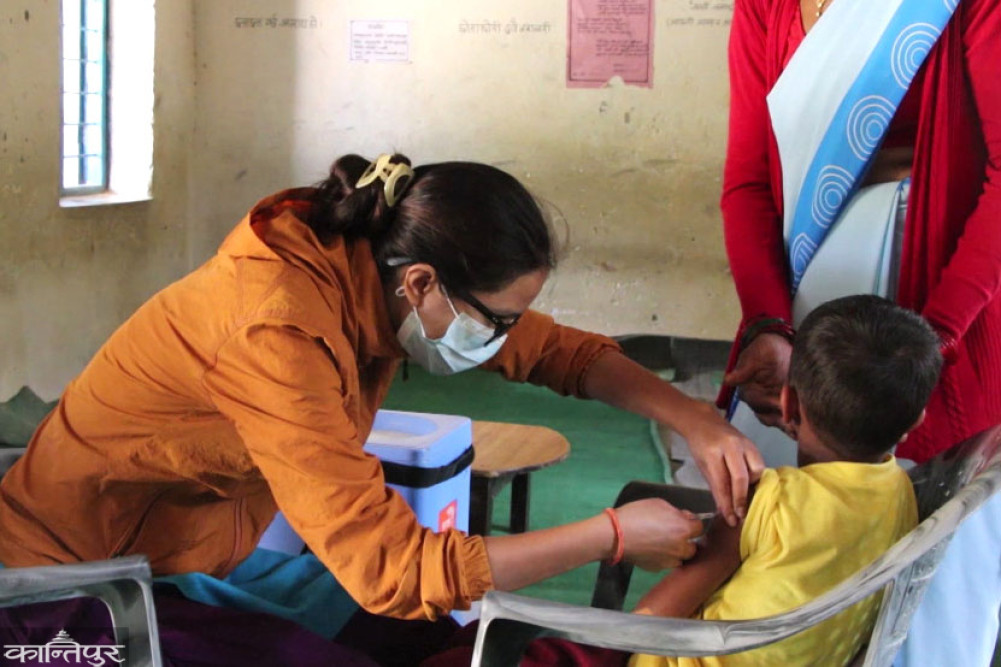
More than 500 children have died from measles in Bangladesh and more than 20,000 have been infected. Vaccination experts have warned that if Nepal ignores the situation, it could lead to a situation similar to that of Bangladesh.
We use Google Cloud Translation Services. Google requires we provide the following disclaimer relating to use of this service:
This service may contain translations powered by Google. Google disclaims all warranties related to the translations, expressed or implied, including any warranties of accuracy, reliability, and any implied warranties of merchantability, fitness for a particular purpose, and noninfringement.
While Bangladesh is facing the biggest measles epidemic in decades, Nepal is also experiencing one measles outbreak after another.
According to the Vaccination Branch of the Family Welfare Division under the Department of Health Services, hundreds of children from different places in 7 districts including Sarlahi, Baglung, Mahottari, Kalikot, Dailekh, Achham and Siraha have been infected with the measles virus in the last 6 months.
According to them, all children in measles-affected areas should be vaccinated immediately, which is a mandatory condition and practice for epidemic control. Doing so helps prevent further spread of the virus and complications. However, special vaccination programs have been conducted only in Dhorpatan municipalities of Sarlahi and Baglung.
Due to the lack of additional vaccines required to control the epidemic, health agencies have not been able to conduct the necessary vaccination campaigns.
Health officials had requested the necessary vaccines from donor agencies immediately after the measles outbreak in Poush. But a health ministry official said that Nepal was not prioritized because donor agencies were more focused on that due to the large outbreak in Bangladesh.
The health ministry has said that it has received 200,000 doses of the vaccine requested in Poush. However, there is confusion about where to send the limited vaccines due to the large number of children who need to be vaccinated.
'We have recently received 200,000 doses of measles vaccine from the donor agency,' said Dr. Abhiyan Gautam, head of the vaccination branch. 'But discussions are underway on where to use these vaccines, because the doses received so far are not enough for all children in the areas where the outbreak has occurred.'
Measles is a highly contagious disease that is transmitted through the respiratory tract of an infected person. It can be fatal for unvaccinated people.
According to experts, due to the government's continued negligence, a large-scale measles outbreak can spread in Nepal at any time. Officials have said that a large wave of the disease has been seen in Nepal, South-East Asian countries such as India, Myanmar, and Bangladesh. However, in other countries, deaths and injuries have been reduced due to strong vaccination systems.
According to them, the situation worsened when the interim government formed after the political change in Bangladesh failed to understand the sensitivity of the regular vaccination program. After the interim government was formed in August 2024, international media reported that a major outbreak occurred due to the suspension of vaccine procurement through UNICEF, shortage of vaccines, and delays in regular vaccination.
The death toll due to measles and related symptoms in Bangladesh has reached 545, with more than 20,000 infected. UNICEF has also said that the situation caused by the 2024 student protests has weakened access to vaccines and left a large number of children vulnerable.
'The current problem in Bangladesh is due to the new government not purchasing vaccines on time and laying off a large number of contract workers involved in the vaccination campaign,' said an official from the Department of Health Services. 'We are also heading towards a situation like Bangladesh, because the government has laid off health workers and has not paid attention to purchasing vaccines even when there are repeated outbreaks.'
According to health officials, there is neither sufficient vaccine stockpiles nor an emergency budget for the outbreak. In the past, donor agencies have provided emergency assistance, but they say that there is currently a delay.
Even months after the outbreak began, the lack of vaccination campaigns and an effective measles prevention plan have shown serious weaknesses in Nepal's disease control system, say child health experts.
'Even if donor agencies cannot provide vaccines on time, the government has the responsibility to protect the lives of citizens,' said vaccinologist Dr. Shyamraj Upreti said, 'The government cannot evade its main responsibility.' Experts say that lack of access to routine vaccination, lack of public awareness about vaccination and apathy of government agencies are the main reasons for the measles outbreak. They have suggested increasing access to vaccines among indigenous, Dalit and marginalized communities and ensuring emergency budgets and vaccine storage.
The measles vaccine is given at 9 months and 15 months of age. The vaccine is available free of charge at government health facilities across Nepal.
Nepal had set a target of eliminating measles by 2026, but the current outbreak has affected this target. Earlier, Nepal had not been able to meet the target of eliminating measles in 2019 and 2023. In 2022 and 2023, measles outbreaks also occurred in various districts, including Kathmandu.
To declare measles elimination, there must be fewer than five cases per million population per year. This requires independent international certification and no new outbreaks for three consecutive years.
According to doctors, people of all age groups are at risk of the disease. Children, pregnant women, the elderly and people with weakened immune systems are especially at risk.
Symptoms of measles include high fever, runny nose, red eyes and small white spots inside the mouth. It can also cause serious complications such as pneumonia and encephalitis. Which can even lead to death.